Every Friday, millions of Muslims set aside whatever they are doing — work, errands, school — and head to the nearest mosque. If you want to make sure you are performing Jummah prayer correctly, this guide covers everything: who it is obligatory for, how to prepare, the exact prayer steps, the Sunnah rakats before and after, and what to do if you arrive late or miss it entirely.
Jummah prayer is the obligatory congregational Friday prayer that replaces Dhuhr for those it is required upon. It consists of:
- Two rakats led by an Imam.
- A two-part Khutbah (sermon) that precedes the prayer.
The Khutbah is not a warm-up to the prayer — it legally replaces the first two rakats of Dhuhr, which is why attending it is compulsory, not optional.
Allah ﷻ commands this prayer directly and explicitly in the Quran:
“يَا أَيُّهَا الَّذِينَ آمَنُوا إِذَا نُودِيَ لِلصَّلَاةِ مِن يَوْمِ الْجُمُعَةِ فَاسْعَوْا إِلَىٰ ذِكْرِ اللَّهِ وَذَرُوا الْبَيْعَ ۚ ذَٰلِكُمْ خَيْرٌ لَّكُمْ إِن كُنتُمْ تَعْلَمُونَ”
“O you who have believed, when the call to prayer is made on Friday, proceed to the remembrance of Allah and leave trade. That is better for you, if you only knew.” — (Surah Al-Jumu’ah, 62:9)
The command “proceed” (فَاسْعَوْا) in this verse does not mean physical rushing — scholars clarify that it refers to earnest intention and directed movement toward the mosque, not sprinting. Significantly, Allah specifically mentions leaving trade, which was the heart of the pre-Islamic Arabian economy. The point is direct: no worldly pursuit outweighs this obligation.
Jummah prayer time begins when the sun passes its zenith — the same starting point as Dhuhr — and ends before Asr time enters. In most mosques, this places Jummah between noon and mid-afternoon on Fridays, though the exact time varies by location and season.
A practical note that many people overlook: do not wait for the Adhan to leave for the mosque. By the time the call is made, the Khutbah is moments away from starting — and arriving after the Khutbah has begun means you have already missed an obligatory part of the prayer.
What You’ll Learn in This Article:
- The complete steps of Jummah prayer, from preparation to tasleem.
- Who must pray Jummah — and who is legally exempt.
- How many rakats Jummah has, including the Sunnah rakats before and after.
- The reward of arriving early — and what you lose by arriving late.
- The conditions that make Jummah prayer valid.
- What to do if you arrive late or miss the prayer.
- Common mistakes that diminish or invalidate the prayer.
Table of Contents
Who Must Pray Jummah Prayer?
Jummah prayer is obligatory for Muslim men who meet four conditions simultaneously:
- Free
- Adult (having reached puberty)
- Of sound mind
- Resident (not traveling)
If any single condition is absent, Jummah is not obligatory on that person — they pray four rakats of Dhuhr instead.
Groups Exempt from Jummah
The following are not obligated to attend, though they may choose to:
- Women — not required, but their attendance is valid and rewarded.
- Travelers — anyone on a legitimate journey.
- The sick — for whom going to the mosque causes genuine hardship.
- Children — those who have not yet reached puberty.
One important distinction: exemption means the obligation is lifted, not that attendance is forbidden. A woman or traveler who attends and prays Jummah with the congregation receives the full reward of the prayer.
How Many Rakats Is Jummah Prayer?
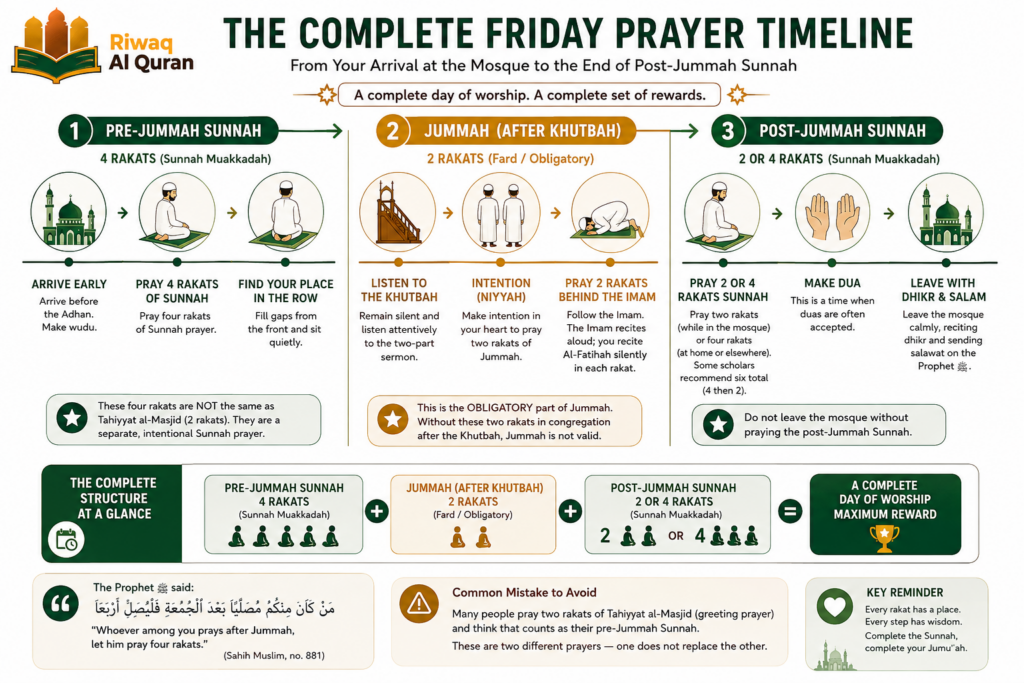
The obligatory portion of Jummah prayer is two rakats, performed in congregation after the Khutbah. But the full Friday prayer also includes Sunnah rakats before and after — which many Muslims skip without realising how established they are. The table below breaks down the complete structure, rakat by rakat.
The Complete Friday Prayer Structure
| Prayer | Rakats | Category |
|---|---|---|
| Sunnah before Jummah | 4 rakats | Sunnah Muakkadah |
| Jummah (after Khutbah) | 2 rakats | Fard (obligatory) |
| Sunnah after Jummah | 2 or 4 rakats | Sunnah Muakkadah |
Regarding the post-Jummah Sunnah, the Prophet ﷺ said:
“مَنْ كَانَ مِنْكُمْ مُصَلِّيًا بَعْدَ الْجُمُعَةِ فَلْيُصَلِّ أَرْبَعًا”
“Whoever among you prays after Jummah, let him pray four rakats.” — (Sahih Muslim, no. 881)


Scholars reconcile this with the two-rakat narrations by noting that both are valid: if you pray in the mosque, pray two rakats; if you leave and pray at home or in another location, pray four. Some scholars such as Ibn Al-Qayyim recommended praying six total — four first, then two — combining both narrations.
A common mistake worth flagging: many people arrive at the mosque and pray two rakats of Tahiyyat al-Masjid (the greeting prayer), then assume that counts as their pre-Jummah Sunnah. These are two different prayers. The pre-Jummah Sunnah is a separate, intentional four-rakat prayer — not the same as greeting the mosque.
How to Get Ready for Jummah Prayer
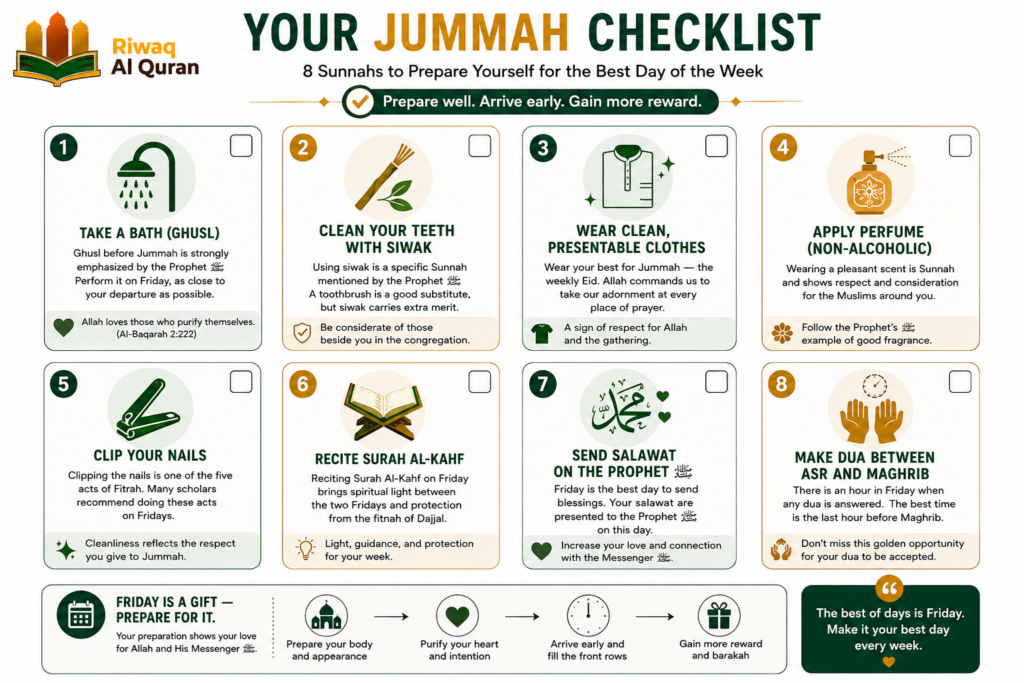
Preparation for Jummah is both physical and spiritual. The Prophet ﷺ gave detailed guidance on this, and following it is part of the etiquette (adab) of the day — not just cultural habit. The preparation steps and prayer steps are two distinct phases; this section covers preparation only.
a. Take a Bath (Ghusl)
Ghusl before Jummah is established as compulsory by the Prophet’s ﷺ own words:
“غُسْلُ يَوْمِ الْجُمُعَةِ وَاجِبٌ عَلَى كُلِّ مُحْتَلِمٍ، وَأَنْ يَسْتَنَّ، وَأَنْ يَمَسَّ طِيبًا إِنْ وَجَدَ”
“Taking a bath on Friday is compulsory for every Muslim who has attained the age of puberty, and also cleaning of teeth with Siwak, and using perfume if available.” — (Sahih Bukhari, no. 880)
The scholars differ on whether the obligation here is absolute (wajib in the strict sense) or a strong emphasis (wajib in the sense of urgent recommendation). The majority hold it as a Sunnah Muakkadah — one so strongly emphasized that leaving it without reason is blameworthy.
What is clear is that the Prophet ﷺ connected the ghusl directly to being fit for the congregation, not merely to cleanliness in general. The timing matters: the ghusl should be performed on Friday specifically, as close to departure as possible, not carried over from the night before.
Allah ﷻ also ties physical purification to His love for the believer:
“إِنَّ اللَّهَ يُحِبُّ التَّوَّابِينَ وَيُحِبُّ الْمُتَطَهِّرِينَ”
“Indeed, Allah loves those who are constantly repentant and loves those who purify themselves.” — (Surah Al-Baqarah, 2:222)
The verse pairs repentance of the heart with purification of the body — a reminder that physical preparation for prayer is not separate from spiritual readiness. Showing up to Jummah clean and composed is itself an act of worship.
b. Clean Your Teeth with Siwak
Preparing for Jummah includes more than performing ghusl. The Sunnah also emphasizes oral hygiene, reflecting the importance of cleanliness and consideration for others in a congregational setting.
- Using a siwak — a natural tooth-cleaning twig from the Arak tree — is a specific Sunnah the Prophet ﷺ mentioned alongside ghusl for Jummah
- A regular toothbrush is an acceptable substitute, but the siwak itself carries additional merit in the Sunnah literature
- The connection between oral hygiene and communal prayer is deliberate: in a congregation, you stand close enough for your breath to reach those beside you
c. Wear Clean, Presentable Clothes
Jummah is the Muslims’ weekly Eid — a day of gathering and spiritual celebration. The Prophet ﷺ encouraged wearing one’s best clothing for it. Allah ﷻ says:
“يَا بَنِي آدَمَ خُذُوا زِينَتَكُمْ عِندَ كُلِّ مَسْجِدٍ”
“O children of Adam, take your adornment at every place of prayer.” — (Surah Al-A’raf, 7:31)
The command is to every child of Adam, not just Muslims — Islam treats presenting oneself well before Allah at the mosque as a universal principle of dignity. For Jummah specifically, many scholars recommend keeping specific clothes reserved only for Friday prayer, which also creates a routine signal to the mind and body that this day is different.

d. Apply Perfume (Non-Alcoholic)
- Wearing oud or a non-alcoholic fragrance is Sunnah for Jummah
- In a congregation where people stand shoulder to shoulder in rows, a pleasant scent is both an act of Sunnah and a mark of consideration for those praying beside you
- The Prophet ﷺ was known for his pleasant scent in congregational settings, and the Companions followed his example
e. Clip Your Nails
Trimming the nails is one of the five acts of the Fitrah — the natural instincts of cleanliness that Islam prescribes. The Prophet ﷺ said:
“الْفِطْرَةُ خَمْسٌ: الْخِتَانُ، وَالاِسْتِحْدَادُ، وَتَقْلِيمُ الأَظْفَارِ، وَنَتْفُ الإِبِطِ، وَقَصُّ الشَّارِبِ”
“Five things are part of the Fitrah: circumcision, shaving the pubic hair, clipping the nails, plucking the armpit hair, and trimming the moustache.” — (Sahih Bukhari, no. 5891)
Many scholars specifically recommend performing these acts on Fridays, treating the weekly Jummah as a natural checkpoint for personal hygiene. The outer state of the worshipper reflects the respect given to the prayer itself.
f. Recite Surah Al-Kahf
Reciting Surah Al-Kahf on Friday is one of the most consistently emphasized Sunnahs of the day. The Prophet ﷺ said:
“مَنْ قَرَأَ سُورَةَ الْكَهْفِ يَوْمَ الْجُمُعَةِ أَضَاءَ لَهُ مِنَ النُّورِ مَا بَيْنَ الْجُمُعَتَيْنِ”
“Whoever reads Surah Al-Kahf on Friday will be illuminated with light between the two Fridays.” — (Al-Hakim, Al-Mustadrak, 2/368; authenticated by Al-Albani in Sahih Al-Jami’, no. 6470)
The “light” referred to by scholars is understood to be spiritual illumination — a strengthened connection to guidance, moral clarity, and protection from the fitnah (trial) of Dajjal, which is one of the themes of the Surah itself. The Surah can be recited at any point during Friday — before or after the prayer — and the reward applies.
g. Send Salawat on the Prophet ﷺ
Friday is the day salawat (blessings upon the Prophet ﷺ) carry the greatest weight. The Prophet ﷺ said:
“إِنَّ مِنْ أَفْضَلِ أَيَّامِكُمْ يَوْمَ الْجُمُعَةِ فِيهِ خُلِقَ آدَمُ وَفِيهِ قُبِضَ وَفِيهِ النَّفْخَةُ وَفِيهِ الصَّعْقَةُ فَأَكْثِرُوا عَلَيَّ مِنَ الصَّلَاةِ فِيهِ فَإِنَّ صَلَاتَكُمْ مَعْرُوضَةٌ عَلَيَّ”
“Among the best of your days is Friday. On it Adam was created, on it he died, on it the Trumpet will be blown, and on it the thunderbolt will occur. So increase your blessings upon me on that day, for your blessings are presented to me.” — (Sunan Abu Dawud, no. 1047)
The Prophet ﷺ specifically mentioned that salawat on Friday are “presented to him” — which scholars explain as being conveyed to him directly, even after his passing.
This makes Friday salawat a uniquely direct act of love and connection to the Prophet ﷺ. A practical recommendation: set a portion of time before leaving for the mosque specifically for repeating Allahumma salli ‘ala Muhammad.
h. Make Dua Between Asr and Maghrib
Every Friday contains one hour during which any sincere dua is answered. The Prophet ﷺ said:
“إِنَّ فِي الْجُمُعَةِ لَسَاعَةً لَا يُوَافِقُهَا عَبْدٌ مُسْلِمٌ يَسْأَلُ اللَّهَ فِيهَا خَيْرًا إِلَّا أَعْطَاهُ إِيَّاهُ”
“There is an hour on Friday during which no Muslim servant of Allah stands in prayer and asks Allah for something good, except that Allah gives it to him.” — (Sahih Muslim, no. 852)
The Prophet ﷺ indicated this hour with his hand, describing it as “short and narrow” — meaning it is brief and easily missed. The strongest scholarly position, backed by a companion’s narration from Abu Hurairah (authenticated in several collections), places this in the final hour before Maghrib. Treat the Asr-to-Maghrib window on Fridays as a non-negotiable appointment for supplication.
Preparing the body is only half the picture — reciting the Tashahhud, Al-Fatihah, and the daily adhkar with correct pronunciation matters just as much. This is exactly where Online Tajweed Classes from Riwaq Al Quran come in: live, one-on-one sessions with certified native Arab instructors who correct your recitation in real time.
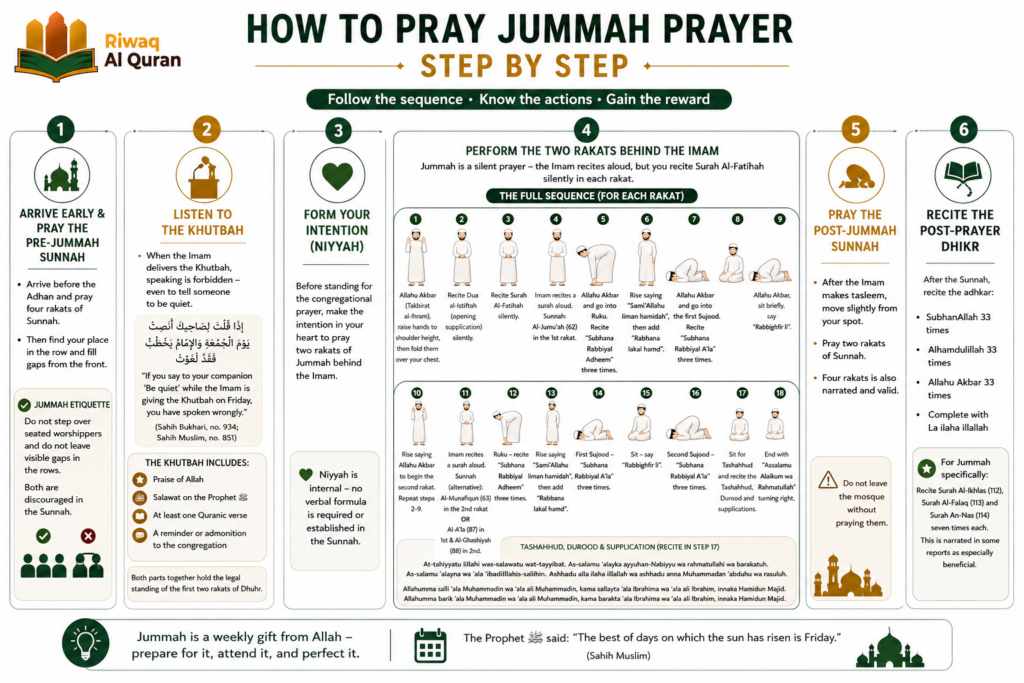
How to Pray Jummah Prayer – Step by Step
Jummah prayer follows a clear sequence. Knowing each phase prevents the confusion many people experience when they arrive at the mosque unsure of what is happening or what they are supposed to do.
a. Arrive Early and Pray the Pre-Jummah Sunnah
Arrive before the Adhan and pray four rakats of Sunnah prayer. Then find your place in the row and fill gaps from the front. Stepping over seated worshippers to find a spot, and leaving visible gaps in the rows, are among the most common Jummah etiquette errors — both are explicitly discouraged in the Sunnah.
b. Listen to the Khutbah
When the Imam ascends the minbar and begins the Khutbah, speaking is forbidden — even to tell someone beside you to be quiet. The Prophet ﷺ said:
“إِذَا قُلْتَ لِصَاحِبِكَ أَنْصِتْ يَوْمَ الْجُمُعَةِ وَالإِمَامُ يَخْطُبُ فَقَدْ لَغَوْتَ”
“If you say to your companion ‘Be quiet’ while the Imam is giving the Khutbah on Friday, you have spoken wrongly.” — (Sahih Bukhari, no. 934; Sahih Muslim, no. 851)
The word used — لَغَوْتَ (laghawta) — means you have engaged in vain speech. Scholars explain that this is not merely discouraged; it negates the reward of your Jummah, meaning the full spiritual benefit of the prayer is diminished. The ruling is strict precisely because the Khutbah holds the legal standing of the first two rakats of Dhuhr. Treat silence during the Khutbah with the same discipline you apply to silence during prayer itself.
The Khutbah consists of two parts separated by a brief seated pause. For a Khutbah to be valid, it must include:
- Praise of Allah.
- Salawat on the Prophet ﷺ.
- Recitation of at least one Quranic verse.
- A reminder or admonition to the congregation.
Both parts together hold the legal standing of the first two rakats of Dhuhr.
c. Form Your Intention (Niyyah)
Before standing for the congregational prayer, form the intention in your heart to pray two rakats of Jummah prayer behind the Imam. The niyyah is internal — no verbal formula is required or established in the Sunnah.
d. Perform the Two Rakats Behind the Imam
Jummah prayer is a silent prayer — the Imam recites aloud, but the congregation recites Surah Al-Fatihah silently for themselves in each rakat, following the principle established in the hadith: “There is no prayer for one who does not recite Al-Fatihah.” (Sahih Bukhari, no. 756). The full sequence runs as one continuous unit across both rakats:
- Say “Allahu Akbar” (Takbirat al-Ihram), raise your hands to shoulder height, then fold them over your chest
- Recite Dua al-Istiftah (the opening supplication) silently
- Recite Surah Al-Fatihah silently
- The Imam recites a surah aloud — the established Sunnah is Surah Al-Jumu’ah (62) in the first rakat
- Say “Allahu Akbar” and go into Ruku — recite “Subhana Rabbiyal Adheem” three times
- Rise saying “Sami’Allahu liman hamidah”, then add “Rabbana lakal hamd”
- Say “Allahu Akbar” and go into the first Sujood — recite “Subhana Rabbiyal A’la” three times
- Say “Allahu Akbar”, sit briefly, say “Rabbighfir li”
- Say “Allahu Akbar” and go into the second Sujood — recite “Subhana Rabbiyal A’la” three times
- Rise saying “Allahu Akbar” to begin the second rakat, following the exact same sequence (steps 2–9 again). The Imam recites Surah Al-Munafiqun (63) in this rakat — or alternatively, Surah Al-A’la (87) in the first rakat and Surah Al-Ghashiyah (88) in the second, based on a separate narration in Sahih Muslim
- After the second Sujood of the second rakat, sit in the Tashahhud position and recite:
“At-tahiyyatu lillahi was-salawatu wat-tayyibat. As-salamu ‘alayka ayyuhan-Nabiyyu wa rahmatullahi wa barakatuh. As-salamu ‘alayna wa ‘ala ‘ibadillahis-salihin. Ashhadu alla ilaha illallah wa ashhadu anna Muhammadan ‘abduhu wa rasuluh.
Allahumma salli ‘ala Muhammadin wa ‘ala ali Muhammadin, kama sallayta ‘ala Ibrahima wa ‘ala ali Ibrahim, innaka Hamidun Majid. Allahumma barik ‘ala Muhammadin wa ‘ala ali Muhammadin, kama barakta ‘ala Ibrahima wa ‘ala ali Ibrahim, innaka Hamidun Majid.”
- End with “Assalamu Alaikum wa Rahmatullah” turning right, then the same turning left
e. Pray the Post-Jummah Sunnah
After the Imam makes tasleem, move slightly from your spot and pray two rakats of Sunnah. Four rakats is also narrated and valid — see the rakat breakdown above. Do not leave the mosque without praying them.
f. Recite the Post-Prayer Dhikr
After completing the Sunnah, recite the standard post-prayer adhkar:
- For Jummah specifically, reciting Surah Al-Ikhlas (112), Surah Al-Falaq (113), and Surah An-Nas (114) seven times each after the prayer is narrated in some reports as especially beneficial.
- The general dhikr — SubhanAllah 33 times, Alhamdulillah 33 times, Allahu Akbar 33 times, completed with La ilaha illallah — is established for every prayer and should not be skipped on Fridays.
Conditions That Make Jummah Prayer Valid
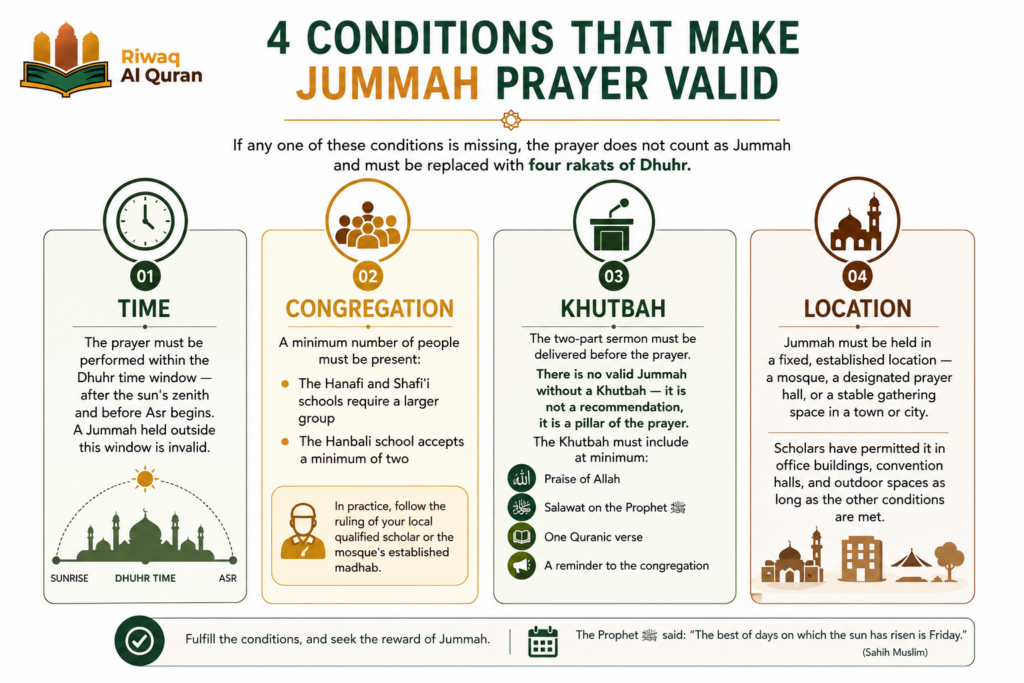
Jummah prayer requires four conditions to be valid. If any one of them is missing, the prayer does not count as Jummah and must be replaced with four rakats of Dhuhr.
a. Time
The prayer must be performed within the Dhuhr time window — after the sun’s zenith and before Asr begins. A Jummah held outside this window is invalid.
b. Congregation
A minimum number of people must be present:
- The Hanafi and Shafi’i schools require a larger group
- The Hanbali school accepts a minimum of two
In practice, follow the ruling of your local qualified scholar or the mosque’s established madhab.
c. Khutbah
The two-part sermon must be delivered before the prayer. There is no valid Jummah without a Khutbah — it is not a recommendation, it is a pillar of the prayer. The Khutbah must include at minimum:
- Praise of Allah
- Salawat on the Prophet ﷺ
- One Quranic verse
- A reminder to the congregation
d. Location
Jummah must be held in a fixed, established location — a mosque, a designated prayer hall, or a stable gathering space in a town or city. Scholars have permitted it in office buildings, convention halls, and outdoor spaces as long as the other conditions are met.
Reconciling these conditions with real-life edge cases — like praying Jummah while traveling, or in a workplace with a small congregation — is exactly the kind of nuance covered in Riwaq Al Quran’s Islamic Studies program. A few courses worth exploring if this area interests you:
- Online Islamic Studies Courses — structured Fiqh guidance with certified scholars
- Online Ijazah Courses — for those seeking certified authorization in recitation
- Online Tafseer Course — to understand the Quranic verses behind these rulings in depth
Book a free trial class and get your questions answered directly, live, by a qualified teacher. something no app or recording can do.
The Reward of Arriving at Jummah Early
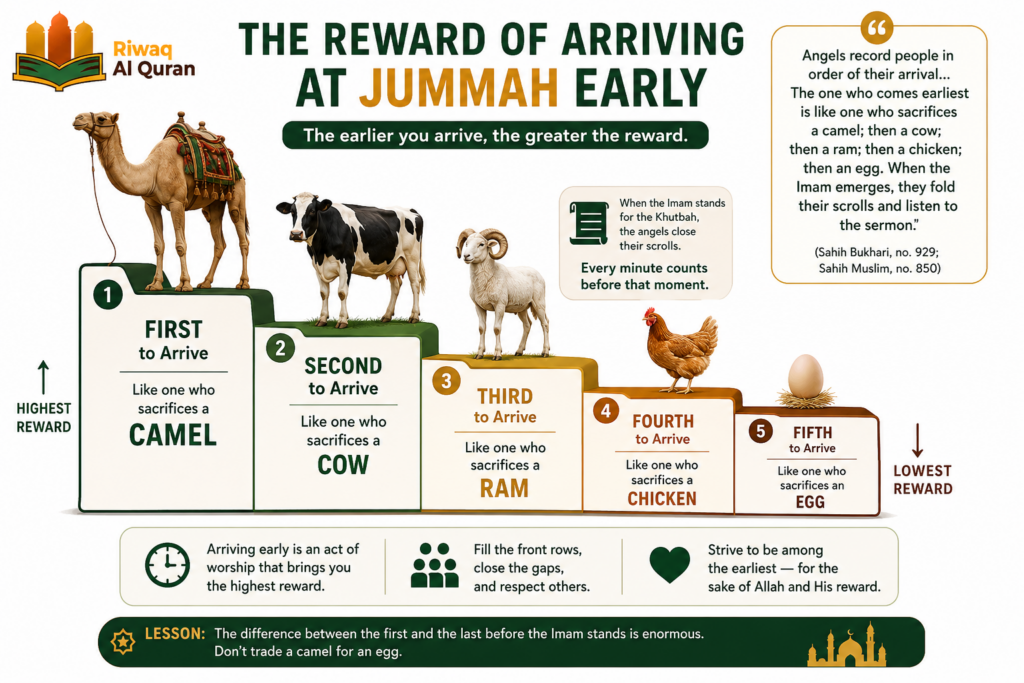
Arriving early to Jummah is not just courtesy — it is directly tied to the spiritual reward you receive. The Prophet ﷺ described the reward system in precise terms:
“إِذَا كَانَ يَوْمُ الْجُمُعَةِ وَقَفَتِ الْمَلاَئِكَةُ عَلَى بَابِ الْمَسْجِدِ يَكْتُبُونَ الأَوَّلَ فَالأَوَّلَ، وَمَثَلُ الْمُهَجِّرِ كَمَثَلِ الَّذِي يُهْدِي بَدَنَةً، ثُمَّ كَالَّذِي يُهْدِي بَقَرَةً، ثُمَّ كَبْشًا، ثُمَّ دَجَاجَةً، ثُمَّ بَيْضَةً، فَإِذَا خَرَجَ الإِمَامُ طَوَوُا صُحُفَهُمْ وَيَسْتَمِعُونَ الذِّكْرَ”
“On Friday, angels stand at the door of the mosque recording people in order of their arrival. The one who comes earliest is like one who sacrifices a camel; then like one who sacrifices a cow; then a ram; then a chicken; then an egg. When the Imam emerges, the angels fold their scrolls and listen to the sermon.” — (Sahih Bukhari, no. 929; Sahih Muslim, no. 850)
Two things in this hadith are often overlooked:
- The reward scale drops sharply — from a camel to a cow to a ram to a chicken to a single egg. The difference between the first arrival and the last arrival before the Imam stands is enormous, described in terms of sacrificial animals that varied greatly in value.
- The moment the Imam stands for the Khutbah, the angels close their scrolls. That recording of early arrival stops completely. Every minute before the Imam stands is a minute that counts toward a higher tier of reward.
Common Mistakes That Diminish or Invalidate Jummah
These are the errors most frequently observed in congregations — worth knowing so you can avoid them:
- Arriving after the Khutbah has started without urgency. Many people treat the Khutbah as introductory and arrive just before the prayer begins. As established above, this negates the early-arrival reward and means missing an obligatory element of the prayer.
- Talking during the Khutbah. Even whispering, responding to a greeting with words, or motioning someone to be quiet verbally — all of these fall under the prohibition. The ruling is clear in Bukhari and Muslim.
- Leaving gaps in the rows. The Prophet ﷺ commanded straightening the rows and closing gaps specifically before congregational prayer. Gaps in Jummah rows are more common and more problematic because of the larger crowd, yet the ruling is the same.
- Praying individual Sunnah when the Imam has stood. If you arrive late and the Imam is already standing for the congregational prayer, do not begin your own prayer — join the congregation immediately. Individual nafl or Sunnah prayers are not permitted once the iqamah is called.
- Skipping the post-Jummah Sunnah entirely. The Prophet ﷺ was consistent in praying after Jummah. Leaving the mosque immediately after the Imam’s tasleem, without praying the Sunnah, contradicts an established practice.
What Happens If You Miss Jummah or Arrive Late?
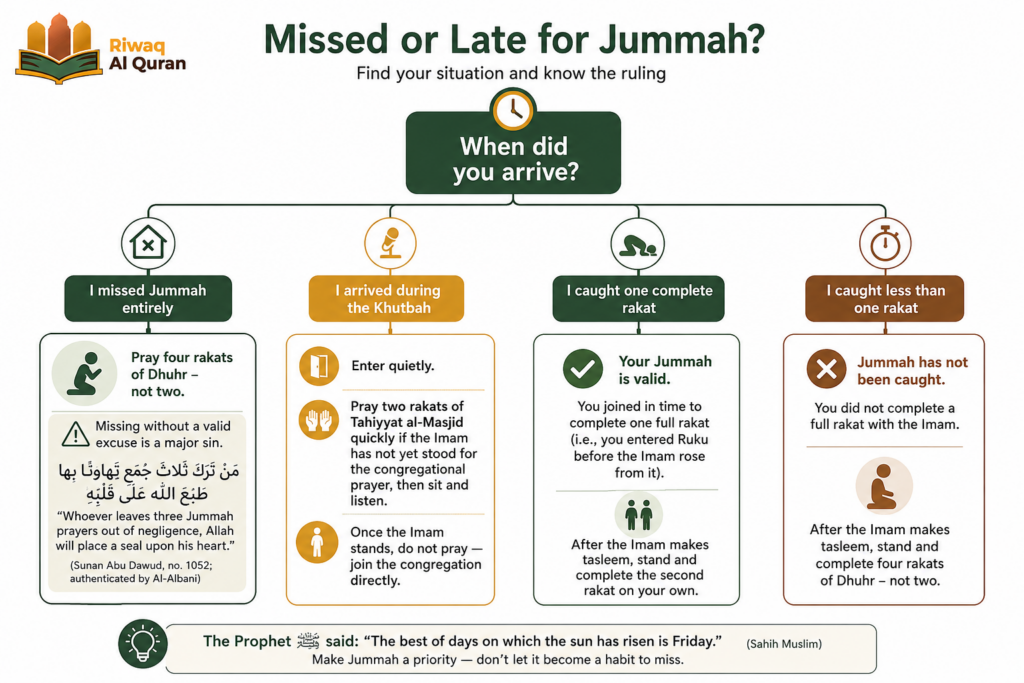
Not everyone arrives at the mosque before the khutbah begins, and sometimes unavoidable circumstances cause a person to miss part—or even all—of the Friday prayer. Islamic rulings distinguish between these situations, explaining what counts as catching Jummah, when Dhuhr must be prayed instead, and how to act when arriving late.
a. If You Miss Jummah Entirely
Anyone who misses Jummah for a valid reason (illness, travel, unavoidable necessity) prays four rakats of Dhuhr instead — not two. Missing Jummah without a legitimate excuse is treated seriously in Islamic law. The Prophet ﷺ warned:
“مَنْ تَرَكَ ثَلَاثَ جُمَعٍ تَهَاوُنًا بِهَا طَبَعَ اللَّهُ عَلَى قَلْبِهِ”
“Whoever leaves three Jummah prayers out of negligence, Allah will place a seal upon his heart.” — (Sunan Abu Dawud, no. 1052; authenticated by Al-Albani)
The word “seal” (طَبَعَ) is the same term used in Quran for hearts that no longer receive guidance. This is not a punishment for a single missed Friday, but a consequence of habitual, careless absence — the kind that signals that Jummah has stopped mattering to a person.
The warning is serious enough that scholars throughout history listed repeated, unjustified absence from Jummah among the major sins.
b. If You Arrive During the Khutbah
Arriving after the khutbah has begun does not mean you should rush or disturb those already listening. The Sunnah provides clear guidance on how to enter the mosque respectfully while ensuring you fulfill any remaining obligations.
- Enter quietly
- Pray two rakats of Tahiyyat al-Masjid quickly if the Imam has not yet stood for the congregational prayer, then sit and listen
- Once the Imam stands, do not pray — join the congregation directly
c. If You Catch One Complete Rakat
If you join the congregation in time to complete one full rakat with the Imam — meaning you entered Ruku before the Imam rose from it — your Jummah is valid. After the Imam makes tasleem, stand and complete the second rakat on your own.
d. If You Catch Less Than One Rakat
If you joined so late that you could not complete a full rakat with the Imam, Jummah has not been caught. After the Imam makes tasleem, stand and complete four rakats of Dhuhr — not two.
The Virtues of Friday in Islam
Friday’s spiritual weight is not symbolic — it is specific and documented. Understanding what makes Friday exceptional gives Jummah prayer its proper context.
1. Friday Is the Best Day of the Week
The Prophet ﷺ said:
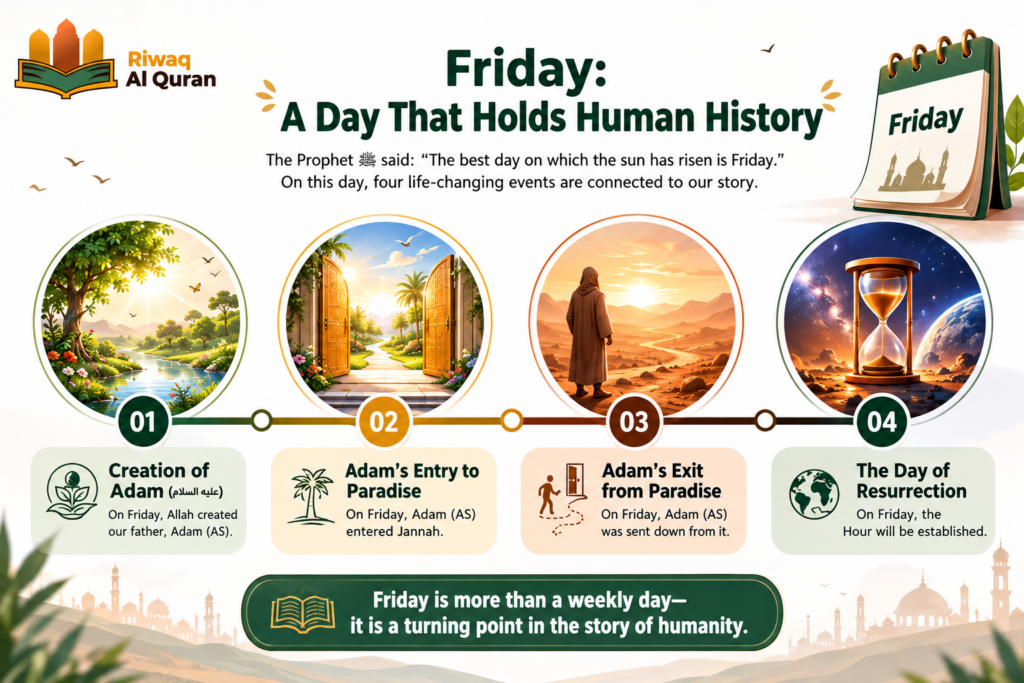
“خَيْرُ يَوْمٍ طَلَعَتْ عَلَيْهِ الشَّمْسُ يَوْمُ الْجُمُعَةِ فِيهِ خُلِقَ آدَمُ وَفِيهِ أُدْخِلَ الْجَنَّةَ وَفِيهِ أُخْرِجَ مِنْهَا وَلَا تَقُومُ السَّاعَةُ إِلاَّ فِي يَوْمِ الْجُمُعَةِ”
“The best day on which the sun has risen is Friday. On it Adam was created, on it he was admitted to Paradise, on it he was expelled from it, and the Hour will not come except on a Friday.” — (Sahih Muslim, no. 854)
The hadith anchors Friday to the beginning, middle, and end of human history — creation, the Garden, expulsion, and the Day of Judgment. It is not merely the best day of the week in a routine sense; it is the axis around which major events of human existence revolve. Knowing this adds weight to how seriously a Muslim should treat what they do on Friday.
2. The Complete Reward for an Ideal Jummah
The Prophet ﷺ also described the comprehensive reward available to those who approach the full Jummah correctly:
“مَنِ اغْتَسَلَ ثُمَّ أَتَى الْجُمُعَةَ فَصَلَّى مَا قُدِّرَ لَهُ ثُمَّ أَنْصَتَ حَتَّى يَفْرُغَ الإِمَامُ مِنْ خُطْبَتِهِ ثُمَّ يُصَلِّيَ مَعَهُ غُفِرَ لَهُ مَا بَيْنَهُ وَبَيْنَ الْجُمُعَةِ الأُخْرَى وَفَضْلُ ثَلَاثَةِ أَيَّامٍ”
“Whoever performs ghusl, then comes to Jummah, prays what is decreed for him, listens attentively until the Imam finishes his Khutbah, then prays with him — his sins between that Friday and the next are forgiven, plus three additional days.” — (Sahih Muslim, no. 857)
Ten days of forgiveness — from Friday to Friday plus three — for completing each of the steps described: ghusl, coming to the mosque, praying the Sunnah, listening to the Khutbah in silence, and praying in congregation. The hadith is a complete checklist for the full reward of Jummah, and each condition listed corresponds directly to the preparation and prayer steps in this guide.
3. The Hour of Accepted Dua
Every Friday contains one specific hour during which no sincere dua goes unanswered. The Prophet ﷺ described it as “short and narrow” — the strongest scholarly position places this in the final hour before Maghrib. The time between Asr and Maghrib on Friday should be used specifically for supplication.
4. Friday Is the Muslims’ Weekly Eid
The Prophet ﷺ treated Friday as a day of celebration — which is why fasting on Friday alone is discouraged, just as fasting on Eid is forbidden. It is a day to gather, worship, and renew one’s connection with the community and with Allah ﷻ.
Start Learning Prayer the Right Way — Book Your Free Trial
Knowing the steps of Jummah prayer is one thing. Being able to recite the Tashahhud, Al-Fatihah, and the post-prayer adhkar with correct pronunciation and Tajweed is another. Many Muslims have been reciting prayer words their entire lives without ever having them checked by a qualified teacher — and small errors accumulate across years without anyone noticing.
Riwaq Al Quran is a comprehensive online platform offering personalized Quran, Arabic, and Islamic Studies classes for all ages and backgrounds.
Watch real moments from our live sessions at Riwaq Al Quran and see how we bring learning to life:
Certified native Arab instructors follow a structured curriculum covering Tajweed, Tafsir, and Memorization, with live one-on-one interaction that makes correction immediate and personal. A snapshot of the programs available:
| Course | What It Covers |
|---|---|
| Online Quran Classes for Kids and Adults | Foundational Quran learning for every age group |
| Quran Memorization Online Course | Structured, specialized Hifz program |
| Online Quran Recitation Course | Expert-led recitation skill-building |
| Online Qirat Course | Exploring diverse Qirat styles |
| Noorani Qaida Online | Efficient learning of Quranic basics |
| Online Arabic Courses | Building the language foundation behind the Quran |
Conclusion
Jummah prayer is two obligatory rakats, but the full Friday prayer is far more than that — it is a complete act of worship that starts before you leave home and continues after the congregation disperses.
Proper preparation (ghusl, siwak, clean clothing, early arrival), listening to the full Khutbah in silence, performing two rakats in congregation, completing the post-Jummah Sunnah, and dedicating the final pre-Maghrib hour to dua: each of these is part of how to pray Jummah prayer the way the Prophet ﷺ taught it and the way that earns the full ten-day forgiveness described in Sahih Muslim.
The most common gaps — arriving after the Khutbah, skipping the Sunnah rakats, not knowing the late-arrival ruling, and talking during the sermon — are exactly what this guide was written to close. Friday is the best day of the week in Islam. Knowing how to observe it correctly is not a minor detail — it is how you make the most of a recurring opportunity that comes only once every seven days.
Frequently Asked Questions
Here are quick, direct answers to the questions people ask most often about Jummah prayer:
How many rakats is Jummah prayer in total?
The obligatory Jummah prayer is two rakats. The full Friday prayer — including the established Sunnah rakats — is eight to ten rakats: four Sunnah before, two obligatory, and two or four Sunnah after.
Is Jummah prayer obligatory for women?
Jummah prayer is not obligatory for women. If a woman attends the mosque and prays with the congregation, she performs two rakats. If she prays at home, she performs four rakats of Dhuhr — not two.
What if I arrive late and only catch part of the Jummah prayer?
If you catch one complete rakat with the Imam — meaning you made Ruku before he rose from it — your Jummah is valid. Complete the second rakat on your own after he makes tasleem. If you caught less than one rakat, pray four rakats of Dhuhr after the Imam finishes.
Can Jummah prayer be prayed at home?
No. Jummah requires a congregation, a Khutbah, and an established location. If you cannot attend, you pray four rakats of Dhuhr at home instead. The two-rakat format cannot be replicated without all three conditions prese
Is attending the Khutbah compulsory?
Yes. The Khutbah is legally equivalent to the first two rakats of Dhuhr — it is part of the prayer, not a prologue to it. Arriving after it has started means missing an obligatory element. Talking during the Khutbah is also forbidden, as established in both Bukhari and Muslim.
Which surahs are recited in Jummah prayer?
The established Sunnah is Surah Al-Jumu’ah (62) in the first rakat and Surah Al-Munafiqun (63) in the second. An alternative narration in Sahih Muslim mentions Surah Al-A’la (87) in the first rakat and Surah Al-Ghashiyah (88) in the second. Both are valid.
What happens if someone misses three Fridays in a row?
The Prophet ﷺ warned that Allah places a seal upon the heart of whoever misses three consecutive Jummah prayers out of negligence — recorded in Abu Dawud (no. 1052) and authenticated by Al-Albani. Scholars classify repeated, unjustified absence from Jummah among the major sins. A single missed Friday for a valid reason (travel, illness) carries no such consequence.