Quranic Arabic grammar — Nahw (النحو) — is the system of rules that governs how Arabic words combine into correct sentences and how their endings change to show meaning. It rests on three word types (noun, verb, particle), two sentence types (nominal and verbal), and a case-ending system called i’rāb. Master these, and the Quran’s structure opens up.
Most people who study Arabic for the Quran learn scattered rules and still can’t parse a verse. The reason is order: grammar only clicks when you learn it as a small, connected system rather than a pile of terms. This guide teaches it that way — every rule shown in an actual Quranic verse, so the grammar and the text you care about are learned together.
Whether you’re a complete beginner or you already read Arabic, this guide covers the word types, the sentence types, i’rāb, and how the short vowels (harakat) carry grammatical meaning — then how to start learning it step by step.
What You Will Learn in This Article
- The three types of Arabic words — noun (ism), verb (fi’l), and particle (harf) — with Quranic examples.
- The two sentence types, nominal and verbal, and how each is built.
- I’rāb — the case-ending system at the heart of Nahw, with a fully worked example.
- How the harakat carry grammatical meaning, not just pronunciation.
- A clear, step-by-step way to start learning Quranic Arabic grammar.
Table of Contents
What is Quranic Arabic Grammar (Nahw)?
Quranic Arabic grammar, or Nahw, is the branch of Arabic that studies how words fit together in a sentence and how their endings change according to their role. Its companion field, Ṣarf (morphology), studies how a single word is formed and conjugated; together they make up Arabic grammar.
A few facts anchor the science:
- Meaning of the word: naḥw literally means “way” or “manner” — the manner in which Arabic is correctly spoken.
- Its founder: it was first systematized in early Islamic history, with Abū al-Aswad al-Du’alī credited as a founder.
- Its cornerstone reference: Sībawayh’s Al-Kitāb became the enduring reference for the science.
For a learner, the value is direct: Nahw is what lets you tell the subject of a verse from its object, and a command from a statement — the difference between reading Arabic sounds and understanding the meaning. That’s why a structured Quranic Arabic course begins here rather than with vocabulary lists.
Why Quranic Arabic Grammar Matters
Quranic Arabic grammar matters because the Quran was revealed in Arabic to be understood and reflected upon, not merely recited as sound — and reflection depends on grasping how the words relate.
(إِنَّآ أَنزَلْنَٰهُ قُرْءَٰنًا عَرَبِيًّا لَّعَلَّكُمْ تَعْقِلُونَ)
“Indeed, We have sent it down as an Arabic Quran that you might understand.” — Surah Yusuf (12:2)
The Quran itself ties understanding to language, and it commands active reflection (tadabbur), which is impossible without knowing who does what to whom in a verse:
(أَفَلَا يَتَدَبَّرُونَ ٱلْقُرْءَانَ أَمْ عَلَىٰ قُلُوبٍ أَقْفَالُهَآ)
“Then do they not reflect upon the Quran, or are there locks upon their hearts?” — Surah Muhammad (47:24)
This is why grammar is more than an academic exercise — it’s part of the value Islam places on seeking knowledge and education. Learning the Quran, including the language that unlocks it, is among the most virtuous pursuits, as the Prophet ﷺ said:
(خَيْرُكُمْ مَنْ تَعَلَّمَ ٱلْقُرْآنَ وَعَلَّمَهُ)
“The best of you are those who learn the Quran and teach it.” — Sahih al-Bukhari 5027
Read together, these make the case plainly: the Quran is in Arabic, it is meant to be reflected upon, and grammar is the tool that makes that reflection possible.
See what learning Quranic Arabic with a native tutor actually looks like — in under a minute:
The Three Types of words in Arabic
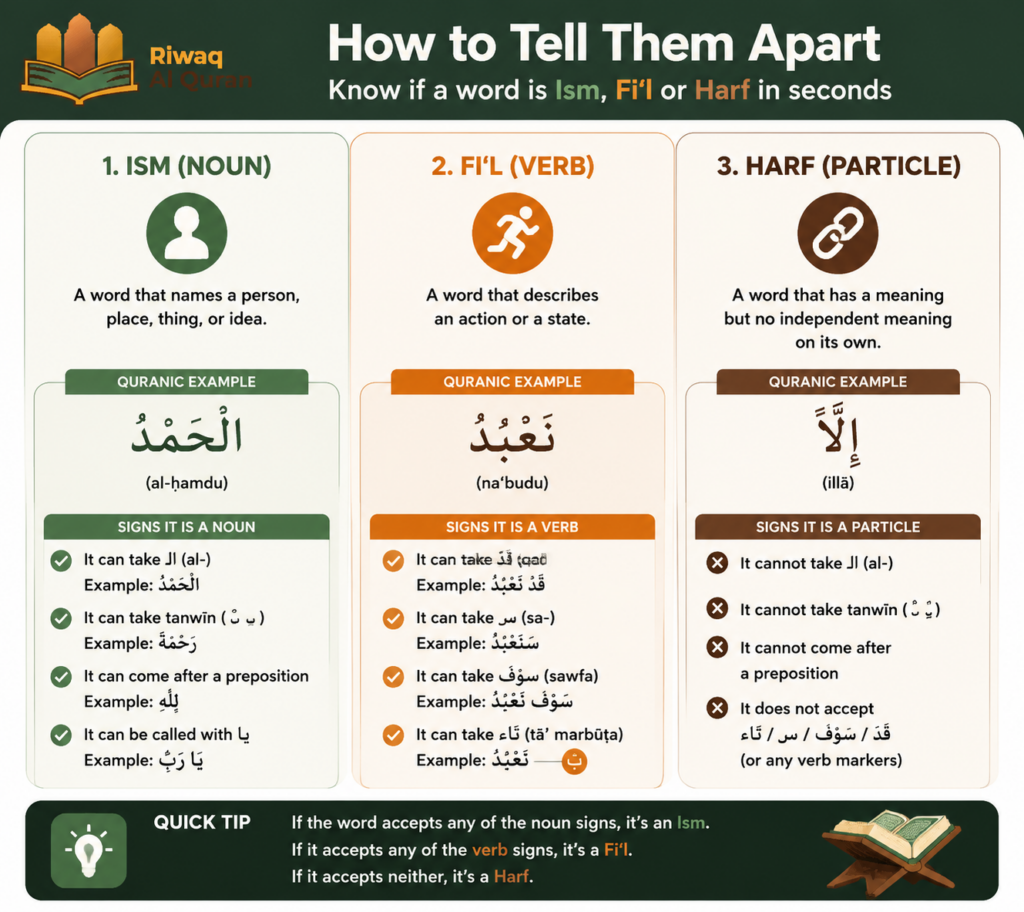
Every word in Arabic (kalima) is one of three types: a noun (ism), a verb (fi’l), or a particle (harf). Learning to tell them apart is the first real skill in Nahw, because every grammar rule after this depends on it.
Here is each type, shown in the Quran.
1. The Noun (ism)
An ism is a word that names a person, place, thing, idea, or quality, and carries no tense. Nouns change for number, gender, definiteness, and case. Almost every word in the Quran’s opening praise is a noun:
(ٱلْحَمْدُ لِلَّهِ رَبِّ ٱلْعَٰلَمِينَ)
“All praise is due to Allah, Lord of the worlds.” — Surah Al-Fatihah (1:2)
Here al-ḥamd (the praise), Allāh, rabb (Lord), and al-ʿālamīn (the worlds) are all nouns.
You don’t have to guess whether a word is a noun — classical Nahw gives it clear signs (ʿalāmāt al-ism). A word is a noun if it accepts any of these:
- It takes “ال” (al-) — like al-ḥamd (ٱلْحَمْدُ).
- It takes tanwīn (the doubled ending ـٌ ـٍ ـً) — like rabbun (رَبٌّ).
- It comes after a preposition — like li-llāhi (لِلَّهِ), where Allāh follows the li.
- It can be called or addressed with “يا” — like yā Rabb (يا رَبِّ).
A common beginner mistake is to assume any word with meaning is a noun. The test is these signs, not the meaning: if a word accepts “ال,” tanwīn, or a preposition before it, it is an ism.
2. The verb (fi’l)
A fi’l is a word that expresses an action tied to time. It comes in three tenses:
- Past (māḍī) — an action already completed.
- Present (muḍāri’) — an action happening now or ongoing.
- Command (amr) — an instruction to do something.
Verbs are the engine of a sentence:
(إِيَّاكَ نَعْبُدُ وَإِيَّاكَ نَسْتَعِينُ)
“It is You we worship and You we ask for help.” — Surah Al-Fatihah (1:5)
Naʿbudu (we worship) and nastaʿīn (we ask for help) are present-tense verbs.
The Quran shows all three tenses clearly. A past-tense verb, marked here by the particle qad — itself a sign of a verb:
(قَدْ أَفْلَحَ ٱلْمُؤْمِنُونَ)
“Successful indeed are the believers.” — Surah Al-Mu’minun (23:1)
And a command verb, giving an instruction:
(ٱقْرَأْ بِٱسْمِ رَبِّكَ ٱلَّذِى خَلَقَ)
“Read in the name of your Lord who created.” — Surah Al-‘Alaq (96:1)
Verbs also have their own recognition signs (ʿalāmāt al-fi’l): a word is a verb if it accepts qad (قد), the future markers sa- (سـ) or sawfa (سوف), or the silent feminine tāʾ (as in qālat, قالَتْ). If none of the noun-signs fit but these do, you’re looking at a verb.
3. The Particle (harf)
A harf is a function word that has no meaning on its own and works only by linking other words. Common groups include:
- Prepositions — مِن, إلى, على.
- Conjunctions — و, ف.
- Other particles — إنّ, لا, إلا.
You see three of them in a single verse:
(وَمَا خَلَقْتُ ٱلْجِنَّ وَٱلْإِنسَ إِلَّا لِيَعْبُدُونِ)
“And I did not create the jinn and mankind except to worship Me.” — Surah Adh-Dhariyat (51:56)
Here wa (and), illā (except), and the li (to) attached to the verb are all particles.
The particle is identified by exclusion: it is the word that accepts neither the noun-signs nor the verb-signs. If you can’t put “ال” on it, can’t add tanwīn, and can’t put qad or sa- before it, it’s a harf.
What makes particles important out of proportion to their size is that many of them change the case of the word after them — a direct link to i’rāb:
- Prepositions (مِن, إلى, على, لـ) put the following noun into the genitive (majrūr).
- “إنّ” and its sisters put the following noun into the accusative (mansub).
- “كان” and its sisters keep the subject nominative but make the predicate accusative.
Spotting the particle first often tells you, in advance, what ending the next word must take.
The Two Types of Arabic Sentences
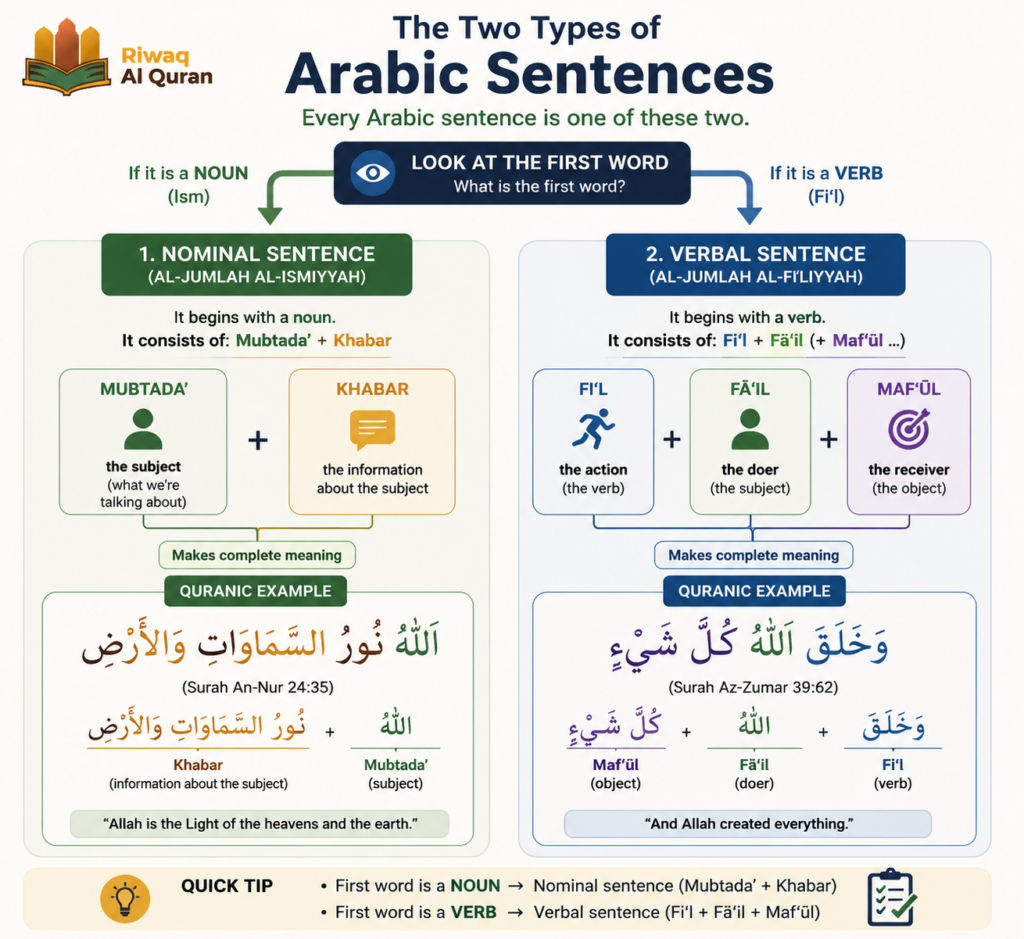
Every Arabic sentence is either nominal (starting with a noun) or verbal (starting with a verb). Knowing which one you’re reading tells you what to expect next and how the words will be marked.
Here is how each is built.
1. The Nominal Sentence (al-jumla al-ismiyya)
A nominal sentence starts with a noun and has two parts:
- The mubtada’ — the subject or topic the sentence is about.
- The khabar — the predicate that tells you something about it.
Both are normally in the nominative case:
(ٱللَّهُ نُورُ ٱلسَّمَٰوَٰتِ وَٱلْأَرْضِ)
“Allah is the Light of the heavens and the earth.” — Surah An-Nur (24:35)

Allāhu is the mubtada’ and nūru is the khabar — and there is no verb “is” in Arabic; the two nouns placed together carry that meaning.
One point that trips up beginners: the khabar is not always a single word. It can take three forms:
- A single noun — as in Allāhu nūru… above.
- A prepositional phrase — such as al-ḥamdu li-llāhi (“praise is for Allah“).
- A full sentence — for example Allāhu yarzuqu ʿibādahu (“Allah provides for His servants“), where a whole verbal sentence acts as the predicate.
The default nominative state of both parts can also change: “إنّ” and its sisters make the mubtada’ accusative, while “كان” and its sisters make the khabar accusative. Recognising the opening word of the sentence tells you which rule is in play.
2. The Verbal Sentence (al-jumla al-fi’liyya)
A verbal sentence starts with a verb, and its natural order runs in three parts:
- The verb (fi’l) — comes first.
- The subject (fāʿil) — the doer, in the nominative.
- The object (maf’ūl) — the receiver, in the accusative.
You see the pattern here:
(خَلَقَ ٱللَّهُ ٱلسَّمَٰوَٰتِ وَٱلْأَرْضَ بِٱلْحَقِّ)
“Allah created the heavens and the earth in truth.” — Surah Al-‘Ankabut (29:44)
Khalaqa is the verb, Allāhu is the subject (nominative, with a ḍamma), and as-samāwāti wa-l-arḍa is the object (accusative) — the exact pattern you’ll parse in thousands of verses.
Two features of the verbal sentence are worth knowing early, because they answer questions learners hit almost immediately:
- The verb usually stays singular even with a plural subject when the subject comes after it — you say khalaqa Allāhu (“Allah created”), not a plural verb, because the doer follows the verb.
- The object can be dropped when the meaning is clear — many verses have only a verb and a subject, with no stated object, and the sentence is still complete.
A quick way to tell the two sentence types apart: look at the very first word. If the sentence opens with a noun, it’s nominal; if it opens with a verb, it’s verbal — and that single check tells you whether to look for a mubtada’ or a fāʿil next.
I’rāb as The Case System at The Heart of Nahw
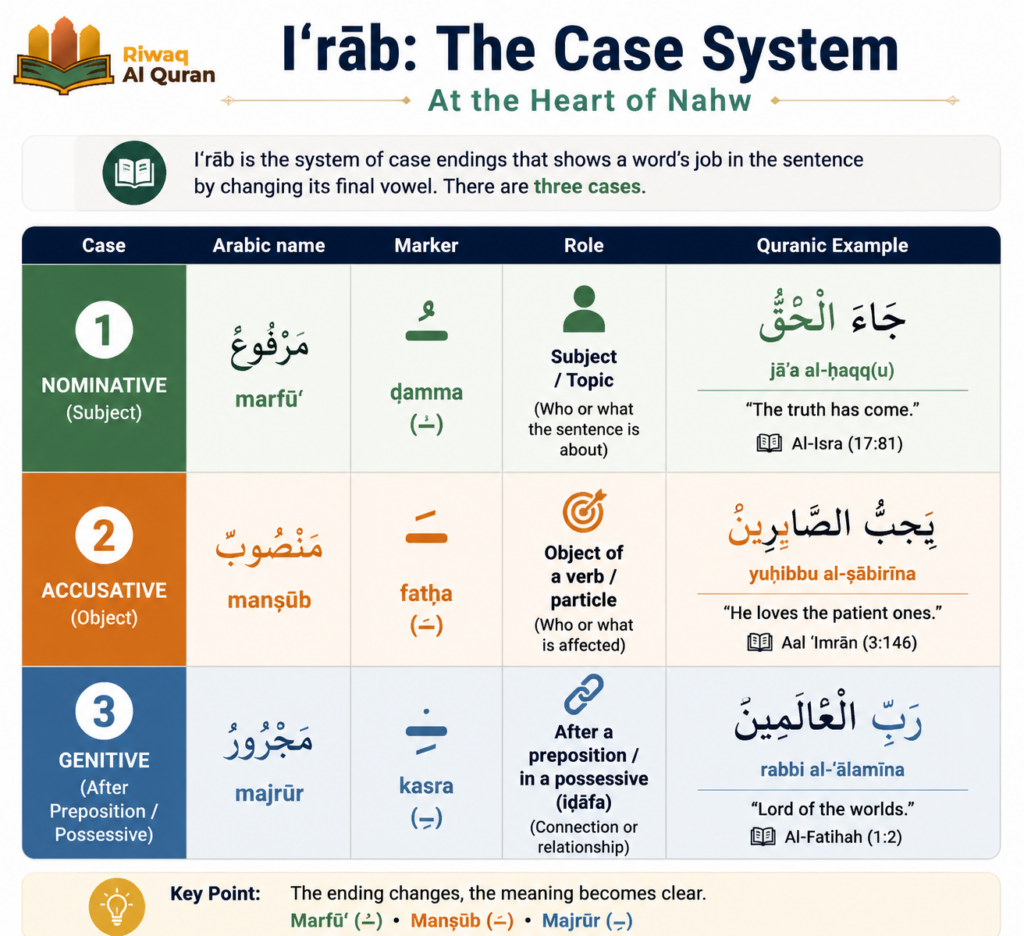
I’rāb is the system of case endings that shows a word’s job in the sentence by changing its final vowel. It is the core of Nahw, because in Arabic the ending, not the word order alone, tells you who did what to whom. There are three cases.
The table below defines each case, its marker, its role, and a Quranic example to match:
| Case | Arabic name | Marker | Role | Quranic example |
|---|---|---|---|---|
| Nominative | marfūʿ | ḍamma (ـُ) | subject / topic | جَاءَ ٱلْحَقُّ — Al-Isra (17:81) |
| Accusative | manṣūb | fatḥa (ـَ) | object of a verb/particle | يُحِبُّ ٱلصَّٰبِرِينَ — Aal ʿImrān (3:146) |
| Genitive | majrūr | kasra (ـِ) | after a preposition / in a possessive (iḍāfa) | رَبِّ ٱلْعَٰلَمِينَ — Al-Fatihah (1:2) |
In جَاءَ ٱلْحَقُّ (“the truth has come”), al-ḥaqqu is the subject, so it takes a ḍamma. In يُحِبُّ ٱلصَّٰبِرِينَ (“He loves the patient”), aṣ-ṣābirīn is the object, so it’s accusative. And in رَبِّ ٱلْعَٰلَمِينَ, both words are genitive — one after an implied preposition, one in a possessive construction.
The practical payoff: once you can spot the case ending, you can identify a word’s role even when the word order shifts — which the Quran does often for emphasis. That single skill is what turns reading into understanding.
Binā’ and The Words That Never Change
Alongside i’rāb, some words are mabnī (built) — their ending is fixed and never changes with their role. These include:
- Pronouns — أنا, نحن, هو, هي.
- Demonstratives — هذا, هذه, أولئك.
- Certain adverbs — أمس, حيث, متى.
Knowing which words are mabnī saves you from looking for a case ending that isn’t there — a common beginner confusion when parsing a verse full of pronouns.
A Worked I’rāb Example Through Parsing a Quranic Verse
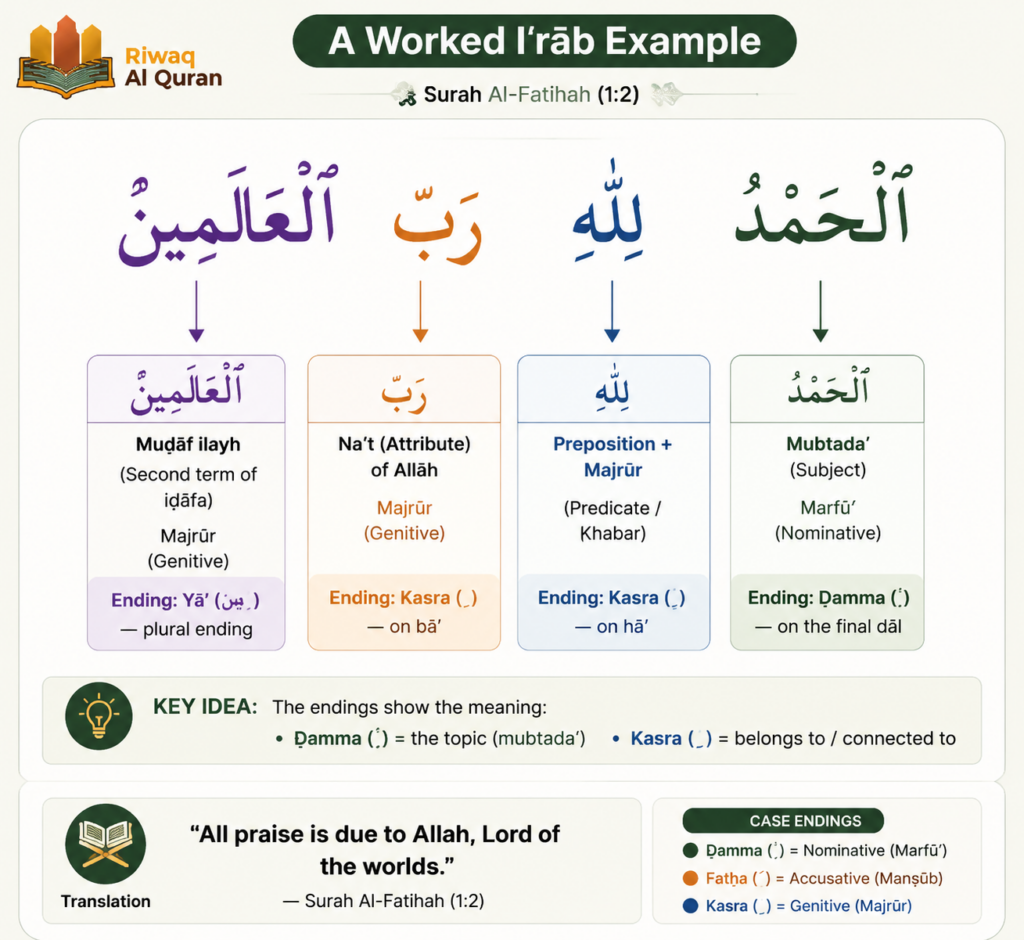
The fastest way to see Nahw at work is to parse (do i’rāb on) a short verse word by word. Take the second verse of Al-Fatihah, which packs three of the rules above into four words:
(ٱلْحَمْدُ لِلَّهِ رَبِّ ٱلْعَٰلَمِينَ)
“All praise is due to Allah, Lord of the worlds.” — Surah Al-Fatihah (1:2)
Here is each word’s role and ending:
- ٱلْحَمْدُ — the mubtada’ (subject of the nominal sentence), nominative (marfūʿ), marked by the ḍamma.
- لِـ + ٱللَّهِ — li is a preposition (harf jarr); Allāhi is genitive (majrūr) because of it, marked by the kasra. Together they form the khabar (predicate).
- رَبِّ — an attribute (naʿt) of Allāh, so it follows it in the genitive, marked by the kasra.
- ٱلْعَٰلَمِينَ — the second term of a possessive construction (muḍāf ilayh) with rabb, genitive, marked by the yā’ (the plural ending ـِينَ).
Notice how the meaning is carried entirely by the endings: the ḍamma tells you al-ḥamd is what the sentence is about, and the kasras tell you the rest belongs to Allah. Parse three or four short verses like this and the whole system starts to feel natural — which is exactly how a tutor at Riwaq Al Quran drills it with you.
How Harakat Carry Grammatical Meaning
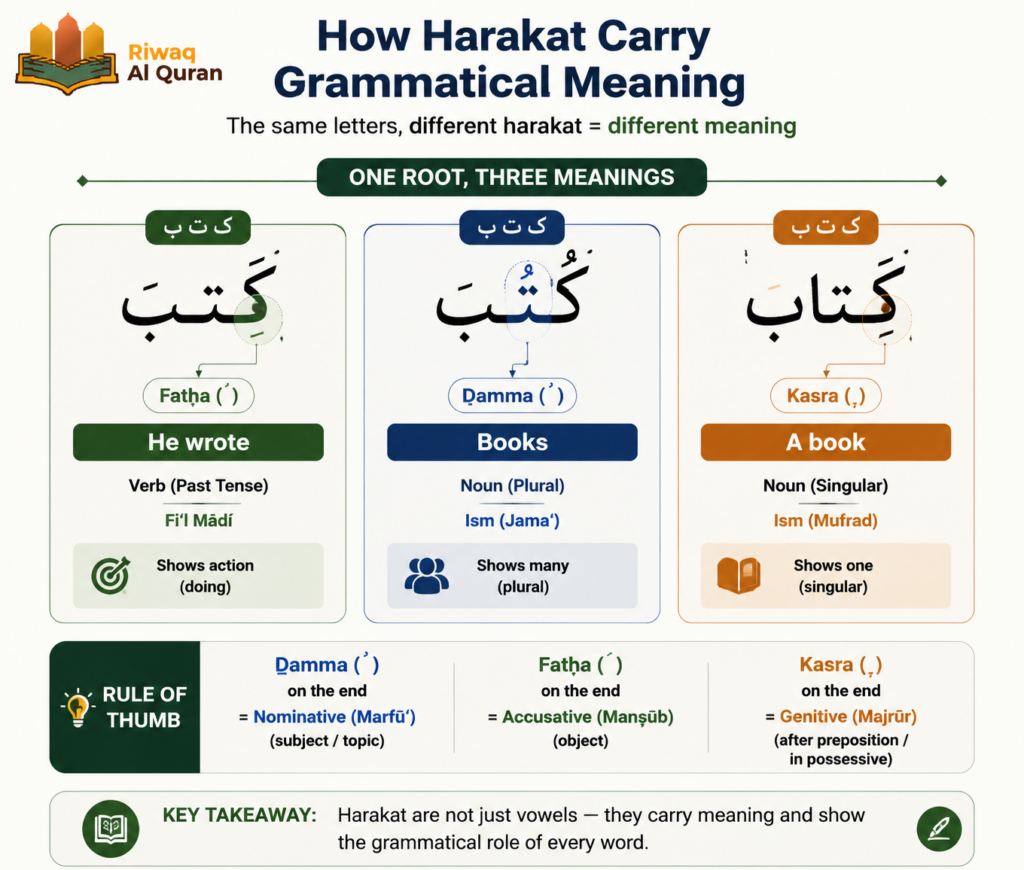
The harakat — fatḥa (ـَ), kasra (ـِ), and ḍamma (ـُ) — are the short vowels written above and below letters, and in Nahw they do more than guide pronunciation: they are the i’rāb endings that show a word’s case. As a rule of thumb:
- A ḍamma on a final letter often signals the nominative.
- A fatḥa often signals the accusative.
- A kasra often signals the genitive.
This is why the same three letters can mean different things — كَتَبَ (kataba, “he wrote,” a verb), كُتُب (kutub, “books,” a plural noun), and كِتَاب (kitāb, “a book”) are distinguished by their harakat alone.
For a Quran learner, this makes vowelling non-negotiable: misplacing a single ḥarakah can change a subject into an object, or a statement into something else entirely. Reading the Mushaf’s harakat carefully is the first habit of correct grammar — and the fastest to build with a teacher checking you.
How To Learn Quranic Arabic Grammar
The reliable path to Quranic Arabic grammar is to build it in order, one layer on the next, rather than jumping between topics. Rushing to advanced rules before the basics are solid is the most common reason learners stall.
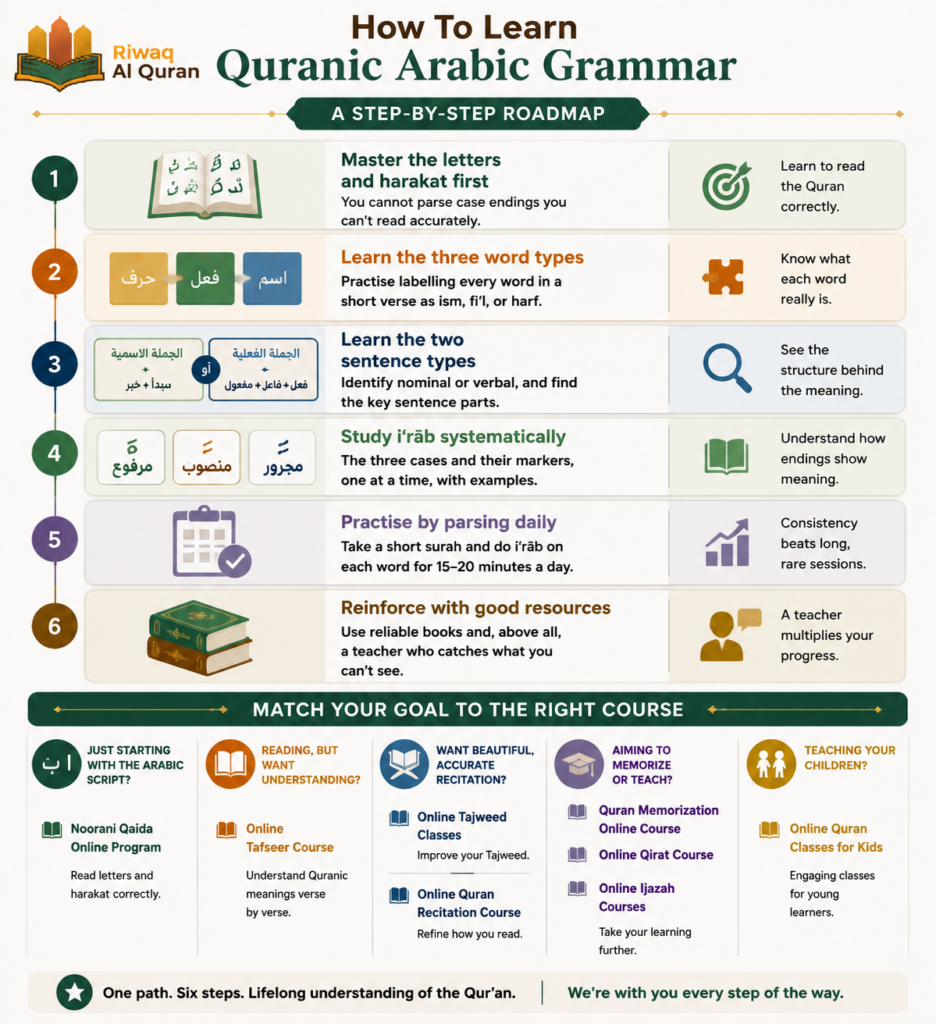
Follow these steps in sequence:
- Master the letters and harakat first — you cannot parse case endings you can’t read accurately, so start by learning how to read the Quran correctly.
- Learn the three word types — practise labelling every word in a short verse as ism, fi’l, or harf.
- Learn the two sentence types — identify whether a verse begins nominal or verbal, and find the mubtada’/khabar or fi’l/fāʿil.
- Study i’rāb systematically — the three cases and their markers, one at a time, with examples.
- Practise by parsing daily — take a short surah and do i’rāb on each word for 15–20 minutes a day; consistency beats long, rare sessions.
- Reinforce with good resources — supplement your study with reliable Islamic studies books and, above all, a teacher who catches the mistakes you can’t see.
Wherever you are on that ladder, there’s a Riwaq Al Quran course built for that exact step. Rather than a long menu, here’s the quick way to match one to your goal:
- Just starting with the Arabic script? Begin with the Noorani Qaida Online program to read letters and harakat correctly.
- Reading, but want understanding? The Online Tafseer Course walks you through Quranic meanings verse by verse.
- Want beautiful, accurate recitation? Online Tajweed Classes and the Online Quran Recitation Course refine how you read.
- Aiming to memorize or teach? The Quran Memorization Online Course, Online Qirat Course, and Online Ijazah courses take you further.
- Teaching your children? Online Quran Classes for Kids keep young learners engaged.
Start Learning Quranic Arabic Grammar Today
Grammar rules are easy to read and hard to apply on your own — parsing a live verse, catching a misplaced case ending, knowing why a word is nominative and not accusative is where self-study stalls. A teacher turns the rules on this page into a skill you can actually use on the Mushaf.
Riwaq Al Quran is a comprehensive online platform offering personalized Quran, Arabic, and Islamic Studies classes for all ages and backgrounds. Its experienced instructors follow a structured curriculum — covering Tajweed, Tafsir, and memorization — through interactive online classes that make communication between student and teacher seamless.
Explore the online Arabic classes, book a free trial, and start understanding the Quran in the language it was revealed in.
Here’s one of our own students putting Arabic into practice — the same path this guide sets you on:
Conclusion
Quranic Arabic grammar (Nahw) is not an endless list of rules — it’s a small, connected system you can hold in your head. It rests on three word types (ism, fi’l, harf), builds them into two sentence types (nominal and verbal), and marks every word’s role through one case system, i’rāb, carried by the harakat. Learn those layers in order and each one supports the next: you can’t parse a sentence until you can name its words, and you can’t read i’rāb until you can read the vowels.
The single idea to carry with you is that in Arabic the ending tells you the meaning. A ḍamma marks the doer, a fatḥa marks the receiver, and a kasra marks possession or a preposition. Once your eye catches those endings, word order stops confusing you — even when the Quran shifts it for emphasis — and you move from sounding out verses to actually understanding them.
So start small and stay consistent: master the letters and harakat, label the word types in a short surah, then parse one verse a day. Treat Quranic Arabic grammar as a system practised on the Quran itself, and get a teacher to catch the mistakes you can’t see. That is the shortest, surest path from reading the Book as sound to understanding it in the language it was revealed in — and it’s a path you can start today.
Frequently Asked Questions About Quranic Arabic Grammar
Below are quick answers to the questions learners most often ask about Nahw — from what it is to how to begin.
What is Nahw in Arabic grammar?
Nahw (النحو) is the branch of Arabic grammar that studies how words combine in a sentence and how their endings change to show their role. It works alongside Ṣarf (morphology, how words are formed) to make up Arabic grammar as a whole.
What are the three types of words in Arabic?
The three types of words in Arabic are the noun (ism), the verb (fi’l), and the particle (harf). A noun names something with no tense, a verb expresses an action tied to time, and a particle is a function word like a preposition or conjunction.
What is i’rāb in Arabic?
I’rāb is the system of case endings that shows a word’s grammatical role by its final vowel: nominative (marfūʿ, ḍamma) for the subject, accusative (manṣūb, fatḥa) for the object, and genitive (majrūr, kasra) after prepositions and in possessive constructions.
What is the difference between a nominal and a verbal sentence?
A nominal sentence (jumla ismiyya) starts with a noun and has a subject (mubtada’) and predicate (khabar). A verbal sentence (jumla fi’liyya) starts with a verb, followed by its subject (fāʿil) and object (maf’ūl).
How do I start learning Quranic Arabic grammar?
Start by mastering the Arabic letters and harakat, then learn the three word types and two sentence types, and finally study i’rāb. Practise by parsing a short surah daily, ideally with a teacher who corrects your errors.