Every time you open the Quran, Meem Sakinah appears on nearly every line. Pronounce it with the wrong rule — adding a nasal sound where none belongs, or dropping one where it is required — and you have altered both the sound and the recitation itself. Allah commands in Surah Al-Muzzammil:
“وَرَتِّلِ الْقُرْآنَ تَرْتِيلًا”
And recite the Quran with measured, distinct recitation.” — (Surah Al-Muzzammil, 73:4)
Reciting with proper Tajweed is not optional — it is an act of honoring the words of Allah, and Meem Sakinah is one of the rules you will apply in almost every verse. The Meem Sakinah rules in Tajweed are only three, each triggered by a single factor: the letter that follows the silent Meem. Master that one habit, and the rules apply themselves.
This guide covers all three Meem Sakinah rules with Quranic verses in Arabic, fixes the most common mistakes students repeat for years, and gives you a practical method for building lasting pronunciation accuracy. It builds directly on the rules of Noon Sakinah and Tanween, which we recommend revisiting alongside this guide.
What You’ll Learn in This Article
- The precise definition of Meem Sakinah and why all its rules are classified as Shafawi.
- All three rules — Idgham Shafawi, Ikhfa Shafawi, and Izhaar Shafawi — with cited Quranic examples in Arabic.
- A quick-reference comparison table covering trigger letters, lip position, Ghunnah, and duration.
- The three most repeated pronunciation mistakes and exactly how to correct each one.
- Authentic hadith on the reward for learning and reciting the Quran, with commentary
- A four-step practice method for building accurate, consistent recitation.
Table of Contents
What Is Meem Sakinah in Tajweed?
Meem Sakinah is one of the most frequently occurring phonetic rules in all of Tajweed, appearing across virtually every page of the Quran. Understanding it correctly is a prerequisite for reading with proper Tajweed, and its structure mirrors the rules of Noon Sakinah and Tanween — three rules instead of four, all of them rooted in the lips.
a. What Does Saakin Mean?
Saakin is a letter that carries a Sukoon (ْ) — a diacritical mark indicating the absence of a short vowel. In practical terms, this means:
- The letter has no Fatha (َ), Damma (ُ), or Kasra (ِ).
- It is held in a suspended state — present in the word but without its own vocal movement.
- It can appear in the middle or at the end of a word.
Understanding Saakin is the foundational step, because all three Meem Sakinah rules depend entirely on what follows this vowelless letter.
b. What Is Meem Sakinah and Why Is It Called Shafawi?
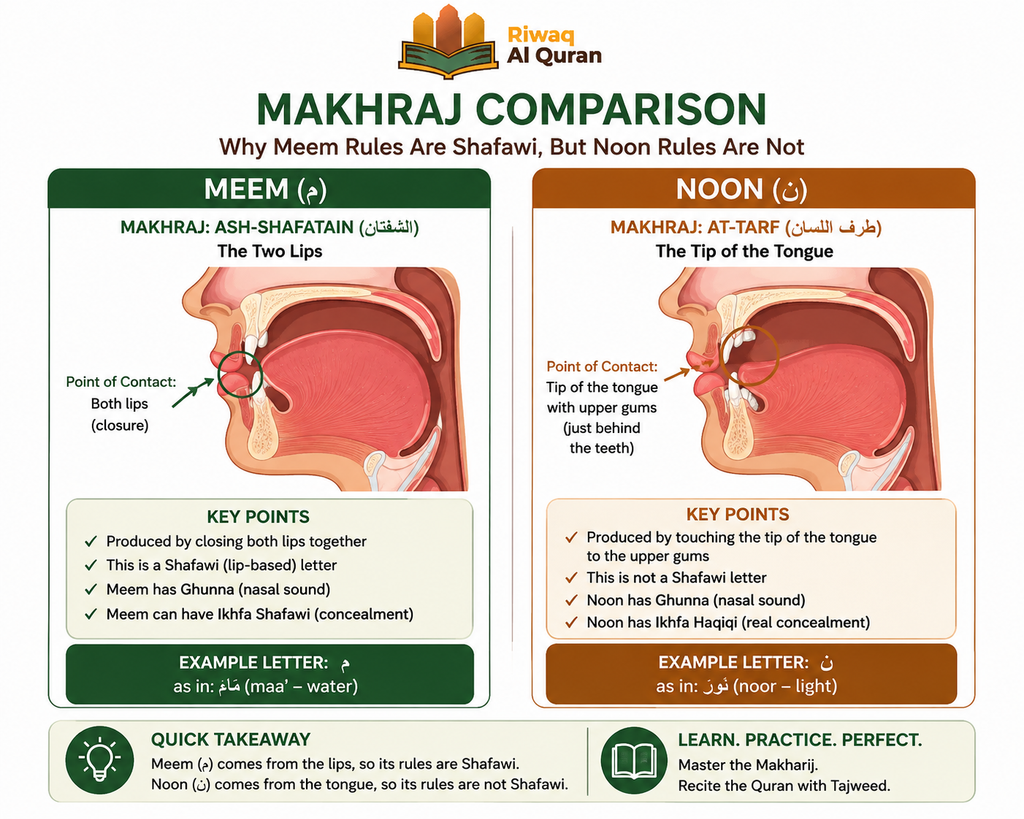
Meem Sakinah is the letter Meem (م) when it carries a Sukoon (مْ), whether it appears in the middle of a word or at the end. Several key facts define it:
- Its articulation point (Makhraj) is the coming together of both lips.
- All three of its rules are classified as Shafawi — derived from شَفَتَانِ, meaning “the two lips”.
- This labial origin distinguishes Meem Sakinah from Noon Sakinah, which originates at the tip of the tongue near the upper front teeth.
- The term Shafawi applies to all three rules because the lips are always the operative factor, regardless of which rule is in play.
You can deepen your understanding of Arabic letters and their articulation points through Riwaq Al Quran’s Online Arabic Courses, which cover the phonetic foundations that underpin every Tajweed rule.


The 3 Meem Sakinah Rules — Explained with Quranic Verses
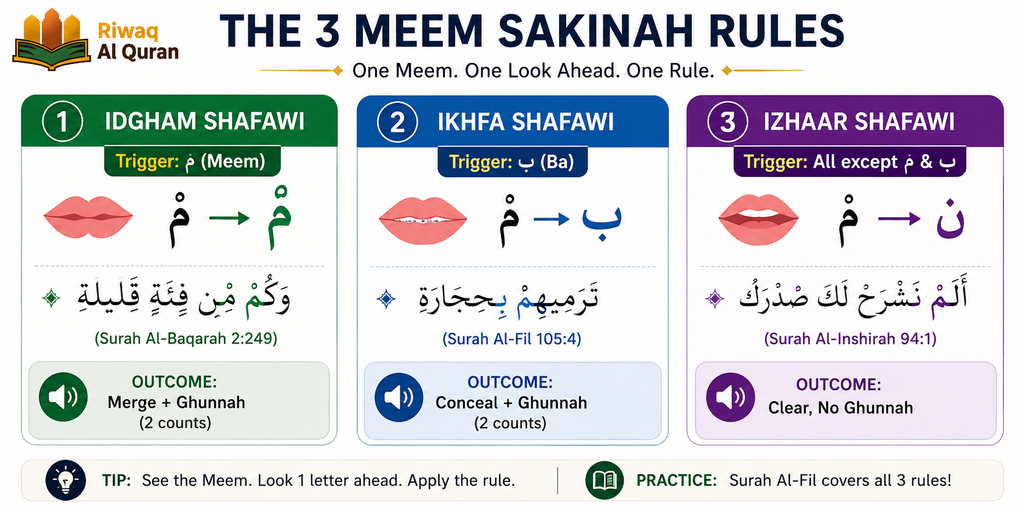
The correct rule is determined entirely by the letter that immediately follows the Meem Sakinah. There is no overlap and no ambiguity: one letter triggers Idgham, one letter triggers Ikhfa, and every other letter in the Arabic alphabet triggers Izhaar. The core skill to build is the habit of scanning one letter ahead — see the Meem, identify the next letter, and the rule becomes automatic.
Before reading further, you may find it helpful to review this step-by-step guide on how to learn Tajweed of the Quran, which frames the broader context in which Meem Sakinah sits alongside every other Tajweed rule you will encounter.
1. Idgham Shafawi — Merging Meem into Meem
Trigger letter: Meem (م) only
Idgham Shafawi occurs when a Meem Sakinah (مْ) is immediately followed by another Meem that carries a vowel. Key characteristics of this rule:
- The silent Meem merges completely into the following voweled Meem.
- The result is one stressed Meem written with a Shaddah (مّ).
- A Ghunnah — nasal resonance — is held for two full counts during the merge.
- In the Mushaf, the Shaddah on the second Meem signals that the first has been fully absorbed.
This rule is technically classified as Idgham Mithlain Sagheer — the merging of two identical letters in their “small” form, meaning the first carries Sukoon and the second carries a vowel. Both letters share the same Makhraj and Sifat (qualities); when they merge, the Ghunnah is produced as the lips meet and resonates through the nasal passage.
This connects directly to the broader topic of Noon and Meem Mushaddadah rules, where a stressed Meem with Shaddah also requires Ghunnah.
Quranic example:
“وَكَم مِّن فِئَةٍ قَلِيلَةٍ غَلَبَتْ فِئَةً كَثِيرَةً بِإِذْنِ اللَّهِ”
“How many a small company has overcome a large company by permission of Allah.” — (Surah Al-Baqarah, 2:249)
The مْ in كَمْ merges with the مِ of مِّن. The Shaddah on the second Meem (مِّن) marks this merger in the Mushaf.
This verse speaks of a small group overcoming a larger one through divine permission. There is a fitting parallel for the Tajweed student: mastering a rule that feels difficult at first, through persistence and trust in the process, is its own form of overcoming.
2. Ikhfa Shafawi — Concealing Meem Before Ba
Trigger letter: Ba (ب) only
Ikhfa Shafawi occurs when a Meem Sakinah (مْ) is immediately followed by Ba (ب). This rule occupies the middle ground between full merging and full clarity:
- The Meem is neither merged nor clearly pronounced — it is concealed.
- The lips rest in light contact, not pressed firmly shut.
- A Ghunnah of two counts resonates through the nasal passage while the lips hold this position.
- The lips then open to articulate the Ba.
The detail most students miss: in Ikhfa Shafawi, the lips must not be pressed tightly together. If they close fully — the way they do for a standalone Meem — an audible “mm” sound is produced before the Ba, which breaks the rule entirely. The correct lip position is a light hover, held loosely, while the nasal sound carries the two counts.
In the Egyptian Mushaf (Al-Mushaf Al-Misri), letters involved in Ikhfa Shafawi are marked in green to alert the reader to apply concealment at that position.
Quranic example:
“تَرْمِيهِم بِحِجَارَةٍ مِّن سِجِّيلٍ”
“Pelting them with stones of hard clay.” — (Surah Al-Fil, 105:4)
The مْ at the end of تَرْمِيهِمْ is followed by the بِ of بِحِجَارَةٍ. The Meem is concealed with Ghunnah for two counts before the lips open for the Ba.
Surah Al-Fil is short, frequently recited, and contains examples of all three Meem Sakinah rules within its five verses. Returning to verse 4 repeatedly while focusing specifically on the هِمْ بِ transition is one of the most efficient drills available for Ikhfa Shafawi.
3. Izhaar Shafawi — Clear Pronunciation Before All Other Letters
Trigger letters: All remaining 26 Arabic letters — every letter except Meem (م) and Ba (ب)
Izhaar Shafawi means to pronounce the Meem Sakinah clearly and completely. Distinct characteristics of this rule:
- The Meem is given its full articulation before the reciter moves to the next letter.
- Two distinct sounds are produced — the Meem, then the following letter — never blended.
- No Ghunnah whatsoever, not even a slight nasal resonance.
- No prolongation of the Meem beyond its natural weight.
Two letters require special attention — Waw (و) and Fa (ف). Because both are articulated near the lips, students instinctively apply softening or a light nasal sound when Meem Sakinah precedes them. This is an error. Both Waw and Fa are Izhaar Shafawi letters — the Meem before either must be fully clear and completely separate.
Quranic examples:
“أَلَمْ نَشْرَحْ لَكَ صَدْرَكَ”
Did We not expand for you your chest?” — (Surah Al-Inshirah, 94:1)
The مْ in أَلَمْ is followed by نَ — Izhaar Shafawi applies. Pronounce the Meem clearly with no nasal resonance before moving to the Noon.
“أَلَمْ تَرَ كَيْفَ فَعَلَ رَبُّكَ بِأَصْحَابِ الْفِيلِ”
“Have you not considered how your Lord dealt with the companions of the elephant?” — (Surah Al-Fil, 105:1)
The مْ in أَلَمْ is followed by تَ — clear pronunciation, no merging, no Ghunnah.
Notice that Surah Al-Fil contains examples of all three Meem Sakinah rules across just five verses — Izhaar in verse 1, Ikhfa in verse 4. Reciting Al-Fil slowly with full attention to every Meem Sakinah functions as a self-contained practice drill covering the complete rule set.
Quick-Reference – The 3 Meem Sakinah Rules at a Glance
The table below places every rule side by side across the four factors you need to apply each correctly — trigger letter, lip position, Ghunnah requirement, and duration. Use it as a rapid-reference before practice sessions until the information becomes automatic.
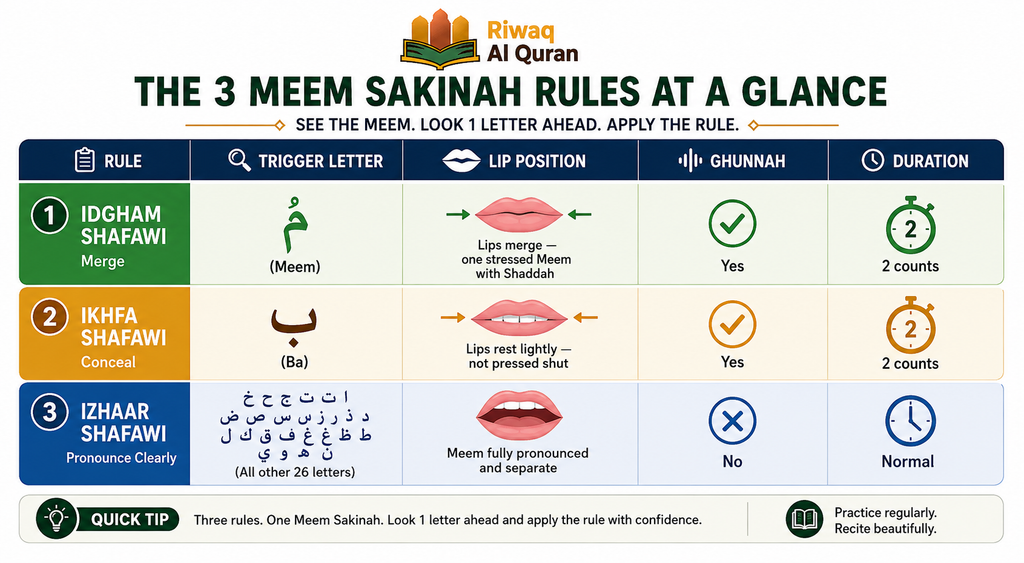
| Rule | Trigger Letter | Lip Position | Ghunnah | Duration |
| Idgham Shafawi | Meem (م) | Lips merge — one stressed Meem with Shaddah | Yes | 2 counts |
| Ikhfa Shafawi | Ba (ب) | Lips rest lightly — not pressed shut | Yes | 2 counts |
| Izhaar Shafawi | All other 26 letters | Meem fully pronounced and separate | No | Normal |
The 3 Most Common Mistakes Students Make with Meem Sakinah
These errors are not beginner problems — they appear across all levels of study, including in students who have been reciting for years. Each mistake has a specific cause, and knowing that cause is what allows you to stop it at the source rather than correcting it symptom by symptom. Understanding the benefits of learning Tajweed fully can sharpen your motivation to address each of these errors with the attention they deserve.
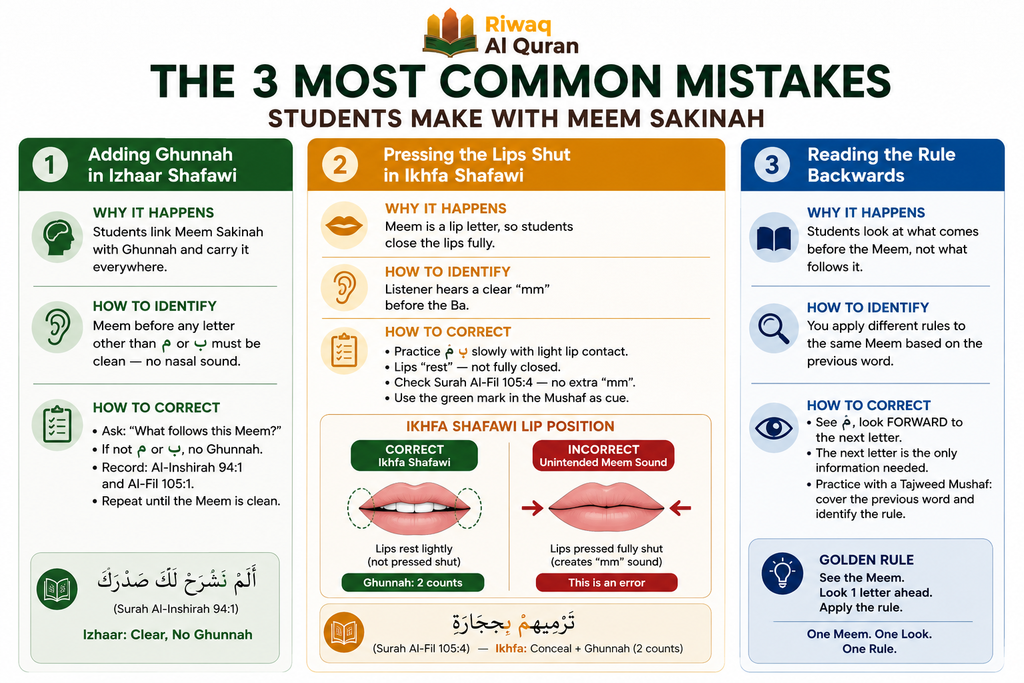
1. Adding Ghunnah in Izhaar Shafawi
Why it happens: Because Ghunnah is required in both Idgham Shafawi and Ikhfa Shafawi, students build a habitual association between Meem Sakinah and nasal resonance — and carry it reflexively into every rule, including Izhaar.
How to identify it: When a Meem Sakinah is followed by anything other than Meem or Ba — including Waw, Fa, Ha, Lam, Kaf, and all others — the Meem must be completely clean, with no nasal sound whatsoever.
How to correct it:
- Before each Meem Sakinah in practice, pause and mentally state: “What follows this Meem?”
- If the next letter is not Meem or Ba, consciously suppress any nasal resonance before pronouncing the Meem
- Record yourself reciting the opening verse of Surah Al-Inshirah and Al-Fil verse 1 — listen specifically for any nasal sound before the Noon and Ta respectively
- Repeat the targeted verses until the clean Meem becomes the default response to those letters
2. Pressing the Lips Shut in Ikhfa Shafawi
Why it happens: Meem is a lip letter, and students instinctively close the lips fully when they see it — which is correct for a voweled Meem but produces an error in Ikhfa.
How to identify it: If someone listening to your recitation can hear a distinct “mm” sound before the Ba, your lips are too closed.
How to correct it:
- Practice the transition مْ بِ in isolation — repeat it slowly with the lips held in light contact rather than pressed shut
- Think of the lips as “resting” rather than “closing” — the nasal resonance does the work, not the lip pressure
- Check Surah Al-Fil verse 4 (تَرْمِيهِم بِحِجَارَةٍ) — if you hear a Meem before the Ba, reduce lip pressure progressively until that extra sound disappears
- In the Egyptian Mushaf, use the green color marking as a visual cue to enter the lighter lip position before you reach the Ba
3. Reading the Rule Backwards
Why it happens: Students focus on what precedes the Meem Sakinah — the vowel or word that came before — rather than scanning forward to the letter that follows it.
How to identify it: If you apply different rules to the same Meem depending on the preceding word rather than the following letter, you are reading the rule backwards.
How to correct it:
- Train one habit only: when you see مْ, the eye moves forward to the next letter immediately.
- The next letter is the only information needed — what came before the Meem is irrelevant to the rule.
- Practice with a Tajweed-annotated Mushaf: cover the word preceding the Meem and identify the rule from the following letter alone until forward-scanning becomes automatic.
How to Practice Meem Sakinah Until It Becomes Natural
Accurate Meem Sakinah is a habit built through deliberate repetition — not passive recitation of whatever Surah is in front of you. The Prophet ﷺ acknowledged that the effort itself carries reward. Aisha رضي الله عنها reported that he said:
«الْمَاهِرُ بِالْقُرْآنِ مَعَ السَّفَرَةِ الْكِرَامِ الْبَرَرَةِ، وَالَّذِي يَقْرَأُ الْقُرْآنَ وَيَتَتَعْتَعُ فِيهِ وَهُوَ عَلَيْهِ شَاقٌّ لَهُ أَجْرَانِ»
“The one who is proficient in the Quran will be with the noble, righteous scribes (angels), and the one who recites the Quran and finds it difficult, stumbling through it, will have a double reward.” — Narrated by Aisha رضي الله عنها. Agreed upon — Sahih Al-Bukhari (4937) and Sahih Muslim (798)
This hadith is a direct reassurance for every student who finds Tajweed rules difficult to hold consistently. The struggle itself is not a failure — it is counted as reward. Accuracy is the goal, but the sincere effort toward accuracy is already valued by Allah. This makes consistent, deliberate practice not just a technique, but an act of worship in itself.
The following four-step sequence produces reliable, lasting results for students at any level. You can accelerate the process significantly through Riwaq Al Quran’s Online Tajweed Classes, where a certified instructor applies real-time correction to your specific recitation habits.
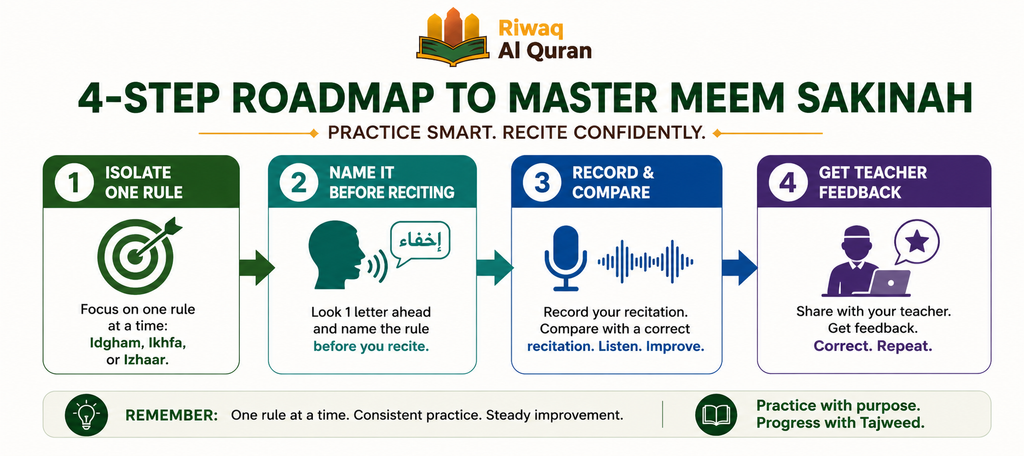
The Four-Step Practice Sequence
Mastering the rules of Meem Sakinah is not built through random reading — it requires a structured approach that locks each rule into muscle memory before moving to the next. Follow this proven four-step sequence to turn your recurring mistakes into consistent recitation accuracy.
1. Isolate one rule per session
Trying to practice all three Meem Sakinah rules at once is the fastest way to confuse them. Dedicating full sessions to a single rule gives your mouth and mind the repetition needed to make it automatic before layering in the next.
- Spend three to five practice sessions working on just one rule before moving to the next.
- For Ikhfa Shafawi: recite Surah Al-Fil verse 4 repeatedly in slow motion, focusing entirely on the هِمْ بِ transition.
- For Izhaar: work through the opening verses of Surah Al-Inshirah, listening for complete Meem clarity before each Noon and Ta.
- Full immersion in one rule before switching builds clean, separate muscle memory rather than confusion between the three.
2. Name the rule aloud before you recite
Your brain recognizes a rule far faster when you verbalize it than when you simply read past it. Saying the rule out loud before each verse creates a conscious checkpoint that gradually rewires into instant, effortless recognition.
- Before reading each verse containing Meem Sakinah, say out loud which rule applies and why — for example: “This is Ikhfa because Ba follows”.
- This forces conscious recognition and accelerates the process of making each rule automatic.
- Over time, the conscious naming step becomes unnecessary because the recognition fires before the word is spoken.
3. Record and compare
Your ear during live recitation is too occupied with pronunciation to catch subtle errors in Ghunnah length or Izhaar clarity. Recording yourself and comparing it to a certified Sheikh’s recitation gives you the objective feedback that self-correction alone cannot provide.
- Record your recitation, then listen to a certified Sheikh reciting the same verses.
- Focus specifically on: Is the Ghunnah reaching two full counts? Is the Izhaar completely clean?
- A practical Ghunnah check: tap two fingers against your knee during the nasal resonance — if the sound covers both taps evenly at a steady pace, the duration is correct.
- The ear catches what the mind misses during live recitation — this step surfaces errors that feel correct as they are happening.
4. Get corrected in real time.
No amount of solo practice replaces the precision of a trained teacher listening to your recitation live. Real-time correction catches the exact moment an error occurs and fixes it before it becomes a habit.
- A qualified teacher identifies within seconds whether your Ghunnah reaches two full counts, whether your lips are positioned correctly for Ikhfa, or whether Ghunnah is leaking into Izhaar.
- Riwaq Al Quran’s Online Tajweed Classes deliver one-on-one live sessions built around your specific recitation, with a certified instructor correcting your Meem Sakinah verse by verse.
- For students building recitation fluency alongside accuracy, the Online Quran Recitation Course provides structured expert-led instruction at your own pace.
Start Reciting the Quran Correctly — Join Riwaq Al Quran
Every step you take toward correct Tajweed is a step toward fulfilling one of the most honored roles described in the Sunnah. The rules you are learning today are not just a personal achievement — they are a foundation you will one day pass on to others.
The Prophet ﷺ said:
«خَيْرُكُمْ مَنْ تَعَلَّمَ الْقُرْآنَ وَعَلَّمَهُ»
“The best of you are those who learn the Quran and teach it.” — Narrated by Uthman ibn Affan رضي الله عنه. Sahih Al-Bukhari (5027)
Learning Tajweed — including every rule of Meem Sakinah — is a direct path toward the quality described in this hadith. The journey begins with personal study, and becomes complete when what has been learned is passed on to others. Every rule you master is a rule you can one day teach.
Riwaq Al Quran is a comprehensive online platform offering personalized Quran, Arabic, and Islamic Studies classes for individuals of all ages and backgrounds. Experienced instructors use a structured curriculum covering Tajweed, Tafsir, and Memorization, with live one-on-one sessions that allow for direct correction and real interaction between students and teachers.
Watch real moments from our live sessions at Riwaq Al Quran and see how we bring learning to life:
Available courses include:
- Online Tajweed Classes — Master Tajweed rules for beautiful Quranic recitation
- Online Quran Recitation Course — Enhance recitation skills with expert-led instruction
- Quran Memorization Online Course — Memorize the Quran effectively with a structured program
- Online Qirat Course — Explore the ten Qirat styles with comprehensive instruction
- Online Tafseer Course — Understand the meanings of the Quran in depth
- Noorani Qaida Online — Build Quranic reading foundations from the ground up
- Online Quran Classes for Kids — Interactive learning designed for young learners
- Online Arabic Courses — Learn the language of the Quran
- Online Ijazah Courses — Earn certified authorization in Quranic recitation
- Online Islamic Studies Courses — Deepen your Islamic knowledge
- Online Courses for Kids — Age-appropriate Islamic education
No commute. No rigid schedule. Sessions are built entirely around your pace and your time.

Conclusion
The Meem Sakinah rules are among the most logical and learnable in all of Tajweed. There are exactly three, and every one is determined by a single piece of information: the letter immediately following the silent Meem.
- Idgham Shafawi: Meem merges into a following Meem — one stressed Meem with Ghunnah for two counts.
- Ikhfa Shafawi: Meem is concealed before Ba — lips rest lightly while Ghunnah resonates for two counts.
- Izhaar Shafawi: Meem is pronounced fully and clearly before all remaining 26 letters — no Ghunnah, no blending.
The three most common errors — adding Ghunnah in Izhaar, pressing the lips too hard in Ikhfa, and reading the rule from the wrong direction — all share one solution: train the eye to move forward to the next letter every time a Meem Sakinah appears. That single habit, built through the four-step practice sequence above, is what separates students who know the rules from those who apply them without thinking.
And as the hadith of the Prophet ﷺ reminds us, every effort made in recitation — including every stumble through a difficult rule — is already counted as reward. Start the journey, apply the practice sequence, and trust the process.
Frequently Asked Questions
The questions below address the most common points of confusion about Meem Sakinah — from basic definitions to the distinctions that are hardest to keep straight during recitation. Each answer is written to be direct and usable on its own.
What are the 3 Meem Sakinah rules?
The three Meem Sakinah rules are Idgham Shafawi (Meem Sakinah followed by Meem — full merge with Ghunnah), Ikhfa Shafawi (Meem Sakinah followed by Ba — concealment with Ghunnah), and Izhaar Shafawi (Meem Sakinah followed by any of the other 26 Arabic letters — clear pronunciation with no Ghunnah). Every rule is determined by the letter that immediately follows the silent Meem.
What is the difference between Ikhfa Shafawi and Izhaar Shafawi?
Ikhfa Shafawi occurs only before the letter Ba and requires Ghunnah for two counts with the lips held in light contact. Izhaar Shafawi occurs before all other letters and requires the Meem to be fully and clearly pronounced with no nasal resonance. The two rules use opposite lip pressure and produce opposite outcomes — one conceals, one clarifies.
Is there Ghunnah in Izhaar Shafawi?
No. Izhaar Shafawi requires complete clarity — no Ghunnah, no nasal sound, no blending with the following letter. Adding Ghunnah in Izhaar is one of the most widespread Tajweed errors, particularly before Waw and Fa, because those letters are articulated near the lips and feel similar to Meem.
What does Shafawi mean in Tajweed?
Shafawi comes from the Arabic word شَفَتَانِ, meaning “the two lips.” It refers to rules that originate at the lips as the primary point of articulation. All three Meem Sakinah rules are classified as Shafawi because the Meem itself is produced by the lips coming together — making the lips the defining factor in every rule that governs it.
What is the difference between Meem Sakinah rules and Noon Sakinah rules?
Noon Sakinah has four rules — Izhaar, Idgham, Iqlab, and Ikhfa — each involving multiple trigger letters. Meem Sakinah has three rules with only two specific trigger letters (Meem and Ba), while all remaining letters produce Izhaar. Noon Sakinah originates at the tip of the tongue; Meem Sakinah originates entirely at the lips, which is why all its rules are Shafawi. A full breakdown is available in the Noon Sakinah and Tanween rules guide.
How long should the Ghunnah last in Meem Sakinah?
In both Idgham Shafawi and Ikhfa Shafawi, the Ghunnah lasts exactly two counts — two steady beats at a consistent recitation pace. A practical calibration method during practice: tap two fingers against your knee while holding the nasal resonance. If the sound covers both taps evenly without cutting short or extending beyond them, the duration is correct.