Is the Quran scientifically proven? The honest answer is that the Quran is a book of guidance, not a science textbook — so it is not “proven” the way a scientific paper is. Yet many of its verses describe natural phenomena in ways strikingly consistent with discoveries made more than a thousand years later, from embryonic development to the expanding universe. That correspondence is one part of the broader study of the miracles of the Quran.
This article examines ten of the most cited scientific facts in the Quran, gives the exact verse in Arabic with its reference and translation, and explains where the alignment is strong, where it is a matter of interpretation, and how careful scholars advise approaching the topic. The goal is accuracy, not cheerleading — because overstated claims damage the very case they try to make.
If you have wondered whether the Quran’s descriptions of nature could have been known in the 7th century, the verses and the balanced analysis below give you a clear, trustworthy starting point.
What you’ll learn in this article
- Whether the Quran is “scientifically proven” — and what that phrase can and cannot mean.
- Ten scientific facts in the Quran, each with the verse, reference, and translation.
- Why the Quran points to nature at all, and where the science is settled versus interpretive.
- Whether the “scientific miracles” are real or exaggerated — an honest look.
- A simple framework for judging any claim before you share it.
Table of Contents
Is the Quran scientifically proven?
The Quran is not scientifically proven in the sense of being a scientific document, because its purpose is spiritual and moral guidance, not empirical instruction. What can be said accurately is that numerous verses describe natural phenomena in language consistent with modern science — a feature Muslims understand as a sign (ayah) of divine authorship.
This distinction matters. Classical Quran scholarship reads these verses primarily for guidance, and the field of “scientific interpretation” (al-i’jaz al-‘ilmi) is itself debated among Muslim scholars. Many caution against tying belief too tightly to current science, since scientific understanding changes while the Quran does not.
Read this way, the verses below are best treated as points of reflection that align with established knowledge — not as laboratory proofs. That framing is both more defensible and closer to how the Quran presents itself.
Why Does The Quran Describe The Natural World?
The Quran points to nature not to teach science, but to lead the reader from the creation to the Creator. It repeatedly presents the natural world as evidence (ayat, “signs”) meant to prompt reflection, which is the lens through which every verse below should be read.
The Quran even frames this as a promise about future discovery:
(سَنُرِيهِمْ ءَايَٰتِنَا فِى ٱلْءَافَاقِ وَفِىٓ أَنفُسِهِمْ حَتَّىٰ يَتَبَيَّنَ لَهُمْ أَنَّهُ ٱلْحَقُّ)
“We will show them Our signs in the horizons and within themselves until it becomes clear to them that it is the truth.” — Surah Fussilat (41:53)
This verse is the theological anchor of the whole subject: it invites people to look outward at the universe and inward at themselves as sources of evidence. It also calls readers to think, not merely to marvel:
(إِنَّ فِى خَلْقِ ٱلسَّمَٰوَٰتِ وَٱلْأَرْضِ وَٱخْتِلَٰفِ ٱلَّيْلِ وَٱلنَّهَارِ لَءَايَٰتٍ لِّأُو۟لِى ٱلْأَلْبَٰبِ)
“Indeed, in the creation of the heavens and the earth and the alternation of night and day are signs for people of understanding.” — Surah Al-Imran (3:190)
The Quran points to creation to turn the heart toward its Creator — this short reflection sits at the center of that idea:
Because of this emphasis, the Quran treats the pursuit of knowledge as a virtue, and the Prophet ﷺ tied it directly to reward:
(مَنْ سَلَكَ طَرِيقًا يَلْتَمِسُ فِيهِ عِلْمًا سَهَّلَ ٱللَّهُ لَهُ بِهِ طَرِيقًا إِلَى ٱلْجَنَّةِ)
“Whoever travels a path seeking knowledge, Allah will make easy for him a path to Paradise.” — Sahih Muslim 2699
Together these establish the correct posture: the verses on nature are invitations to study and reflect, and studying them is itself an act of worship — one of the many benefits of seeking knowledge in Islam, not a hunt for scientific trophies.
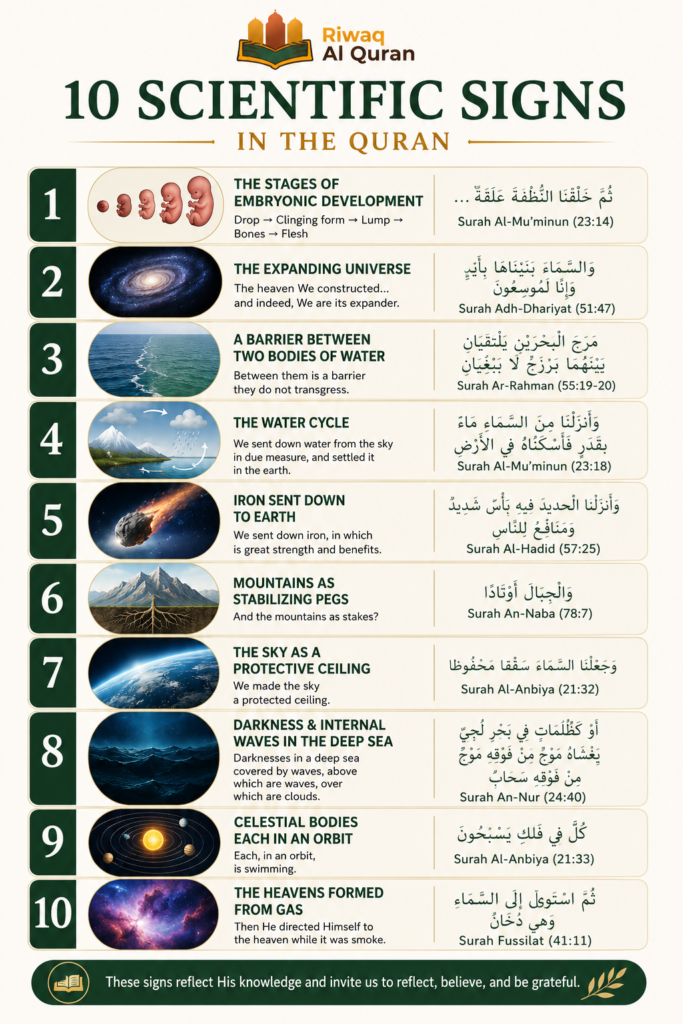
10 scientific facts in the Quran and the verses behind them
The ten examples below are the most frequently cited Quranic verses where the Quran’s description of nature matches modern understanding. Each entry gives the verse, its reference, and an honest note on how strong the correspondence is.
Here they are, one by one.
1. The stages of embryonic development
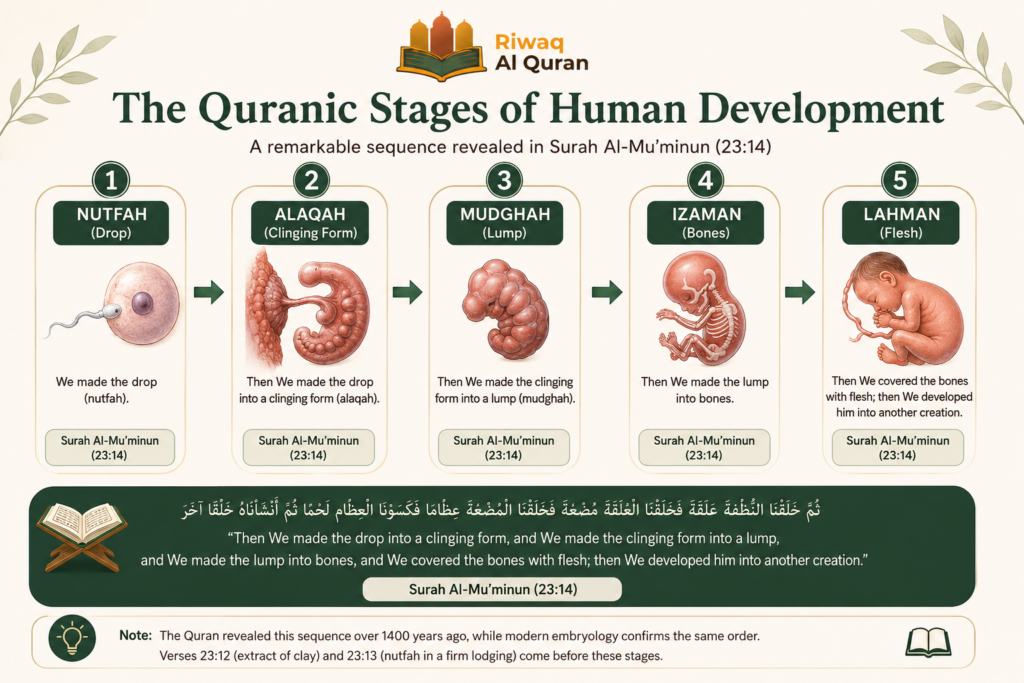
The Quran describes human creation as a sequence of distinct stages, using the terms nutfah (drop), alaqah (clinging form), and mudghah (lump). The order it gives — drop, clinging form, lump, bones, then flesh over the bones — tracks the recognizable phases of early development.
(ثُمَّ خَلَقْنَا ٱلنُّطْفَةَ عَلَقَةً فَخَلَقْنَا ٱلْعَلَقَةَ مُضْغَةً فَخَلَقْنَا ٱلْمُضْغَةَ عِظَٰمًا فَكَسَوْنَا ٱلْعِظَٰمَ لَحْمًا ثُمَّ أَنشَأْنَٰهُ خَلْقًا ءَاخَرَ)
“Then We made the drop into a clinging form, and We made the clinging form into a lump, and We made the lump into bones, and We covered the bones with flesh; then We developed him into another creation.” — Surah Al-Mu’minun (23:14)
The strength here is the ordered sequence. Note the correct references: the extract of clay is verse 23:12, the nutfah settling in a firm lodging is 23:13, and the staged development above is 23:14 — a detail many articles get wrong. The precise translation of alaqah (“clinging form” vs. “clot”) is discussed among scholars, so present it as the Quran’s terminology, not a fixed medical claim.
2. The expanding universe
The Quran describes the heaven as being continually extended, which many Muslims connect to the discovery that the universe is expanding.
(وَٱلسَّمَآءَ بَنَيْنَٰهَا بِأَيْدٍ وَإِنَّا لَمُوسِعُونَ)
“And the heaven We constructed with strength, and indeed, We are its expander.” — Surah Adh-Dhariyat (51:47)
Edwin Hubble’s observations in 1929 established that galaxies are receding and space itself is expanding. The Arabic musi’un carries meanings of both “expanding” and “having vast capability,” so classical and modern readings differ — the cosmological reading is a reflection many find compelling, offered here as interpretation.
3. A barrier between two bodies of water
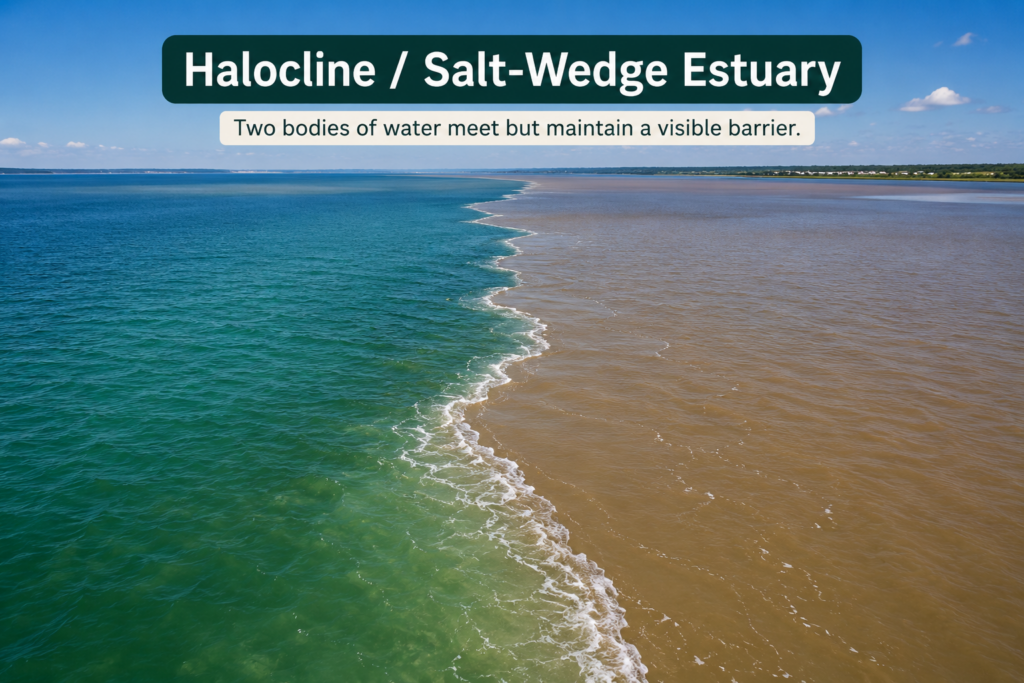
The Quran describes two seas that meet yet keep a barrier between them, so neither overwhelms the other.
(مَرَجَ ٱلْبَحْرَيْنِ يَلْتَقِيَانِ بَيْنَهُمَا بَرْزَخٌ لَّا يَبْغِيَانِ)
“He released the two seas, meeting side by side; between them is a barrier they do not transgress.” — Surah Ar-Rahman (55:19–20)
Oceanography confirms that water masses of different salinity, temperature, and density resist immediate mixing, forming boundaries such as haloclines and the sharp fronts seen in salt-wedge estuaries. The water does eventually mix, so the accurate framing is “resists mixing at a boundary,” not “never mixes.”
4. The water cycle
The Quran describes rain sent down in due measure and stored in the earth — an outline of the hydrological cycle.
(وَأَنزَلْنَا مِنَ ٱلسَّمَآءِ مَآءً بِقَدَرٍ فَأَسْكَنَّٰهُ فِى ٱلْأَرْضِ)
“And We sent down water from the sky in due measure, and settled it in the earth.” — Surah Al-Mu’minun (23:18)
Other verses add evaporation, cloud formation, and rainfall. The full cycle was only formally described in the 17th century, making the Quran’s repeated, accurate references to it a genuinely strong correspondence.
5. Iron sent down to Earth
The Quran states that iron was “sent down,” and mentions both its strength and its benefits for people.
(وَأَنزَلْنَا ٱلْحَدِيدَ فِيهِ بَأْسٌ شَدِيدٌ وَمَنَٰفِعُ لِلنَّاسِ)
“And We sent down iron, in which is great strength and benefits for the people.” — Surah Al-Hadid (57:25)
Scientifically, iron is forged inside massive stars and dispersed by supernova explosions, reaching Earth during its formation and via meteorites. A common overclaim is that iron is “purely extraterrestrial”; the accurate statement is that all of Earth’s iron ultimately originated in space, which is the reflection this verse invites.
Verses like these are why so many learners want to study the Quran’s meanings closely — and a structured Tafsir course with a qualified teacher is the clearest way to understand them in their proper context.
6. Mountains as stabilizing pegs
The Quran likens mountains to pegs or stakes set into the earth.
(وَٱلْجِبَالَ أَوْتَادًا)
“And the mountains as stakes?” — Surah An-Naba (78:7)
Geology shows that mountains have deep “roots” extending into the crust, and the principle of isostasy describes how these roots help balance the crust. The peg imagery aligns well with the idea of mountains as stabilizing structures rather than mere surface features.
7. The sky as a protective ceiling
The Quran calls the sky a “protected ceiling,” which corresponds to the atmosphere’s shielding role.
(وَجَعَلْنَا ٱلسَّمَآءَ سَقْفًا مَّحْفُوظًا)
“And We made the sky a protected ceiling.” — Surah Al-Anbiya (21:32)
Earth’s atmosphere filters harmful ultraviolet and cosmic radiation and burns up the vast majority of incoming meteoroids. Describing the sky as a guarded canopy is a fitting match for this protective function.
8. Darkness and internal waves in the deep sea
The Quran describes the deep sea as layered darkness with waves above waves — a picture that matches deep-ocean conditions.
(أَوْ كَظُلُمَٰتٍ فِى بَحْرٍ لُّجِّىٍّ يَغْشَىٰهُ مَوْجٌ مِّن فَوْقِهِۦ مَوْجٌ مِّن فَوْقِهِۦ سَحَابٌ)
“Or like darknesses in a deep sea covered by waves, upon which are waves, over which are clouds.” — Surah An-Nur (24:40)
Sunlight is absorbed with depth until the deep sea is in near-total darkness, and oceanographers have identified internal waves that form between water layers of different density, distinct from the surface waves above them. The verse’s layered imagery reflects both features.
9. Celestial bodies each in an orbit
The Quran states that the sun and moon each move in an orbit, using a word that conveys floating or swimming through space.
(كُلٌّ فِى فَلَكٍ يَسْبَحُونَ)
“Each, in an orbit, is swimming.” — Surah Al-Anbiya (21:33)
Modern astronomy confirms that celestial bodies travel in defined orbital paths, and the sun itself moves through the galaxy. The term falak (orbit) and the verb “swimming” together match orbital motion through space closely.
10. The heavens formed from gas
The Quran describes the heaven as having been “smoke” before it was shaped, which many connect to the gaseous state of the early universe.
(ثُمَّ ٱسْتَوَىٰٓ إِلَى ٱلسَّمَآءِ وَهِىَ دُخَانٌ)
“Then He directed Himself to the heaven while it was smoke.” — Surah Fussilat (41:11)
Cosmology holds that stars and galaxies condensed from vast clouds of gas and dust (nebulae). The description of the early heaven as dukhan (smoke) is offered as a reflection consistent with this gaseous origin.
Are the Quran’s scientific miracles real or exaggerated?
The honest answer is that some correspondences are strong and others are overstated — and telling them apart is what makes the topic credible. Critics rightly point out that vague verses are sometimes stretched to fit whatever science is currently popular, a pattern called “reading science back into the text.”
The modern “scientific miracle” movement (al-i’jaz al-‘ilmi) was popularized in the 20th century and grew rapidly online, which is exactly why weak claims spread alongside strong ones — the same caution applies to related genres like the prophecies of the Quran and hadith and Quranic numerology. A number of Muslim scholars have themselves criticized the trend for tying eternal scripture to provisional science.
The strongest examples share two features: the classical commentators already read the verse in the relevant way before the modern science existed, and the science itself is settled rather than contested. The water cycle, orbital motion, and the deep sea’s darkness meet that bar well; more elaborate claims often do not. Holding this line protects both scientific honesty and the credibility of the faith.
How To Evaluate A “Scientific Miracle” Claim Before You Share It?
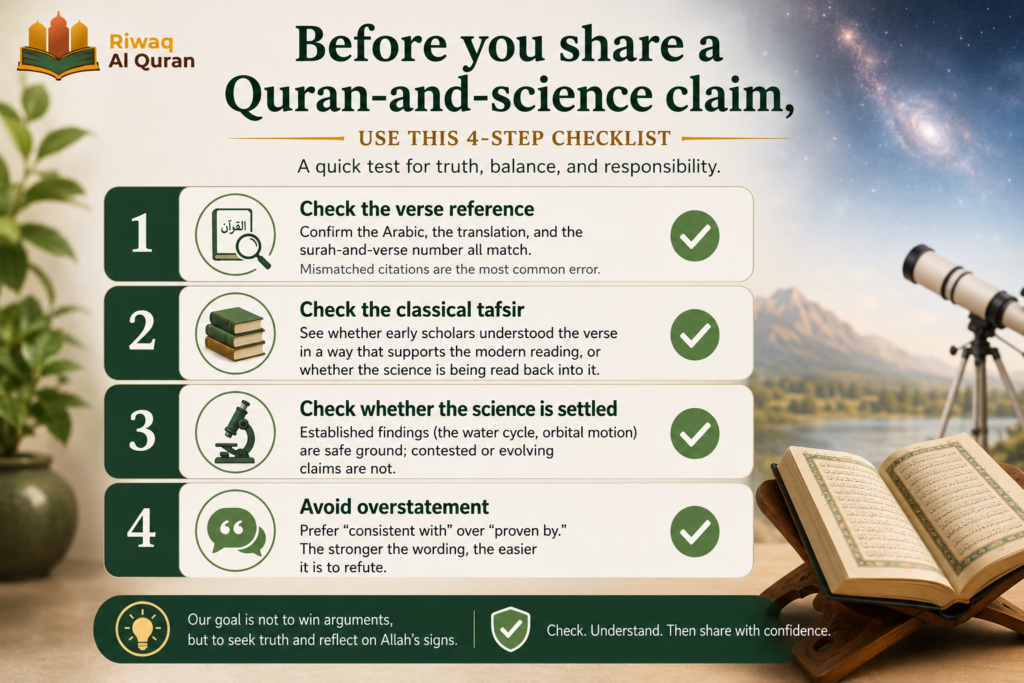
Not every “scientific miracle” claim online is sound, and sharing a weak one can undermine trust. Before you accept or forward a claim linking a verse to science, run it through four checks.
Use this quick test:
- Check the verse reference — Confirm the Arabic, the translation, and the surah-and-verse number all match. Mismatched citations are the most common error.
- Check the classical tafsir — See whether early scholars understood the verse in a way that supports the modern reading, or whether the science is being read back into it.
- Check whether the science is settled — Established findings (the water cycle, orbital motion) are safe ground; contested or evolving claims are not.
- Avoid overstatement — Prefer “consistent with” over “proven by.” The stronger the wording, the easier it is to refute.
This framework is the single most useful habit for anyone studying the Quran and science, because it protects both scientific accuracy and the credibility of the faith argument.
How should Muslims approach science in the Quran?
Muslims are encouraged to reflect on the natural world as a sign of the Creator, while keeping the Quran’s primary purpose — guidance — in view. A balanced approach avoids two extremes: dismissing these correspondences entirely, and overselling them as decisive proofs.
Four principles keep that balance:
- Treat the verses as invitations to reflect, not as a science syllabus. The Quran points to creation to turn hearts toward the Creator.
- Hold scientific claims lightly, since human knowledge changes and the Quran does not. Anchor faith in the Quran, not in the latest paper.
- Use accuracy as an act of integrity — a carefully stated correspondence is more convincing, and more honest, than an exaggerated one.
- Let wonder lead to study. Reflection on these signs is most valuable when it deepens your understanding of the Quran as a whole.
Read the Quran the way it was meant to be understood
Notice what made this article trustworthy: every verse checked against its Arabic, its reference, and its classical meaning. That’s the difference between understanding the Quran and repeating a claim you saw online — and it’s a difference you can only build with a teacher who knows the context.
That is exactly what Riwaq Al Quran gives you. Sit one-to-one with a qualified teacher, study these verses in their full Tafsir, and learn to tell a sound interpretation from a stretched one — from home, at your own pace, with someone who can actually answer your questions. Start with a free trial and read the Quran with confidence, not guesswork.

Where to start with Riwaq Al Quran?
Whatever drew you to this topic — the meanings, the language, or the recitation — there’s a place to begin at Riwaq Al Quran, where qualified instructors teach one-to-one across Quran, Arabic, and Islamic Studies for every age and level.
Start with the course that matches your goal:
- Understand the verses → Online Tafseer Course — go into their meanings in context.
- Read them in the original → Online Arabic courses — study the language of the Quran.
- Start from the basics → Noorani Qaida Online — learn Quranic reading from the letters up.
- Refine your recitation → Online Quran Recitation Course and Online Tajweed Classes — read fluently and correctly.
- Carry the Quran with you → Quran Memorization Course and Online Qirat Course — memorize and explore the ten styles.

Or explore by who’s learning:
- Online courses for kids
- Online Quran classes for kids and adults
- Online Islamic Studies courses
- Online Ijazah courses
See what studying with a qualified Riwaq Al Quran teacher looks like before you start your free trial:
Conclusion
So, is the Quran scientifically proven? Not as a science textbook — and it never claimed to be one. What the verses in this article show is something more measured and, for many, more remarkable: a 7th-century text describing embryonic stages, the expanding universe, the water cycle, and the layered darkness of the deep sea in ways that align with knowledge confirmed centuries later.
The honest position is the strongest one. Present these correspondences as signs consistent with modern science, check every verse and claim carefully, and keep the Quran’s real purpose — guidance — at the center. Approached this way, the scientific facts in the Quran deepen reflection without resting faith on shifting ground.
Let these verses be a beginning, not an endpoint: study them in context, and let wonder turn into real understanding.
Frequently asked questions about the Quran and science
Below are the most common questions about whether the Quran is scientifically proven, answered directly.
Is the Quran scientifically proven?
The Quran is not scientifically proven in the sense of being a science textbook, because its purpose is guidance. However, many verses describe natural phenomena — such as embryonic development and the expanding universe — in ways consistent with modern scientific discoveries.
What are the scientific facts mentioned in the Quran?
The Quran references embryonic stages, the expanding universe, a barrier between seas, the water cycle, iron’s origin, mountains as pegs, the protective sky, deep-sea darkness, celestial orbits, and the gaseous origin of the heavens. Each is tied to a specific verse.
Does the Quran mention embryology?
Yes, the Quran describes human development as ordered stages — nutfah (drop), alaqah (clinging form), and mudghah (lump), followed by bones and flesh — in Surah Al-Mu’minun (23:12–14). The sequence tracks recognizable phases of early development.
Did the Quran mention the Big Bang or an expanding universe?
The Quran describes the heaven as continually extended in Surah Adh-Dhariyat (51:47), which many connect to cosmic expansion, and as originally “smoke” in Surah Fussilat (41:11). These are interpretive correspondences, not explicit scientific statements.
What is the strongest scientific correspondence in the Quran?
The clearest examples are the water cycle, orbital motion of celestial bodies, and the layered darkness of the deep sea, because the science is settled and classical scholars already read the verses that way. These meet the bar better than more elaborate claims.
Should Muslims rely on science to prove the Quran?
No, scholars advise against tying faith to changing science. The verses are best seen as signs that invite reflection, with belief anchored in the Quran itself rather than in scientific findings that may be revised over time.