| Key Takeaways |
| Prophet Hud was sent to the people of ‘Aad, an ancient Arab tribe known for their immense physical power and architectural achievements. |
| The story of Prophet Hud appears across multiple Quranic surahs, with Surah Hud (Chapter 11) providing the most detailed and continuous narrative account. |
| Prophet Hud’s name is mentioned by name five times in the Quran, according to classical scholars of Quranic sciences. |
| The people of ‘Aad were destroyed by a violent, freezing wind that lasted seven nights and eight days, as described explicitly in the Quran. |
| Prophet Hud’s core message — pure monotheism and abandoning arrogance — remains one of the Quran’s most repeated warnings to powerful civilizations. |
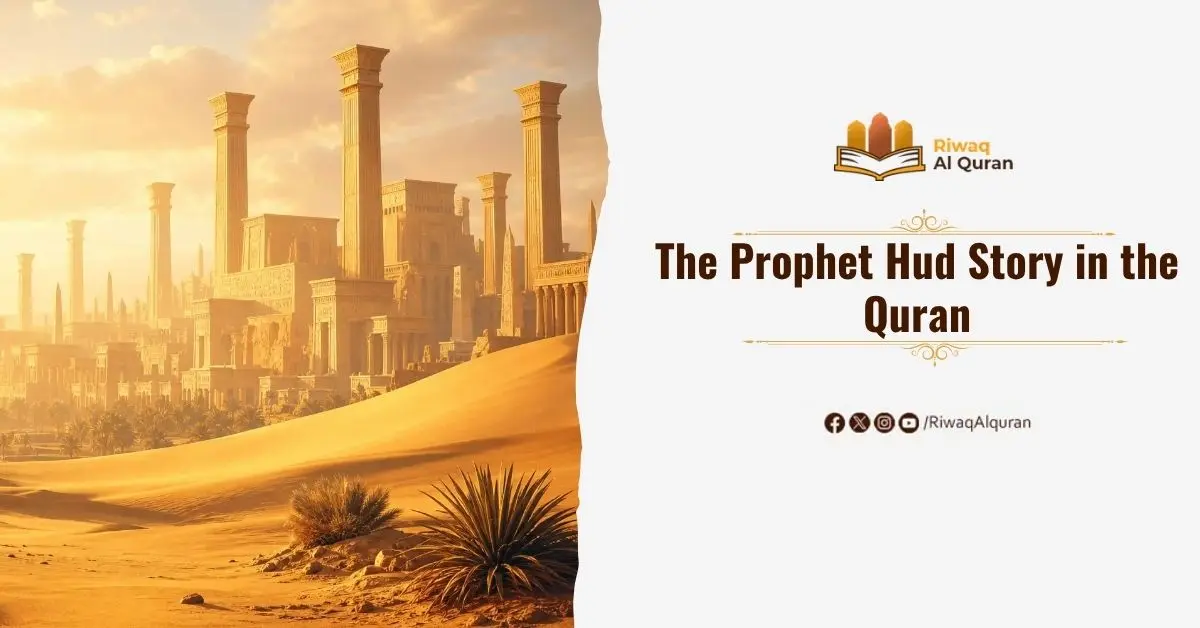
The people of ‘Aad were not a forgotten tribe — they were a civilization that shook the earth. Towering in build, dominant in power, and breathtaking in their constructions, they believed no force could humble them.
Into that pride walked Prophet Hud, one of Allah’s chosen messengers, carrying a message as simple as it was unwelcome: worship Allah alone.
Table of Contents
1. A Mighty People Emerged from the Descendants of Noah
The story of ‘Aad begins in the aftermath of the great flood. The people of ‘Aad were descendants of the generation that followed Prophet Nuh (Noah), establishing themselves in the region known as Al-Ahqaf — a vast stretch of curved sand dunes located in the southern Arabian Peninsula, corresponding roughly to the area of present-day Yemen and Oman.
Classical Quranic exegetes, including Ibn Kathir in his Tafsir al-Qur’an al-‘Azim, describe the people of ‘Aad as a people of extraordinary physical stature and strength.
Allah had blessed them with powerful bodies, abundant rain, fertile land, and impressive architectural skill. Their cities featured towering pillars that became their defining symbol in the Quran:
أَلَمْ تَرَ كَيْفَ فَعَلَ رَبُّكَ بِعَادٍ إِرَمَ ذَاتِ ٱلْعِمَادِ ٱلَّتِى لَمْ يُخْلَقْ مِثْلُهَا فِى ٱلْبِلَـٰدِ
Alam tara kayfa fa’ala rabbuka bi-‘Aad, Irama dhati l-‘imad, allati lam yukhlaq mithluhā fi l-bilad
“Have you not considered how your Lord dealt with ‘Aad — Iram — who had lofty pillars, the like of whom had never been created in the land?” (Al-Fajr 89:6-8)
Their blessings were immense. But blessings without gratitude breed arrogance — and arrogance, the Quran consistently shows, invites reckoning.
2. Allah Sent Prophet Hud as Their Own Brother from Among Them
When the people of ‘Aad had strayed fully into polytheism and oppression, Allah sent them a messenger from within their own community. This is the consistent Quranic pattern — prophets sent from among their own people, sharing their language, lineage, and lived reality.
Prophet Hud was an Arab, from the tribe of ‘Aad itself. The Quran introduces him with a phrase that carries deliberate warmth:
وَإِلَىٰ عَادٍ أَخَاهُمْ هُودًا
Wa ilā ‘Ādin akhāhum Hūdā
“And to ‘Aad [We sent] their brother Hud.” (Al-A’raf 7:65)
The word akhāhum — their brother — is not merely biological. It signals that Hud was not a foreign voice imposing alien ideas. He was one of them, raised among them, known to them. This made his message harder to dismiss and their rejection more deliberate.
At Riwaq Al Quran, our Azhari-certified tutors often highlight this verse when teaching students how the Quran builds emotional context through word choice — a dimension that deepens both Quran recitation and understanding when studied with proper guidance through Riwaq’s recitation course.
Book Your Free Session in Riwaq’s Recitation Course

3. Prophet Hud Called His People to Pure Monotheism and Gratitude
Prophet Hud’s message to ‘Aad was direct and without compromise. He called them to three essential truths: worship Allah alone, abandon the worship of idols, and fear Allah’s punishment.
Prophet Hud reminded them that their power — their towering bodies, their fertile lands, their architectural mastery — was a gift from Allah, not a product of their own superiority.
The Quran records his words:
وَٱذْكُرُوٓا۟ إِذْ جَعَلَكُمْ خُلَفَآءَ مِنۢ بَعْدِ قَوْمِ نُوحٍۢ وَزَادَكُمْ فِى ٱلْخَلْقِ بَسْۜطَةً ۖ فَٱذْكُرُوٓا۟ ءَالَآءَ ٱللَّهِ لَعَلَّكُمْ تُفْلِحُونَ
Wadhkurū idh ja’alakum khulafā’a min ba’di qawmi Nūḥin wa zādakum fi l-khalqi basṭatan fadh-kurū ālā’a Allāhi la’allakum tufliḥūn
“And remember when He made you successors after the people of Noah and increased you in stature extensively. So remember the favors of Allah that you might succeed.” (Al-A’raf 7:69)
Hud did not attack their achievements. He redirected their pride toward its true source — and invited gratitude rather than rebellion. This is the prophetic method: wisdom before confrontation, reminder before warning.
Experience Riwaq Al Quran Classes
Watch real moments from our live sessions at Riwaq Al Quran and see how we bring learning to life. These clips highlight our interactive, student-focused approach designed to keep learners engaged, motivated, and actively involved in every step of their educational journey.
4. The People of ‘Aad Rejected Prophet Hud with Arrogance and Mockery
The response of ‘Aad to Prophet Hud was a masterclass in the psychology of rejection that the Quran documents with piercing clarity. They leveled three accusations at him: that he was foolish, that he was a liar, and that their gods had afflicted him with madness.
The Quran records their reply:
قَالُوا۟ يَـٰهُودُ مَا جِئْتَنَا بِبَيِّنَةٍۢ وَمَا نَحْنُ بِتَارِكِىٓ ءَالِهَتِنَا عَن قَوْلِكَ وَمَا نَحْنُ لَكَ بِمُؤْمِنِينَ
Qālū yā Hūdu mā ji’tanā bibayyinatin wa mā naḥnu bitārikī ālihatinā ‘an qawlika wa mā naḥnu laka bimu’minīn
“They said, ‘O Hud, you have not brought us clear evidence, and we are not ones to abandon our gods on your word. We are not believers in you.'” (Hud 11:53)
Their rejection was not based on lack of evidence — it was rooted in pride. They could not imagine that their gods, their traditions, and their power could be subject to a higher authority. This is precisely the arrogance the Quran identifies as the defining sin of ‘Aad.
At Riwaq Al Quran, our Online Quran Tafseer Course pairs students with Azhari-certified tutors who walk through the historical, linguistic, and spiritual dimensions of these stories in structured, accessible sessions designed for non-Arabic speakers.
Enroll Now in Riwaq’s Tafseer Course with a FREE trial

5. Prophet Hud Stood Firm and Declared His Complete Reliance on Allah
Faced with ridicule, threats, and the collective rejection of his entire people, Prophet Hud’s response stands as one of the most powerful declarations of tawakkul — reliance on Allah — recorded in the Quran.
He told his people plainly:
إِنِّى أُشْهِدُ ٱللَّهَ وَٱشْهَدُوٓا۟ أَنِّى بَرِىٓءٌ مِّمَّا تُشْرِكُونَ
Innī ushhidu Allāha washhadū annī barī’un mimmā tushrikūn
“Indeed, I call Allah to witness and witness [yourselves] that I am free from whatever you associate with Allah.” (Hud 11:54)
This verse is studied in Islamic scholarship as an example of prophetic decisiveness — a complete and public disavowal of shirk.
Hud did not soften his position to preserve social acceptance. He named his stance clearly and called Allah as his witness. His courage was not defiance — it was rooted in certainty that Allah’s protection was enough.
For students building their connection to these Quranic narratives, learning to understand such verses in their original Arabic context transforms recitation from mechanical reading into engaged worship.
Our Quranic Arabic Course is specifically designed to help non-Arabic speakers access exactly this depth.
Book Your FREE Trial in Riwaq’s Quranic Arabic Classes
6. The Punishment Arrived — A Devastating Wind That Erased a Civilization
When ‘Aad refused every call and doubled their arrogance, the divine decree came. The punishment of ‘Aad was not gradual — it was absolute and complete.
Allah sent against them a wind unlike any force they had ever confronted, despite their legendary physical strength.
The Quran describes this destruction in vivid, unforgettable terms:
وَأَمَّا عَادٌ فَأُهْلِكُوا۟ بِرِيحٍۢ صَرْصَرٍ عَاتِيَةٍ سَخَّرَهَا عَلَيْهِمْ سَبْعَ لَيَالٍۢ وَثَمَـٰنِيَةَ أَيَّامٍ حُسُومًۭا
Wa ammā ‘Ādun fa-uhlikū biriḥin ṣarṣarin ‘ātiyah, sakhkharahā ‘alayhim sab’a layālin wa thamāniyata ayyāmin ḥusūmā
“And as for ‘Aad, they were destroyed by a screaming, violent wind which He imposed upon them for seven nights and eight days.” (Al-Haqqah 69:6-7)
The wind lasted seven nights and eight consecutive days. The people of ‘Aad — those towering, powerful bodies — were left fallen like hollow palm tree trunks.
Their strength, which they had mistaken for invincibility, could not save them from a wind sent by the One who created the wind itself.
| Key Details of the Punishment of ‘Aad | Description from Quran |
| Nature of the Wind | Described as ṣarṣar — screaming, bitterly cold, violent |
| Duration | Seven nights and eight days continuously |
| Effect on People | They fell like hollow, uprooted palm trunks |
| Scope of Destruction | The entire civilization of ‘Aad was obliterated |
| Quranic Source | Surah Al-Haqqah 69:6-7, Surah Al-Ahqaf 46:24-25 |
Nothing of ‘Aad remained. Their towers, their bodies, their idols — consumed entirely.
7. Prophet Hud and the Believers Were Saved by Allah’s Mercy
Among the total destruction of ‘Aad, Prophet Hud and the small group of believers who had accepted his message were saved. This is another consistent Quranic pattern: divine punishment spares the believers while encompassing the rejectors.
The Quran states:
فَأَنجَيْنَـٰهُ وَٱلَّذِينَ مَعَهُۥ بِرَحْمَةٍۢ مِّنَّا وَقَطَعْنَا دَابِرَ ٱلَّذِينَ كَذَّبُوا۟ بِـَٔايَـٰتِنَا ۖ وَمَا كَانُوا۟ مُؤْمِنِينَ
Fa-anjaynahū wa lladhīna ma’ahu biraḥmatin minnā wa qaṭa’nā dābira lladhīna kadhdhabū biāyātinā wa mā kānū mu’minīn
“So We saved him and those with him by mercy from Us and We eliminated those who denied Our signs and were not believers.” (Al-A’raf 7:72)
This verse carries enormous comfort for those who feel isolated in their faith. Hud stood largely alone in a people who rejected him completely.
Yet his small community of believers was enough — Allah’s mercy covered them fully while the punishment erased those who insisted on denial.
The story of ‘Aad in the Quran is not ultimately about destruction. It is about the enduring safety of those who choose faith regardless of what surrounds them.
Understanding such Islamic topics for youths through proper Islamic education like Riwaq’s Islamic studies course builds exactly this kind of grounded conviction.
Begin your Islamic Studies with a FREE trial lesson

Prophet Hud Story Summary
The prophet Hud story summary can be understood across three movements: blessing, warning, and consequence. Allah granted ‘Aad extraordinary gifts — strength, prosperity, architectural mastery.
Prophet Hud then sent them a prophet from their own people to redirect those gifts toward gratitude and worship. When they refused, mocked, and persisted, the gifts became irrelevant against a divine decree.
| Phase | Core Quranic Theme |
| The Blessing of ‘Aad | Allah’s generosity to a powerful civilization |
| Prophet Hud’s Call | Monotheism, gratitude, and abandoning arrogance |
| ‘Aad’s Rejection | Arrogance, mockery, and attachment to idols |
| The Divine Punishment | Complete destruction by a violent, eight-day wind |
| Salvation of the Believers | Mercy for those who believed with Hud |
The summary is not merely historical. As scholars note, Allah explicitly reminds later generations of ‘Aad’s fate as a warning — not a curiosity.
How Many Times Is Prophet Hud Mentioned in the Quran?
Prophet Hud is mentioned by name seven times in the Quran, according to classical Quranic scholarship. His name appears in: Surah Al-A’raf (7:65), Surah Hud (11:50, 11:53, 11:58, 11:60), Surah Al-Shu’ara (26:124), and Surah Al-Ahqaf (46:21). An entire surah — Surah Hud, the 11th chapter — bears his name.
The repeated mention of Hud across multiple surahs, revealed in both Makkah and Madinah, reflects how central his story is to the Quran’s broader message about the consequences of arrogance and the fate of nations that reject divine guidance.
For students engaged in Quran memorization, recognizing the recurring appearance of prophetic narratives across different surahs is an excellent technique for building connective memory — each appearance reinforces the others and deepens retention naturally.
Start your Hifz journey with a Free Trial
What Does the Name Hud Mean in Arabic?
The most accepted view among scholars of Arabic philology is that Hud is a proper name of Semitic origin used specifically for this prophet. Some scholars derived the name Hud meaning from the Arabic root h-w-d, which carries connotations of returning, repenting, or turning back — which connects thematically to his call for his people to return to Allah.
Ibn Kathir notes in his Tafsir that Hud was an Arab prophet — the first Arab messenger mentioned in the Quran — making his name part of ancient Arabic prophetic lineage.
Regardless of the precise linguistic root, his name is inseparable from his identity as the caller of ‘Aad and the survivor of their destruction.
Read Also: Stages of Revelation of the Quran
What Was Prophet Hud’s Family Tree and Lineage?
The prophet Hud family tree is recorded in classical Islamic scholarship; according to these sources, Hud’s lineage traces back to Shem (Sam), the son of Prophet Nuh (Noah). The scholarly genealogy recorded is: Hud ibn Abdullah ibn Ribah ibn Al-Jarud ibn ‘Aad ibn ‘Aws ibn Iram ibn Sam ibn Nuh.
Read Also: The Story of Khidr in the Quran
Why Students Love Learning with Riwaq Al Quran
Hear directly from our students about how Riwaq Al Quran Academy has transformed their connection with the Book of Allah. Their experiences reflect the dedication, care, and quality that guide every step of our teaching.
Read Also: The Story of Prophet Dawud in the Quran
Start Learning the Quran with Riwaq Al Quran Today
The story of Prophet Hud is embedded across the Quran — in Surah Al-A’raf, Surah Hud, Surah Al-Shu’ara, Surah Al-Ahqaf, and more. Reading it well requires not just translation but the ability to hear the Quran as it was revealed — with proper recitation, Tajweed, and contextual understanding.
At Riwaq Al Quran, our Azhari-certified tutors bring 9+ years of experience teaching non-Arabic speaking Muslims exactly this depth. Whether you want to recite more accurately or understand what you recite more deeply, we offer:
- One-on-one sessions with Al-Azhar University graduates
- Flexible 24/7 scheduling worldwide
- Online Quran Memorization Course for Hifz students
- Islamic Studies Classes for Kids and adults
- 2 Free Trial Classes — no commitment required
Start your free trial today and connect with a tutor who will guide you with the same patience and precision that has served thousands of students worldwide. Insha’Allah, your connection to the Quran’s stories begins here.
We offer courses in Online Quran & Tajweed Classes, Arabic Language, and Islamic Studies.
- Online Quran Memorization Course
- Recitation Course
- Tafseer Course
- Tajweed Classes
- Online Quran Classes for Kids.
- Ijazah Program.
- Qira’at Course.
- Arabic Language Classes.
- Islamic Studies Courses.
Enroll now for 2 Free Trial Classes

Conclusion
The prophet hud story in the Quran is far more than an account of a destroyed civilization. It is a precise, recurring divine reminder that power without gratitude, and strength without submission to Allah, carries its own end. ‘Aad had everything — and lost everything — precisely because they could not see beyond their own greatness.
Prophet Hud’s steadfastness, his calm declaration of freedom from shirk, and his ultimate salvation alongside the believers make his story one of the most instructive in the Quran. Read it slowly.
Read it with Tajweed. And let it remind you — as it reminded every generation before us — that the only security worth building is the one rooted in Allah alone.
Frequently Asked Questions About the Prophet Hud Story in the Quran
Where Is the Story of Prophet Hud Found in the Quran?
The story of Prophet Hud appears most fully in Surah Hud (Chapter 11), verses 50–60. Additional accounts appear in Surah Al-A’raf (7:65–72), Surah Al-Shu’ara (26:123–140), and Surah Al-Ahqaf (46:21–26). Together, these passages provide a complete picture of his prophethood, his call, the rejection of ‘Aad, and their final destruction.
Who Were the People of ‘Aad and Why Were They Destroyed?
The people of ‘Aad were an ancient Arab civilization descended from the post-flood generation of Prophet Nuh. They were known for immense physical strength and monumental architecture. They were destroyed because they persistently rejected the monotheistic message of Prophet Hud, worshipped idols, and responded to divine warning with arrogance and mockery instead of repentance.
What Was the Punishment of the People of ‘Aad?
Allah sent against ‘Aad a violent, freezing wind — described in the Quran as ṣarṣar (screaming and bitterly cold) — that struck them continuously for seven nights and eight days. The entire civilization was annihilated. The Quran describes them as falling like hollow palm trunks, with nothing of their power or buildings able to protect them from Allah’s decree.
How Does the Story of Prophet Hud Relate to the Story of Aad in the Quran?
The story of ‘Aad in the Quran and the story of Prophet Hud are inseparable — Hud was sent specifically to ‘Aad. His story defines their identity in the Quran: without Hud’s mission, ‘Aad appears only as an archeological memory. Through Hud, the Quran gives ‘Aad theological significance — they are the definitive example of a powerful people who received divine mercy through a prophet and chose arrogance instead.