
The difference between Idgham Kamil and Idgham Naqis is simple in principle: Idgham Kamil is a complete merging of one letter into the next, with no trace of the first letter left, while Idgham Naqis is an incomplete merging, where a feature of the first letter — usually the nasal sound Ghunnah — remains audible after the merge.
Idgham itself is one of the core rules of Tajweed, the science of correct Quranic recitation, and refers to merging a Sakin letter (a letter with no vowel) into the Mutahrik letter (a letter with a vowel) that follows it. Getting Kamil and Naqis right is a common sticking point for students, because the difference comes down to a single missing or present mark in the Mushaf.
This guide defines both types clearly, shows you how to spot each one directly from the Quran’s script, covers the three related sub-types — Mutamathilain, Mutajanisain, and Mutaqaribain — with real verse examples for each, and flags the mistakes students most often make while learning them.
What You’ll Learn in This Article
- The exact difference between Idgham Kamil and Idgham Naqis, and how to hear it.
- How to identify each type directly from the Sakin and Shada marks in the Mushaf?
- The three sub-types of Idgham based on how close two letters are in articulation.
- The specific exception that blocks Idgham even when two letters look identical.
- The most common mistakes students make when applying these rules, and how to avoid them.
Key Tajweed Terms You Need to Know Before Comparing Idgham Kamil and Idgham Naqis
A few terms need defining before the comparison makes sense, since both rules depend on them:
- Sakin letter: a letter carrying no vowel mark (no Fatha, Kasra, or Damma).
- Mutahrik letter: a letter that does carry one of those three vowels.
- Harka: the general term for any of the three vowel marks.
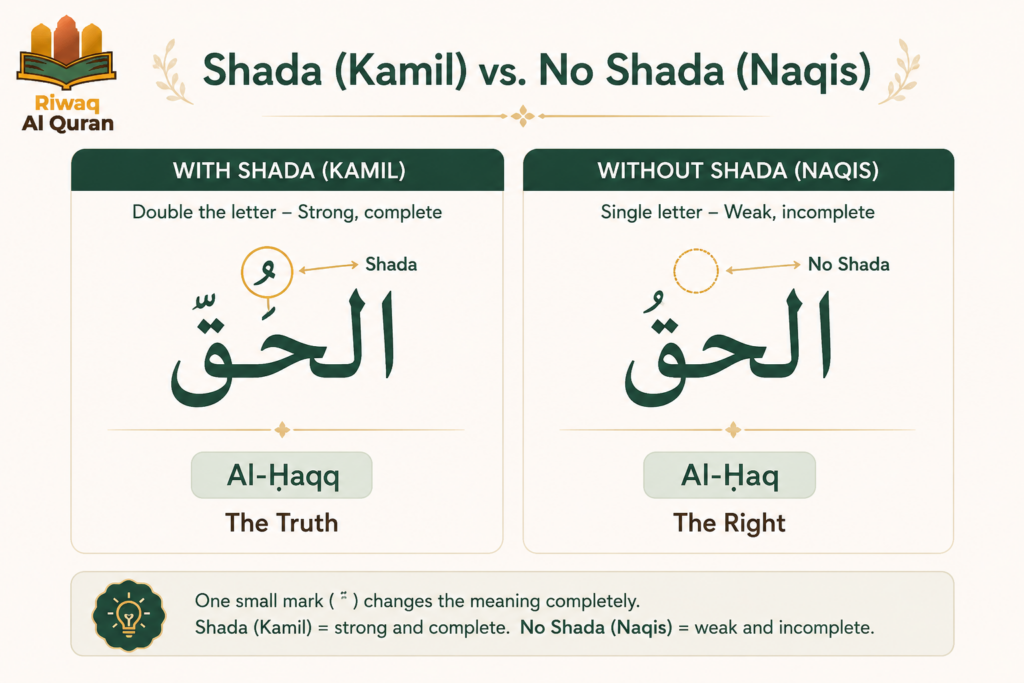
- Shada (ّ): the doubling mark placed over a letter to show it’s pronounced twice.
- Ghunnah: the nasal sound produced through the nose, associated mainly with the letters Noon and Meem.
Table of Contents
What Is Idgham Kamil?
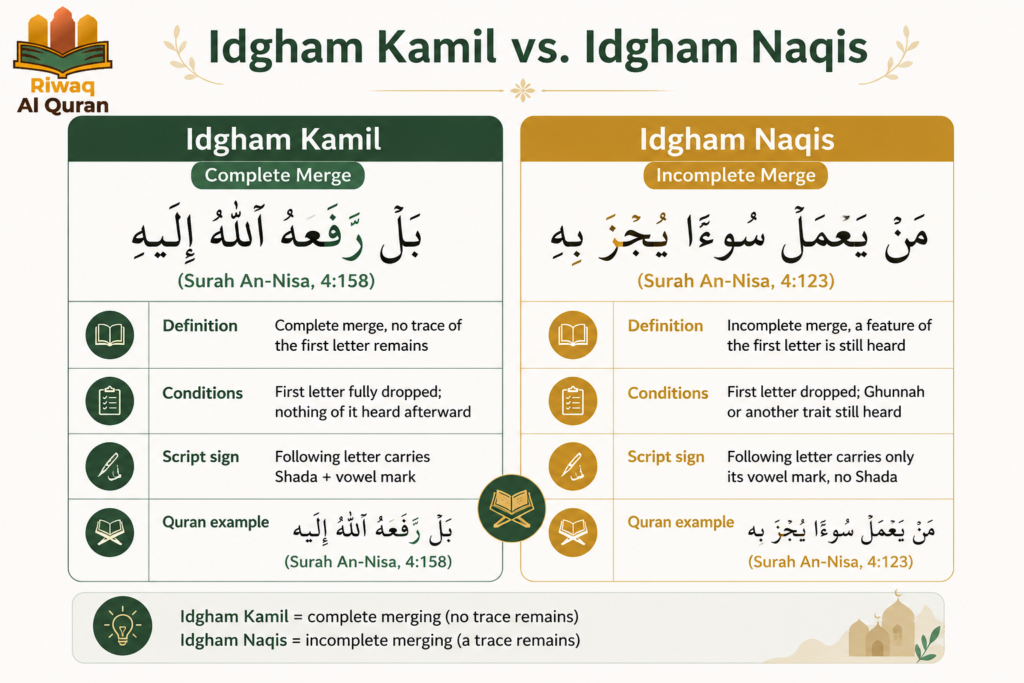
Idgham Kamil means complete merging in Arabic, and it refers to a Sakin letter merging so fully into the following letter that no trace of the first letter’s sound remains.
a. Conditions for Idgham Kamil
Two conditions must hold for a merge to count as Kamil:
- The first letter is dropped entirely.
- No characteristic feature of it — no nasal tone, no articulation trace — is heard afterward.
In the Mushaf, Idgham Kamil is marked by the first Sakin letter carrying no Sukoon sign and nothing else above or below it, while the following letter carries a Shada along with its own vowel mark.
b. Example of Idgham Kamil From the Quran and Everyday Speech
- Quran:
(بَلْ رَّفَعَهُ ٱللَّهُ إِلَيْهِ)
“Rather, Allah raised him up to Himself.” (Surah An-Nisa, 4:158)
— the Laam in “بل” merges so completely into the Raa that follows it that the verse is pronounced as if written “برفعه,” with no trace of the Laam sound surviving.
- Everyday Arabic: in “قد تذهب الفتاة,” the Dal in “قد” drops entirely, and the phrase is pronounced as though written “قتذهب.”
Hearing this distinction correctly takes guided practice, not just reading about it — a tutor who can correct your pronunciation in real time makes this rule click far faster than self-checking against a written description.
What Is Idgham Naqis?
Idgham Naqis means incomplete merging, and it applies when a Sakin letter merges into the following letter but a feature of the first letter — most often Ghunnah, sometimes an articulation trait like tongue elevation — remains audible.
a. Conditions for Idgham Naqis
Two conditions define Idgham Naqis:
- The first letter is dropped.
- Some characteristic of it — usually Ghunnah, sometimes another articulation trait — is still heard after the merge.
In the script, Idgham Naqis looks almost identical to Idgham Kamil, with one key difference: the following letter carries only its vowel mark, without a Shada.
b. Example of Idgham Naqis From the Quran and Everyday Speech
- Quran:
(مَن يَعْمَلْ سُوٓءًۭا يُجْزَ بِهِ)
“Whoever do (Surah An-Nisa, 4:123).
— the Noon in “من” drops, but its Ghunnah is held for two Harakat (roughly the duration of two short vowel counts) rather than disappearing completely


- Everyday Arabic: in “من يشرب اللبن يقوى جسمه,” the Noon sound drops but its Ghunnah is still held for two Harakat.
Idgham Kamil and Idgham Naqis A Side by Side Comparison
Before comparing the two rules directly, it helps to see every distinguishing feature laid out together in one place, since the difference between them comes down to a small set of specific signals rather than a broad conceptual gap.
| Idgham Kamil | Idgham Naqis | |
|---|---|---|
| Definition | Complete merge, no trace of the first letter remains | Incomplete merge, a feature of the first letter is still heard |
| Conditions | First letter fully dropped; nothing of it heard afterward | First letter dropped; Ghunnah or another trait still heard |
| Script sign | Following letter carries Shada + vowel mark | Following letter carries only its vowel mark, no Shada |
| Quran example | بَلْ رَّفَعَهُ ٱللَّهُ إِلَيْهِ (Surah An-Nisa, 4:158) | مَن يَعْمَلْ سُوٓءًۭا يُجْزَ بِهِ (Surah An-Nisa, 4:123) |
The Three Sub-Types of Idgham Based on Letter Closeness
Both Kamil and Naqis can occur across three further sub-categories, based on how close the two merging letters are in their place and manner of articulation. These sub-types explain why a merge happens at all, while Kamil and Naqis describe how completely it happens.
1. Idgham Mutamathilain and the Rule of Two Identical Letters
Idgham Mutamathilain occurs when the Sakin letter and the following Mutahrik letter are exactly the same letter, sharing the same articulation point and characteristics.
Quran:
(ٱذْهَب بِّكِتَـٰبِى)
“Go with this letter of mine and deliver it to them.” (Surah An-Naml, 27:28)
where the Baa and Kaaf sounds are dropped respectively.
An exception
Idgham is not applied when the first letter is one of the three Madd (vowel-lengthening) letters — Waw(و), Yaa(ي), or Alif( ا) — even if it looks identical to the next letter.
In:
(ءَامَنُوا۟ وَعَمِلُوا۟)
“Those who believe and do righteous deeds” (Surah Al-Ma’idah, 5:93)
– the first Waw is a lengthened vowel sound articulated from a different point than the following consonantal Waw, so no merge occurs despite the letters appearing the same on the page
2.Idgham Mutajanisain and the Rule of Two Similar Letters
Idgham Mutajanisain occurs when the Sakin and following letter share the same place of articulation but differ in characteristics.
- Complete (Kamil) examples:
(يَـٰبُنَىَّ ٱرْكَب مَّعَنَا)
“O my dear son! ” (Surah Hud, 11:42)
(هَمَّت طَّآئِفَتَانِ)
“Two groups among you were about to lose heart.” (Surah Aal-e-Imran, 3:122)
where the Baa in “اركب” and the Taa in “همت” drop entirely.
- Incomplete (Naqis) example:
(لَئِنۢ بَسَطتَ إِلَىَّ يَدَكَ)
“If you raise your hand to kill me…” (Surah Al-Ma’idah, 5:28)
— the Taa (ط) and Taa (ت) in “بَسَطتَ” share the same articulation point but differ in one trait, Isti’la (the raising of the tongue). The Taa sound drops, but that tongue-raising quality remains, which is why this specific case is Mutajanisain Naqis rather than Kamil.
Distinguishing Kamil from Naqis inside the same sub-type — as with this Mutajanisain example — is exactly the kind of detail that’s hard to self-teach from text alone.
3. Idgham Mutaqaribain and the Rule of Two Close Letters
Idgham Mutaqaribain occurs when the two letters have a close, but not identical or fully shared, place of articulation.
Quran examples:
(مِن لَّدُنَّا)
“From Our Own Presence.” (Surah Taha, 20:99).
(بَلْ رَانَ)
“But no! Their hearts have been stained by all ˹the evil˺ they used to commit.” (Surah Al-Mutaffifin, 83:14).
where the Noon and Laam sounds merge completely into the letters that follow.
Common Mistakes Students Make When Learning Idgham
A few recurring mix-ups explain most of the confusion between these rules in practice:
- Assuming any matching-articulation pair is automatically Mutajanisain Kamil: As the Surah Al-Ma’idah, 5:28 example shows, the same articulation point can still produce a Naqis merge if a trait like Isti’la survives — check the script sign, not just the letter pairing.
- Applying Idgham to Waw, Yaa, or Alif on sight: These three Madd letters can look identical to the following letter while being articulated from a completely different point, which blocks the merge entirely.
- Cutting the Ghunnah short in Idgham Naqis: The nasal sound needs to be held for a full two Harakat — trimming it early turns a Naqis merge into something that sounds closer to Kamil, which changes the recitation.
- Reading the Shada as decorative rather than diagnostic: In this specific rule, the presence or absence of a Shada is the single clearest sign distinguishing Kamil from Naqis in the Mushaf — it’s worth training your eye to check for it every time.
Learn Idgham the Right Way With Riwaq Al Quran
Reading the rules is a starting point — hearing the difference between a complete and incomplete merge takes a tutor listening to your actual recitation.
Riwaq Al Quran is a comprehensive online platform that offers personalized Quran, Arabic and Islamic Studies Online classes for individuals of all ages and backgrounds.
Their experienced instructors use a structured curriculum to cover Tajweed, Tafsir, and Memorization, providing easy and effective access to learning the Quran. The advanced online classes allow for seamless communication and interaction between students and teachers.
Join Riwaq Al Quran for a deeper connection with the Quran.

We offer several courses such as:
Online courses for kids.
Online Quran classes for kids and adults.
Online Arabic courses
Online Ijazah courses
Online Islamic Studies courses.


Here are a sample of our set of Quran Courses that will be helpful for you:
Online Tafseer Course: Delve into Quranic meanings with our insightful online Tafseer course.
Noorani Qaida Online: Learn Quranic basics efficiently through our Noorani Qaida online program.
Online Quran Recitation Course: Enhance Quranic recitation skills through our expert-led online course.
Online Tajweed Classes: Master Tajweed rules for beautiful Quranic recitation in online classes.
Quran Memorization Online Course: Memorize the Quran effectively with our specialized online memorization course.
Online Qirat Course: Explore diverse Qirat styles with our comprehensive online Qirat course.
Online Quran Classes for Kids: Nurture a love for the Quran in kids through interactive online classes.

Conclusion
Idgham Kamil and Idgham Naqis both describe a Sakin letter merging into the Mutahrik letter that follows it, and the entire difference comes down to whether any trace of the first letter survives that merge — completely gone in Kamil, partially audible (usually as Ghunnah) in Naqis.
The three sub-types, Mutamathilain, Mutajanisain, and Mutaqaribain, explain why the merge happens based on how close the two letters are in articulation, and each can appear in either its complete or incomplete form.
Recognizing these patterns directly from the Quran’s script — the presence or absence of a Shada, the Sakin marks, the specific letter pairs involved — is what separates reciting by memorized habit from reciting with real Tajweed accuracy.
Practicing with real verses, like the examples cited throughout this guide, and staying alert to the common mistakes covered above, is the fastest way to make the Kamil-versus-Naqis distinction second nature.
FAQs
The questions below cover the points readers most often ask after learning the difference between Idgham Kamil and Idgham Naqis, including how the rule connects to the broader sub-types.
What is Idgham in Tajweed?
Idgham is a Tajweed rule where a Sakin letter (a letter with no vowel) merges into the Mutahrik letter (a letter with a vowel) that follows it, rather than being pronounced separately. It’s one of the core rules governing how connected letters are recited in the Quran.
What is the difference between Idgham Kamil and Idgham Naqis?
Idgham Kamil is a complete merge where no trace of the first letter remains, while Idgham Naqis is an incomplete merge where a feature of the first letter, usually Ghunnah, is still heard. The script shows this difference through the presence (Kamil) or absence (Naqis) of a Shada on the following letter.
How many types of Idgham are there?
Idgham divides first into Kamil (complete) and Naqis (incomplete), and separately into three sub-types based on articulation closeness: Mutamathilain (identical letters), Mutajanisain (same articulation point, different features), and Mutaqaribain (close but not identical articulation).
What is Idgham Mutajanisain?
Idgham Mutajanisain is a sub-type of Idgham that occurs when the Sakin letter and the following letter share the same place of articulation but differ in their characteristics, such as the Taa and Taa pairing in Surah Al-Ma’idah, 5:28.
Does Idgham apply when the first letter is a Madd letter?
No, Idgham does not apply when the first letter is one of the three Madd (vowel-lengthening) letters — Waw, Yaa, or Alif — even if it appears identical to the following letter, because the Madd letter is articulated from a different point than its consonantal counterpart.