Choosing the right reciter is one of the most overlooked steps in learning Tajweed — the science of correct Quranic recitation covering pronunciation, articulation, and intonation. Before a student ever opens a Tajweed textbook, listening to a skilled Qari (reciter) trains the ear to recognize correct sounds, something no written rule can fully teach on its own.
This guide explains why listening comes first, gives you a practical way to match a reciter to your current learning stage, and profiles four of the most respected reciters in modern Islamic history — with where to find their recordings for free.
These four reciters, all from the twentieth century, remain the most widely referenced Qaris for Tajweed study today, decades after most of them passed away. Each represents a distinct point on the clarity-to-style spectrum described above — the quick comparison below can help you decide where to start before reading each profile in full.
Table of Contents
1. Sheikh Mahmoud Khalil Al-Husary as the Reference Standard for Tarteel
Al-Husary (1917–1980) is the clearest starting point for beginners, because his entire recitation career was built around preserving correctness over ornamentation.
- He memorized the entire Quran by age eight and began public recitation by age twelve.
- Al-Azhar awarded him the title Sheikh al-Maqāri’ (شـيخ المقارئ, “Scholar of the Reciting Schools”) in 1957.
- In 1967, he was elected President of the Islamic World League of Quran Reciters.
- He recited before the United States Congress, at the United Nations in 1977, and at Buckingham Palace in 1978.
Al-Husary was a strong proponent of preserving tarteel — measured, unembellished recitation focused on the text itself rather than musical rhythm — which is why his recordings remain the most commonly used reference for Quran recitation and Tajweed study worldwide.
If you want feedback on your own recitation rather than just a reference to compare against, Riwaq Al Quran’s Online Tajweed Classes pair you with a native-speaking instructor who corrects your articulation in real time.
You can listen to his recordings on YouTube and at this website.

2. Sheikh Mustafa Ismail as the Maqamat Specialist
Mustafa Ismail (1905–1978) is the strongest choice for an intermediate learner developing an ear for how style and correct Tajweed function together rather than in conflict.
- He completed his hifdh (Quran memorization) by age ten.
- He became Al-Azhar’s official reciter in 1947.
- In 1977, he recited inside Al-Aqsa Mosque in Jerusalem.
His recitation is distinguished by his use of Arabic maqamat to illustrate meaning through melody — a technique the composer Muhammad Abdel-Wahab once described this way: كبير في فنه، وإدارة صوته، وهو المقرئ الوحيد الذي يفاجئ المستمع بمسارات مقامية غير متوقعة (“He was great in his art and in his voice control, and he was the only reciter who surprised listeners with unexpected melodic routes”).
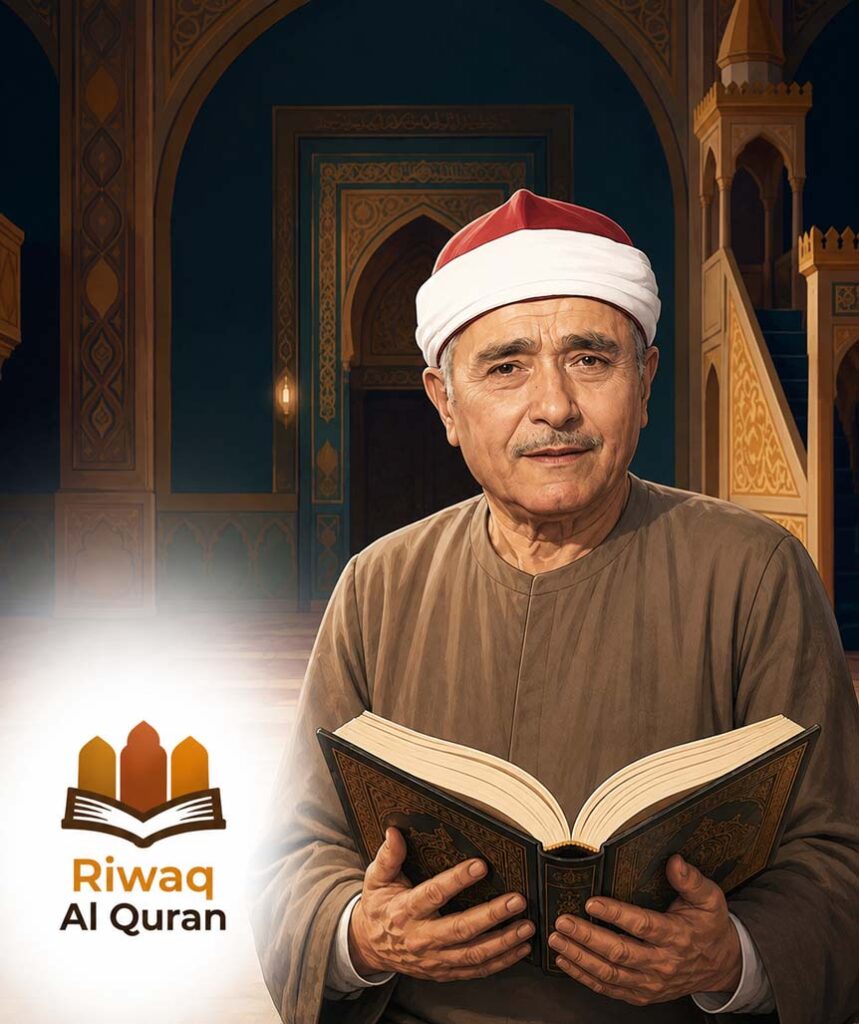
Exploring recitation through this lens is exactly what an online Qirat course is built to teach.
You can listen to his recordings at this website.
3. Sheikh Abdul Basit Abdul Samad and His Title as the Golden Throat
Abdul Basit (1927–1988) belongs to the Egyptian reciting style, and his consistency and vocal control make his recordings a reliable reference standard for advanced learners checking their own recitation and memorization.
- He came from a family of reciters — his grandfather, father, and two siblings were all well-versed Qaris.
- He completed his own memorization by age ten.
- He recited in Jerusalem’s Al-Aqsa Mosque and the Ibrahimi Mosque in Hebron.
- He received numerous honors from Islamic leaders and heads of state during and after his lifetime.
Known as the “Golden Throat” (صاحب الحنجرة الذهبية) and the “Voice of Heaven” (كروان الجنة), Abdul Basit is recognized for combining melodic beauty with technical precision.
4. Sheikh Muhammad Siddiq Al-Minshawi and His Title as the Crying Voice
Al-Minshawi (1920–1969) is a strong fit for younger learners or anyone who responds better to an expressive style than a measured one — including families looking for Quran classes for kids.
- He came from a family of huffaz, calligraphers, and Qaris.
- He memorized the Quran himself by age eight.
- He held the same title as Al-Husary, Sheikh al-Maqāri’.
- He authored several books on the Quran despite dying at 49.

Al-Sharawy described his impact this way: هو ورفاقه الآخرون يركبون مركبًا ويبحرون في بحر القرآن الكريم، ولن يتوقف هذا المركب عن الإبحار حتى يرث الله سبحانه وتعالى الأرض ومن عليها (“He and his companions sail a vessel through the sea of the Quran, and it will not stop sailing until Allah inherits the earth and all upon it”).
Nicknamed “the Crying Voice” (الصوت الباكي) for his emotional, animated delivery, Al-Minshawi also recorded Al-Mushaf Al-Mu’allim, a teaching recitation with children repeating after him.
5. Sheikh Mishary Rashid Alafasy as the Modern Global Reference
Alafasy (born 1976) is a Kuwaiti reciter whose style blends classical Tajweed discipline with a clearer, more contemporary vocal tone than the twentieth-century Egyptian reciters.
This makes him a natural next step for an intermediate learner who has built solid articulation on Al-Husary’s tarteel and now wants to hear how that same discipline sounds in a more modern recitation style.
His broad international following also means his recordings are frequently uploaded with synced translations, which is genuinely useful if you’re pairing recitation practice with meaning study rather than pronunciation alone.
You can listen to his recordings on his official website or his official YouTube channel.
6. Sheikh Saad Al-Ghamdi and His Calm Unhurried Voice
Al-Ghamdi (born 1967) is a Saudi reciter known specifically for a slow, gentle, unhurried delivery distinct from both Al-Husary’s strict tarteel and the more melodic Egyptian styles.
For a beginner who finds pure tarteel too clinical to stay engaged with, Al-Ghamdi’s recitation offers the same measured pace with a noticeably warmer, calmer tone — a useful bridge between correctness and listenability, and one reason his recordings are commonly used for nighttime or reflective listening rather than active study sessions.
You can listen to his recordings at this website.
7. Sheikh Yasser Al-Dosari as the Taraweeh Standard
Al-Dosari (born 1980) is a Saudi reciter and Imam whose recitation is frequently heard in Ramadan Taraweeh broadcasts from Saudi Arabia, pairing clarity with real emotional depth.
For an intermediate-to-advanced learner, his recitations of longer passages are a good test of whether your own recitation holds up over extended listening, since Taraweeh recitation demands the kind of sustained, consistent Tajweed that shorter practice sessions don’t reveal.
You can listen to his recordings at this website.
8. Sheikh Ahmed Al-Ajmi as the Consistency Check
Al-Ajmi (born 1968) is a Kuwaiti reciter recognized for combining emotional delivery with dependable clarity across long recitation sessions.
Like Abdul Basit, his recordings work well as a fixed reference for memorization and self-correction — the consistency of his pacing makes it easier to notice where your own recitation drifts from the source.
You can listen to his recordings at this website.
A Quick Comparison of Which Reciter Fits Your Stage
Before reading each reciter’s full profile, this table gives you a fast way to match a name to your current stage of learning.
| Reciter | Signature Style | Best Suited For |
|---|---|---|
| Al-Husary | Tarteel — measured, unembellished | Beginners |
| Mustafa Ismail | Maqamat-based melodic style | Intermediate learners |
| Abdul Basit Abdul Samad | Egyptian style — melodic precision | Advanced learners, memorization checks |
| Al-Minshawi | Expressive, animated delivery | Younger learners, family listening |
| Mishary Rashid Alafasy | Clear, contemporary blend of classical and modern | Intermediate learners wanting a modern reference |
| Saad Al-Ghamdi | Calm, unhurried, soothing delivery | Beginners who find tarteel too dry |
| Yasser Al-Dosari | Expressive with clarity, Taraweeh-style | Intermediate to advanced learners |
| Ahmed Al-Ajmi | Emotional delivery paired with consistent clarity | Advanced learners, memorization checks |
How to Choose the Right Reciter for Your Learning Stage?
Not every reciter suits every stage of learning, and this is where most guides on this topic stop short — they list names without telling you which one to actually start with. The right match depends on whether you’re training your ear for accuracy or developing an appreciation for style.
1. Beginners Should Prioritize Clarity Over Melody
A slower, clearer, tarteel-focused reciter is the better starting point for beginners, for a specific reason:
- Every letter and rule is easier to isolate at a measured pace.
- A common mistake beginners make is starting with a highly melodic, mujawwad-style reciter before their letter articulation is solid.
- This early exposure to heavy ornamentation can train decorative listening habits before the underlying correctness is in place.
- Pairing this listening stage with a structured foundation, like a Noorani Qaida program, helps you connect what you hear to the letter-level rules you’re learning.
2. Intermediate Learners Should Start Comparing Styles
Once basic articulation feels natural, listening to reciters with more expressive or melodic approaches helps you understand how correct Tajweed and personal style coexist without one compromising the other.
This includes exposure to maqamat, the Arabic system of melodic modes used to shape recitation without breaking Tajweed rules — the same territory covered in a structured Qirat course exploring different recitation styles.
3.Advanced Learners and Those Memorizing Should Use a Reciter as a Reference Standard
For memorization and self-correction, a reciter known for consistency and precision works best as an audio reference.
Comparing your recitation against the same fixed rendition every time makes it much easier to catch your own errors — the same principle behind a structured Quran memorization course, where a fixed method replaces guesswork.
Why You Need to Listen to Quran Reciters Before Learning Tajweed?
The Quran is fundamentally an oral text, not a written one. Understanding this origin — and the spiritual effect of hearing it recited — is what makes listening a required first step, not an optional extra, before opening a Tajweed textbook.
a. The Quran Is an Oral Tradition
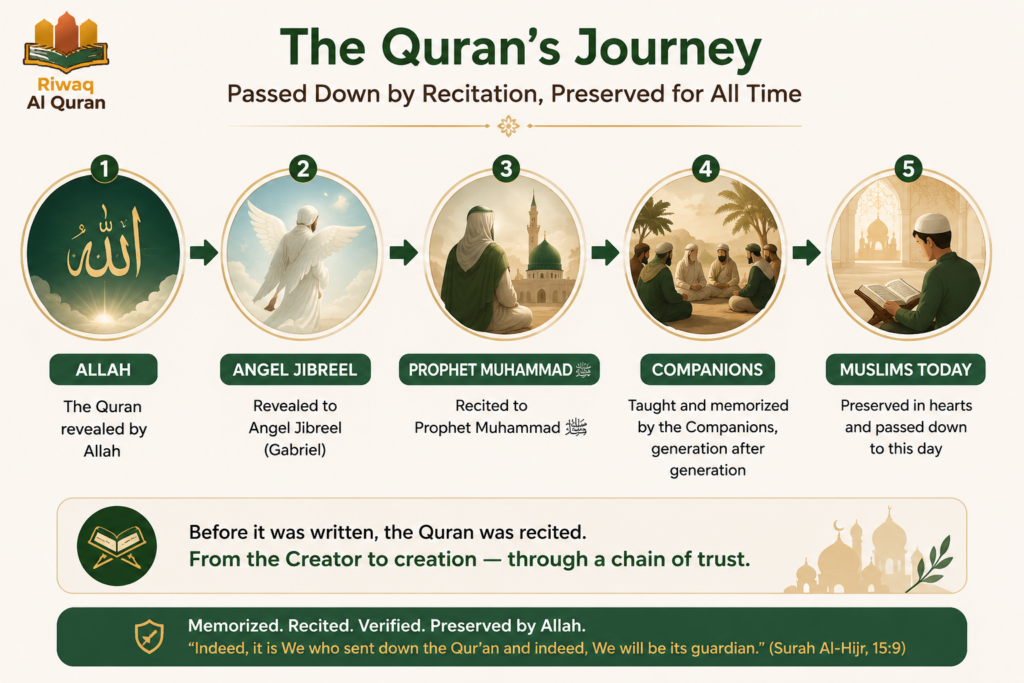
The Quran was transmitted from Allah to the Angel Jibreel, to the Prophet Muhammad ﷺ, to his companions, and onward through recitation — writing it down came later, as a supplementary method of preservation. Even the word “Quran” (قرآن) comes from the verb qara’a, meaning “to read” or “to recite.”
Allah commands this recitation to be done with care:
- وَرَتِّلِ ٱلْقُرْءَانَ تَرْتِيلًا (Surah Al-Muzzammil, 73:4) — “And recite the Quran with measured recitation.”
- This instruction to the Prophet ﷺ, and by extension to every Muslim who recites after him, is the foundation the entire science of Tajweed was built to formalize and preserve.
b. Listening to the Quran Is a Spiritual Experience
Listening also does something a textbook can’t: it deepens faith through direct exposure to the text. Allah describes this effect directly:
(إِنَّمَا ٱلْمُؤْمِنُونَ ٱلَّذِينَ إِذَا ذُكِرَ ٱللَّهُ وَجِلَتْ قُلُوبُهُمْ وَإِذَا تُلِيَتْ عَلَيْهِمْ ءَايَـٰتُهُۥ زَادَتْهُمْ إِيمَـٰنًۭا وَعَلَىٰ رَبِّهِمْ يَتَوَكَّلُونَ)
“The believers are only those whose hearts tremble when Allah is mentioned, and when His verses are recited to them, it increases their faith.” (Surah Al-Anfal, 8:2)
Perfect Your Tajweed With Riwaq Al Quran
Listening to these reciters trains your ear — but correcting your own recitation takes a tutor who can hear the difference in real time.
Riwaq Al Quran is a comprehensive online platform that offers personalized Quran, Arabic, and Islamic Studies online classes for individuals of all ages and backgrounds.
Their experienced instructors use a structured curriculum to cover Tajweed, Tafsir, and Memorization, providing easy and effective access to learning the Quran. The advanced online classes allow for seamless communication and interaction between students and teachers.

We offer several courses, including:
- Online courses for kids
- Online Quran classes for kids and adults
- Online Arabic courses
- Online Ijazah courses
- Online Islamic Studies courses

 Here is a sample of our Quran courses that will be helpful for you:
- Online Tafseer Course: Delve into Quranic meanings with our insightful online Tafseer course.
- Noorani Qaida Online: Learn Quranic basics efficiently through our Noorani Qaida online program.
- Online Quran Recitation Course: Enhance Quranic recitation skills through our expert-led online course.
- Online Tajweed Classes: Master Tajweed rules for beautiful Quranic recitation in online classes.
- Quran Memorization Online Course: Memorize the Quran effectively with our specialized online memorization course.
- Online Qirat Course: Explore diverse Qirat styles with our comprehensive online Qirat course.
- Online Quran Classes for Kids: Nurture a love for the Quran in kids through interactive online classes.
Conclusion
More than four reciters, and no single “best” one among them — that’s the actual takeaway, not a hedge.
- For accuracy first: Al-Husary teaches a beginner what correct sounds like before style gets added on top.
- For style without sacrificing correctness: Mustafa Ismail shows an intermediate learner that melody and accuracy aren’t in tension.
- For memorization and self-checking: Abdul Basit and Ahmed Al-Ajmi give an advanced learner or a memorizer the same fixed reference, session after session, to catch their own drift against.
- For approachability: Al-Minshawi and Saad Al-Ghamdi make the Quran easier to sit with for a younger listener or anyone who finds strict tarteel too clinical to stay engaged with.
- For a modern register and sustained listening: Alafasy brings that same discipline into a more contemporary sound, and Al-Dosari’s Taraweeh recitations test whether your own Tajweed actually holds up once a passage gets long.
None of these eight replace the other seven. Each one answers a different question — what does correct sound like, what does correct-with-style sound like, and which voice keeps you listening long enough to actually learn from it.
Pick the one that matches where you are right now, listen with intention rather than in the background, and let your own recitation catch up to what you’re hearing. That’s the only part no reciter, however skilled, can do for you.
FAQs
The questions below cover what most learners ask after deciding to start listening to Quran reciters — from where to find the recordings to which style suits which stage of learning.
Who is the best reciter for beginners learning Tajweed?
Sheikh Mahmoud Khalil Al-Husary is generally considered the best starting point for beginners, since his tarteel style prioritizes slow, clear, unembellished recitation that makes individual letters and rules easy to isolate.
Are these reciters’ recordings free to listen to?
Yes, recordings from all four reciters are freely available on YouTube and on mp3quran.net, a dedicated Quran audio archive organized by reciter and recitation style.
What is the difference between tarteel and mujawwad recitation?
Tarteel is a measured, unembellished style of recitation focused on the text itself, while mujawwad incorporates more melodic and stylistic expression; both must still follow correct Tajweed rules, but tarteel is generally easier for beginners to follow.
Why is listening to the Quran important before learning Tajweed?
Listening trains your ear to recognize correct pronunciation and intonation before you apply written Tajweed rules, since the Quran was transmitted orally and many of its correct sounds are easier to hear than to read from a rule alone.
Can I use a reciter’s recording to check my own memorization?
Yes, reciters known for consistency, such as Abdul Basit Abdul Samad, are commonly used as a fixed audio reference for memorization, since comparing your recitation against the same rendition each time makes errors easier to catch.