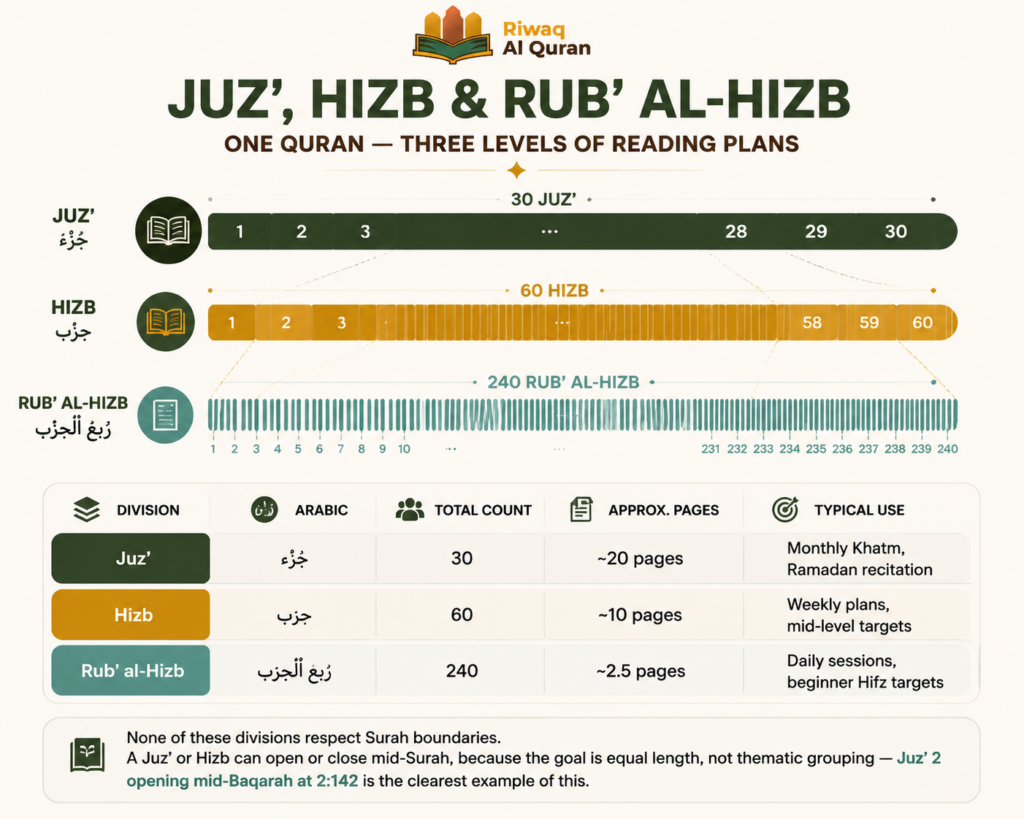
Anyone starting to memorize or recite the Quran runs into two terms almost immediately: Juz’ and Hizb. Juz’ and Hizb in the Quran are the classical system scholars built to divide the text into equal, trackable portions — 30 Juz’, 60 Hizb, and 240 smaller quarters called Rub’ al-Hizb.
These are not arbitrary chapter breaks. They were designed so a reciter can measure progress by pages covered rather than guesswork, and so a full reading of the Quran — a Khatm — can be planned around a fixed number of days, following the Prophet’s ﷺ own guidance on pacing, discussed below with the hadith itself.
This guide explains what each division means, exactly where they fall in the Quranic text with real examples, and how to use them to build a memorization or recitation schedule that actually holds up over weeks and months.
What You’ll Learn in This Article
- The Quran is split into 30 equal Juz’ (parts), each about 20 pages of the standard Mushaf.
- Each Juz’ divides into 2 Hizb, giving 60 Hizb across the whole Quran.
- Each Hizb divides into 4 quarters, called Rub’ al-Hizb, for 240 equal portions in total.
- These divisions follow text length, not Surah boundaries — a Juz’ can start or end in the middle of a Surah, as Juz’ 2 does.
- The Prophet ﷺ himself set boundaries on Khatm pacing (Sahih al-Bukhari 5054), and the 30-Juz’ system is the practical tool built on that guidance.
Table of Contents
What Is a Juz’ in the Quran, and How Many Are There?
A Juz’ (جُزْء), plural Ajza’ (أَجْزَاء), is one of the 30 equal parts that make up the Quran. The word means “part” or “portion,” and each Juz’ runs to roughly 20 pages in the standard 15-line Mushaf used across the Muslim world today.
There are exactly 30 Juz’ in every standard printed Mushaf, regardless of publisher or script style. This count is fixed — it is not an estimate or a regional variation.
1. Real Quranic Examples of Where Each Juz’ Begins
A. Juz’ 1 — opens with the Basmala of Surah Al-Fatiha
(بِسْمِ اللَّهِ الرَّحْمَٰنِ الرَّحِيمِ)
“In the Name of Allah — the Most Compassionate, Most Merciful.” — Surah Al-Fatiha 1:1.
This opening line is repeated at the start of every Surah but one, so its placement as the very first verse of Juz’ 1 is fitting — it is the phrase a reciter returns to at the start of nearly every section they read.
B. Juz’ 2 — begins mid-Surah, partway through Al-Baqarah
(سَيَقُولُ ٱلسُّفَهَآءُ مِنَ ٱلنَّاسِ مَا وَلَّىٰهُمْ عَن قِبْلَتِهِمُ ٱلَّتِى كَانُوا۟ عَلَيْهَا ۚ قُل لِّلَّهِ ٱلْمَشْرِقُ وَٱلْمَغْرِبُ ۚ يَهْدِى مَن يَشَآءُ إِلَىٰ صِرَٰطٍ مُّسْتَقِيمٍ)
“The foolish among the people will ask, ‘Why did they turn away from the direction of prayer they used to face?’ Say, ‘The east and west belong ˹only˺ to Allah. He guides whoever He wills to the Straight Path.'” — Surah Al-Baqarah 2:142.
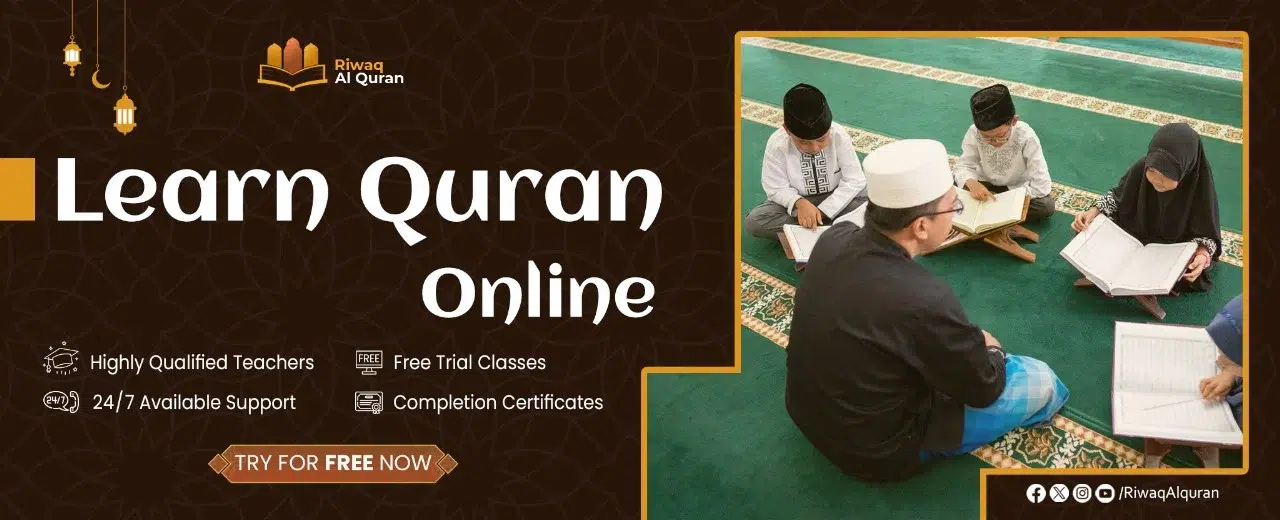
This is the clearest proof that Juz’ boundaries follow length, not topic: the discussion of the Qibla change runs on either side of the Juz’ 1/Juz’ 2 split, cut through the middle of a single argument rather than at a new Surah.

C. Juz’ 30 (‘Amma) — opens Surah An-Naba
(عَمَّ يَتَسَآءَلُونَ)
“What are they asking one another about?” — Surah An-Naba 78:1.
Juz’ ‘Amma is usually the first Juz’ students memorize, since it holds the Quran’s shortest Surahs — Riwaq Al Quran’s Azhari-certified tutors typically start beginner Hifz students here for exactly that reason, before building toward the longer Juz’ near the start of the Mushaf.
2. Why Muslims Complete the Quran in 30 Days
Completing one Juz’ per day finishes the entire Quran in exactly 30 days — a pace that lines up with a lunar month and with Ramadan, the month Allah describes as the one in which the Quran was revealed:
(شَهْرُ رَمَضَانَ ٱلَّذِىٓ أُنزِلَ فِيهِ ٱلْقُرْءَانُ هُدًى لِّلنَّاسِ وَبَيِّنَـٰتٍ مِّنَ ٱلْهُدَىٰ وَٱلْفُرْقَانِ)
“Ramadan is the month in which the Quran was revealed as a guide for humanity with clear proofs of guidance and the decisive authority…” — Surah Al-Baqarah 2:185
The Prophet ﷺ set a floor, not just a target, on how fast a Khatm should be paced. He told the companion Abdullah ibn Amr:
(اقْرَإِ الْقُرْآنَ فِي شَهْرٍ” قُلْتُ: إِنِّي أَجِدُ قُوَّةً. قَالَ: “فَاقْرَأْهُ فِي سَبْعٍ وَلاَ تَزِدْ عَلَى ذَلِكَ)
“Recite the whole Qur’an in one month’s time.” I said, “But I have the power (to do more than that).” The Prophet ﷺ said, “Then finish the recitation of the Qur’an in seven days, and do not finish it in less than this period.” — Sahih al-Bukhari 5054
This hadith sets two clear boundaries for a Khatm pace:
- One month — the standard, unhurried pace, matching Ramadan and one Juz’ a day.
- Seven days — the fastest pace the Prophet ﷺ permitted, and the floor he set even for a companion capable of more.
It also carries a practical lesson often missed — the Prophet ﷺ discouraged rushing even for someone who had the stamina for it, because comprehension and reflection matter as much as completion.
To see how this pacing plays out in practice, watch highlights from Riwaq Al Quran’s Ramadan Khatm competition, where students raced to complete their recitation within this same window:
What Is a Hizb in the Quran, and How Many Are There?
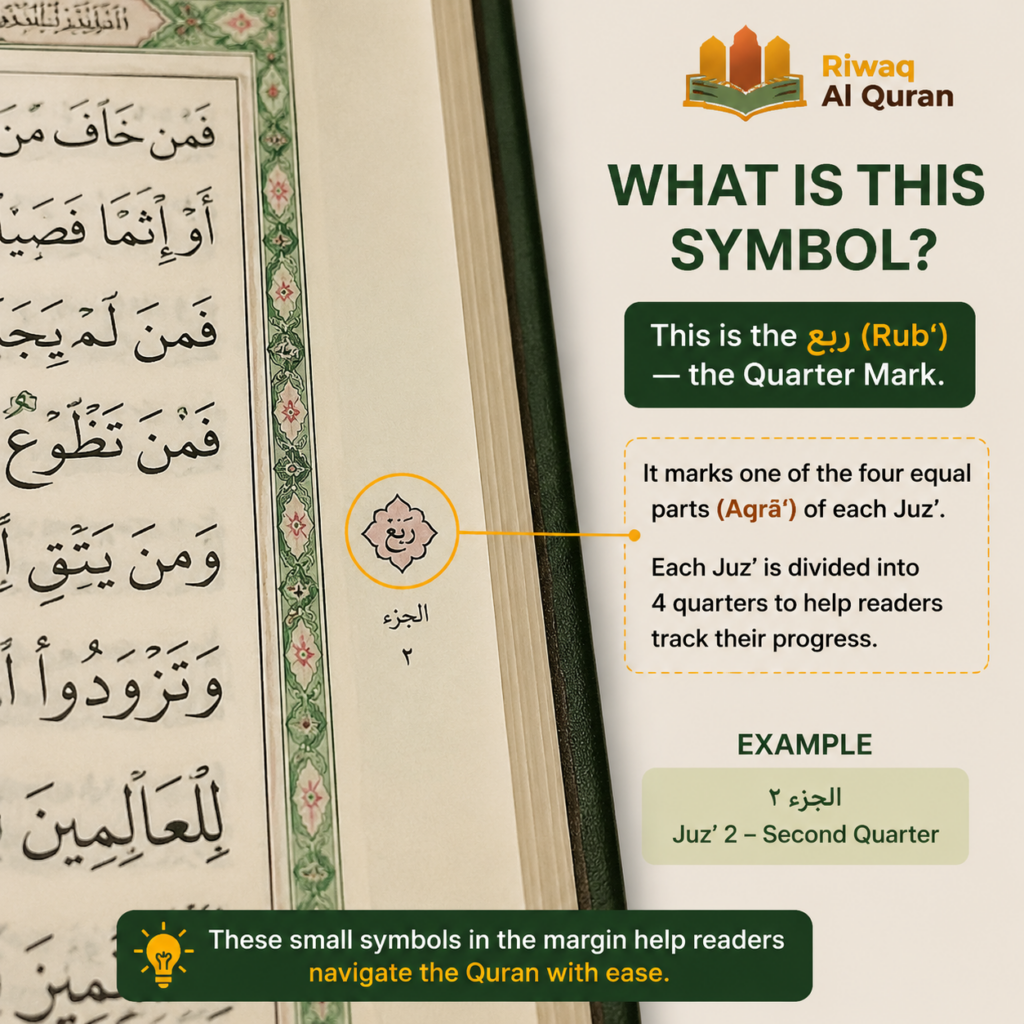
A Hizb (حِزْب), plural Ahzab (أَحْزَاب), is exactly half of a Juz’. Since the Quran has 30 Juz’, it has 60 Hizb in total, each spanning about 10 pages.
Hizb gives reciters a finer unit than the Juz’ without dropping to page-by-page guesswork. A student who finds a full Juz’ too heavy for one sitting can use a Hizb as a realistic midpoint target instead. The term shares its root with the Arabic word for a group or faction, reflecting how recitation duties were once split among groups of reciters working through the text together.
1. What Is Rub’ al-Hizb?
Rub’ al-Hizb (رُبْع الحِزْب) is one quarter of a Hizb, and the Quran contains 240 of them — the smallest of the three standard divisions, at roughly 2.5 pages each. In printed Mushafs, a small ربع marker in the margin marks where each quarter falls.
This is the unit most beginner Hifz plans actually run on day to day, since 2.5 pages is a realistic new-memorization load for someone building the habit. Riwaq Al Quran’s tutors build new students’ first month around Rub’ al-Hizb targets before scaling up to a full Hizb, which keeps early sessions achievable instead of overwhelming.
2. The Manzil as a Related Weekly Division
A related division worth knowing is the Manzil — splitting the Quran into 7 parts, one per day of the week, so a full Khatm is completed every seven days. This maps directly onto the seven-day floor the Prophet ﷺ set in the hadith above.
A well-known report in Sunan Abi Dawud 1393 describes the companions dividing the Quran this way for daily recitation — worth knowing as background, though it’s worth being precise here: Al-Albani graded that specific chain as da’if (weak), so it’s cited for historical context on the Manzil concept, not as a sahih ruling in its own right.
The 30-Juz’ and 60-Hizb system, by contrast, rests on the unambiguously sahih hadith above.
3. Page Counts Vary by Mushaf Tradition
One practical note: page counts shift depending on which Mushaf tradition you’re using. The 604-page figure applies to the 15-line Madani Mushaf common in the Gulf and much of the Arab world. Indo-Pak print Mushafs, which typically use a different line count per page, arrive at a different total — but the 30 Juz’, 60 Hizb, and 240 Rub’ al-Hizb structure itself stays identical across every tradition, since it’s based on text length, not page layout.
Comparing Juz’, Hizb, and Rub’ al-Hizb
The table below lines up all three divisions side by side, making it easy to see how they scale from the broadest planning unit down to the smallest daily one.
| Division | Arabic | Total count | Approx. pages | Typical use |
|---|---|---|---|---|
| Juz’ | جُزْء | 30 | ~20 pages | Monthly Khatm, Ramadan recitation |
| Hizb | حِزْب | 60 | ~10 pages | Weekly plans, mid-level targets |
| Rub’ al-Hizb | رُبْع الحِزْب | 240 | ~2.5 pages | Daily sessions, beginner Hifz targets |
None of these divisions respect Surah boundaries. A Juz’ or Hizb can open or close mid-Surah, because the goal is equal length, not thematic grouping — Juz’ 2 opening mid-Baqarah at 2:142, shown above, is the clearest example of this.
Using Juz’ and Hizb Beyond Memorization
Even for Muslims who are not memorizing, the Juz’ and Hizb system structures daily recitation meaningfully.
- During Ramadan, completing one Juz’ a night is a widespread practice tied to finishing a full Khatm by Laylat al-Qadr, and many Imams structure Tarawih recitation around exactly this pace — one Juz’ per night across the month.
- Outside Ramadan, reciting one Hizb a day completes a full Khatm in about two months, a realistic target for recitation rather than memorization.
- The same divisions guide Tahajjud recitation for those who pray it regularly, giving a night’s recitation a clear stopping point instead of an arbitrary one.
For readers who want to understand the meaning behind what they’re reciting, not just keep pace, Riwaq’s Online Quran Tafseer Course follows this same Juz’ sequencing, studying each portion’s meaning in the order it’s recited.
How to Use Juz’ and Hizb to Memorize the Quran Faster
Knowing the divisions exist is not the same as using them well. The difference between a plan that sticks and one that stalls after two weeks usually comes down to how deliberately these units are applied.
1. The Rub’ Anchor Method
Always start and end a new memorization lesson exactly at a Rub’ al-Hizb marker, never mid-verse or mid-paragraph. This gives the memory a fixed boundary to attach to, and it means every completed lesson is also a clean, countable unit of progress — 1 Rub’, 2 Rub’, and so on toward a full Hizb.
2. Use Hizb Completion as a Review Trigger
Every time a new Hizb of fresh memorization is complete, dedicate one full session to reviewing the Hizb before it, rather than moving straight ahead. This keeps older material from quietly slipping while attention is on what’s new.
3. Test Your Retention Before Moving Forward
Every completed Juz’ deserves a structured self-assessment rather than an assumption that it has been retained. Riwaq’s Quran memorization test guide outlines how to check retention honestly before advancing to the next Juz’.
4. Pair Memorization with Tajweed Review
Memorizing without correct Tajweed embeds errors that take far longer to unlearn later than they would have taken to fix at the start. Riwaq’s Tajweed rules guide covers the essential rules every memorization student needs to apply alongside new material.
5. Common Mistakes When Using These Divisions for Hifz
- Treating every Rub’ or Hizb as equal effort, when they are only equal in length — a Rub’ in Surah Al-Baqarah, with its longer, denser verses, takes noticeably longer to secure than a Rub’ in Juz’ ‘Amma. Students who keep a fixed daily quota without adjusting for this tend to fall behind and then abandon the schedule entirely, rather than simply slowing down for harder sections.
- Stopping a session at a natural pause in reading rather than at the actual Rub’ or Hizb marker, which fragments review later and makes it harder to test recall against a clean boundary.
6. A Realistic Timeline for a Full Khatm
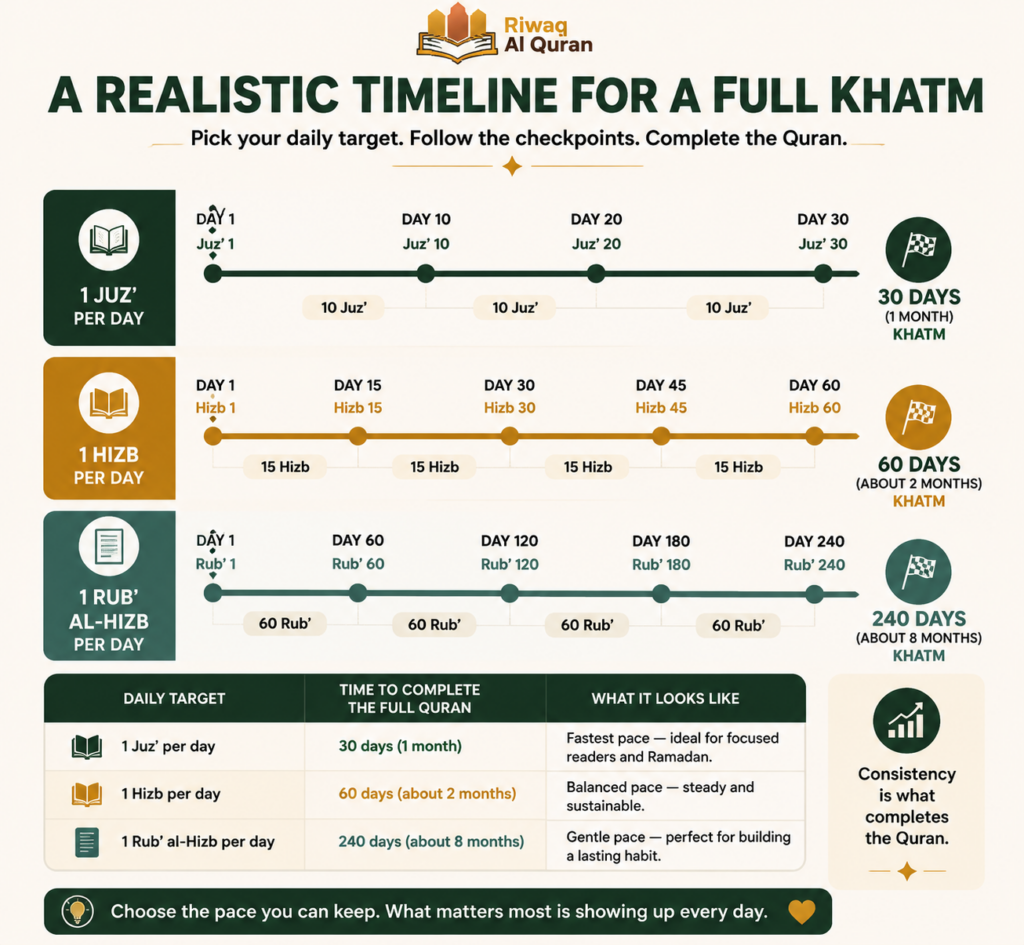
The pace that works best usually comes down to which division a reader anchors their daily target to — the table below lays out what each choice means in practice.
| Daily target | Time to complete the full Quran |
|---|---|
| 1 Juz’ per day | 30 days |
| 1 Hizb per day | 60 days (about 2 months) |
| 1 Rub’ al-Hizb per day | 240 days (about 8 months) |
Outside Ramadan, a Hizb-per-day pace is the most common sustainable target for working adults who still want a Khatm within a season rather than a year — well within the seven-day-minimum, one-month-standard range the Prophet ﷺ described. Riwaq’s Quran memorization schedule guide breaks these frameworks down further for different learner profiles.
Riwaq Al Quran’s tutors set this pace individually — a working adult with 20 minutes a day is not given the same daily Rub’ count as a student with a full hour, even though both are working toward the same 30-Juz’ structure.
Start Your Juz’-Based Memorization Plan Today
Understanding the Juz’ and Hizb system is the easy part. Applying it consistently, with someone correcting your Tajweed and adjusting your pace, is what actually gets you through a Khatm.
Riwaq Al Quran is a comprehensive online platform offering personalized Quran, Arabic, and Islamic Studies classes for learners of all ages and backgrounds.
Here’s what that consistency looks like in practice — one of our own students placing in a Juz’ memorization competition after building exactly this kind of schedule:
Every student is paired with an Al-Azhar-trained, Ijazah-certified Hafiz tutor who builds a Juz’-based schedule around their own pace rather than a generic template — sessions run one-on-one, 24/7, plans start from $32/month with a 100% money-back guarantee, and new students get 2 free trial classes before committing to anything.

Beyond memorization, Riwaq also offers:
- Online Quran Classes for Kids and adults alike
- Online Arabic Language Classes
- Online Ijazah Program
- Islamic Studies Courses, including our Best Islamic Studies Online Course for a broader grounding in Islamic knowledge


Popular Quran courses at Riwaq include:
- Online Tafseer Course — study Quranic meaning in depth, not just recitation.
- Noorani Qaida Online — build the foundational reading skills Hifz depends on.
- Online Quran Recitation Course — refine pronunciation and fluency with a tutor correcting in real time.
- Online Tajweed Classes — master the rules that keep recitation accurate as memorization scales up.
- Quran Memorization Online Course — the core Hifz program this guide’s Juz’-based approach is built around.
- Online Qirat Course — explore the recognized recitation styles once the basics are secure.
Conclusion
The Quran’s structure breaks down into three layers: 30 Juz’ for monthly or Ramadan recitation, 60 Hizb for weekly or twice-monthly plans, and 240 Rub’ al-Hizb for daily sessions. Each layer serves the same purpose at a different scale — turning 604 pages into a target you can actually track.
Understanding Juz’ and Hizb changes how you approach the Quran. Instead of an open-ended task, you get fixed checkpoints: a Hizb finished today, a Juz’ finished this week, a Khatm finished by a set date. That structure is what turns recitation and memorization from an intention into a habit.
If you’re building a memorization plan around these divisions, working with a tutor who can set your daily Rub’ or Hizb targets and check your retention makes the difference between steady progress and stalling out. Riwaq Al Quran’s Azhari-certified tutors do exactly this — book a free trial to get a Juz’-based plan built around your pace..
Frequently Asked Questions
The questions below cover the details students ask most once they’ve got the basic Juz’/Hizb structure down — sequencing, page counts, and realistic pacing.
What is the difference between a Juz’ and a Surah in the Quran?
A Juz’ is a length-based division — one of 30 equal parts built for recitation planning. A Surah is a distinct chapter, ranging from 3 verses (Al-Kawthar) to 286 verses (Al-Baqarah). Juz’ boundaries ignore Surah boundaries entirely, which is why Juz’ 2 begins mid-Surah at Al-Baqarah 2:142.
How many pages is one Juz’ in the standard Quran?
One Juz’ is about 20 pages in the standard 15-line Madani Mushaf, with the full Quran running 604 pages across 30 Juz’. Page counts shift slightly with font size or print format, but the 30-Juz’ count itself never changes.
Why doesn’t the Quran’s Juz’ division follow Surah beginnings?
Because the Juz’ and Hizb system was built for equal length, not theme. Juz’ 2 opens at Al-Baqarah 2:142 rather than at a new Surah simply because that is where 1/30th of the text falls. Surahs keep their own identity regardless of where a Juz’ line lands inside or across them.
Is it permissible to memorize the Quran out of Juz’ order?
Yes, memorizing out of sequence is both permissible and common. Most beginners start with Juz’ ‘Amma because of its shorter Surahs, then move to Juz’ 29 or 28 before returning to Juz’ 1. The only real requirement is keeping consistent review of whatever has already been memorized. Riwaq’s Quran memorization techniques guide covers sequencing strategies in more depth.
How long does it take to memorize one Juz’ of the Quran?
For an adult memorizing about one Rub’ al-Hizb a day, a full Juz’ typically takes 4 to 6 weeks once daily review is factored in alongside new memorization. Pace varies with prior Arabic exposure, session length, and how consistently review sessions are kept up.
What does the hadith say about how fast a Khatm should be completed?
The Prophet ﷺ told Abdullah ibn Amr to recite the whole Quran in a month, and when Abdullah said he had the strength to go faster, capped it at seven days minimum (Sahih al-Bukhari 5054). This range — 7 days to 30 days — is the scriptural basis for both the one-Juz’-a-day Ramadan pace and the more common one-Hizb-a-day pace used the rest of the year.
What is a Manzil, and how is it different from a Hizb?
A Manzil is a division of the Quran into 7 parts, one for each day of the week, aimed at completing a Khatm every seven days — matching the fastest pace the Prophet ﷺ permitted. It’s described in a report in Sunan Abi Dawud 1393, though that specific narration is graded da’if (weak) by Al-Albani, so it’s best treated as documented historical practice rather than a hadith-based ruling. Unlike the Hizb, which splits the text into 60 equal parts for finer daily tracking, the Manzil is a broader weekly unit and is far less common in modern Mushafs and memorization plans.