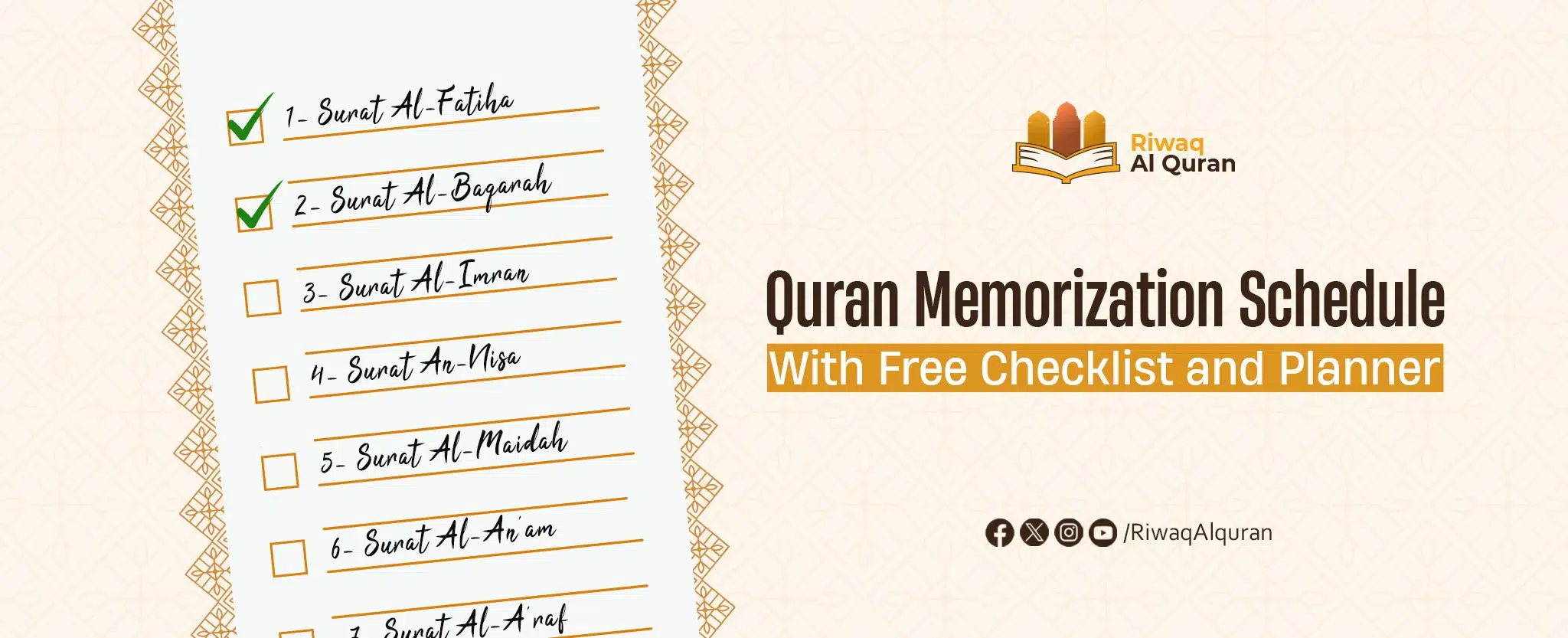
A Quran memorization schedule is the structured daily and weekly plan that turns the goal of becoming a hafiz from an abstract intention into something you actually complete. Allah describes the Quran itself as suited for exactly this kind of sustained effort:
(وَلَقَدْ يَسَّرْنَا الْقُرْآنَ لِلذِّكْرِ فَهَلْ مِن مُّدَّكِرٍ)
“And We have certainly made the Quran easy for remembrance, so is there any who will remember?” (Surah Al-Qamar, 54:17)
This guide walks through how to build a realistic schedule, four common completion timelines with accurate daily paces, the two techniques that prevent memorization mistakes from settling in, and what to do when you fall behind.
If you’d rather work from a ready-made weekly structure than build one from scratch, our Quran Memorization Timetable and Planner walks through the same principles in planner form.
What You’ll Learn in This Article
- What separates a working Hifz schedule from one that quietly falls apart
- Four realistic completion timelines, with the actual daily page pace each requires.
- The 70/30 rule most experienced Hifz teachers use to balance new memorization with revision.
- Two specific techniques — Visual Memory and Talqin — that prevent mistakes from becoming permanent.
- What to do the moment you realize your schedule has gone off track.
Table of Contents
What Is a Quran Memorization Schedule?
A Quran memorization schedule is a structured plan that breaks the Quran’s 604 pages into daily or weekly memorization targets, paired with regular revision sessions, so that progress is both steady and retained.
The schedule tells you when to memorize; technique and consistency determine whether it actually sticks.
New Memorization and Revision Through the 70 to 30 Rule
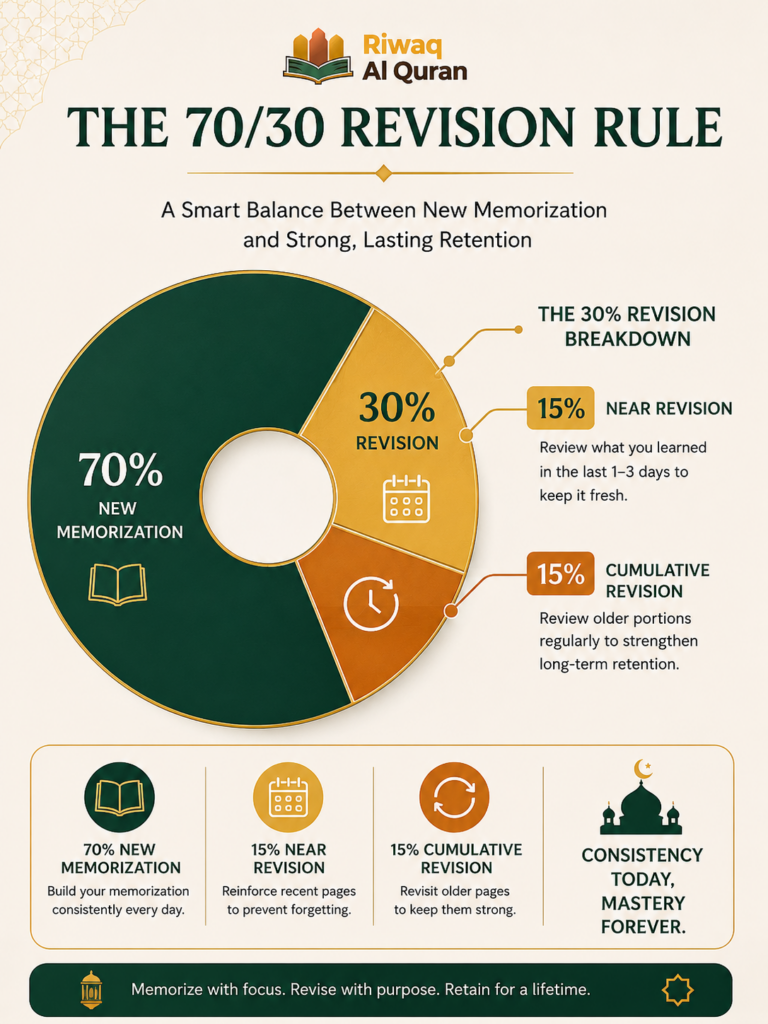
Experienced Hifz teachers generally recommend spending no more than 70% of your study time on new memorization, with at least 30% reserved for revision.
A true Hifz schedule isn’t just about moving forward — it’s about making sure the pages you memorized months ago stay firm, since without deliberate revision, new memorization pushes older material out just as quickly as it went in.
The Prophet ﷺ described exactly this risk directly, and the image he used is worth sitting with:
(إِنَّمَا مَثَلُ صَاحِبِ الْقُرْآنِ كَمَثَلِ الْإِبِلِ الْمُعَقَّلَةِ إِنْ عَاهَدَ عَلَيْهَا أَمْسَكَهَا وَإِنْ أَطْلَقَهَا ذَهَبَتْ)
“The parable of the companion of the Quran is that of a tied camel. If he is committed to it, he will keep it. If he releases it, he will lose it.” (Sahih al-Bukhari 5031; Sahih Muslim 789)
The Prophet ﷺ reinforced the same point elsewhere with a striking comparison, one that directly explains why revision can’t be treated as optional:
(اسْتَذْكِرُوا الْقُرْآنَ فَإِنَّهُ أَشَدُّ تَفَصِّيًا مِنْ صُدُورِ الرِّجَالِ مِنَ النَّعَمِ)
“Keep revising the Quran, for it escapes from the hearts of men faster than a camel breaking loose from its tether.” (Sahih al-Bukhari 5032)
Read together, these two hadith aren’t just describing a risk — they’re describing memorized Quran as something that requires active, ongoing effort to keep, not something that becomes permanent once learned. This is exactly the mechanism the 70/30 rule is designed around.
In practice, this split shows up as three distinct kinds of daily activity:
- New memorization — reciting and repeating a page you haven’t memorized before, until you can produce it without looking at the Mushaf.
- Near revision — reviewing the last 5 to 10 pages you memorized recently, while they’re still fragile in your memory.
- Cumulative (old) revision — periodically revisiting Juz’ or Surahs memorized months or years ago, which is the step most self-taught students skip and the one most responsible for long-term forgetting. Our Quran Revision Timetable breaks this cumulative layer into a weekly structure if you want a ready framework for it.
Skipping the third category is the single most common reason students reach the final third of the Quran only to discover the first third has faded.
How Many Years Does It Take to Memorize the Quran?
The honest answer depends entirely on your daily pace, measured in pages rather than verses — verse length varies enormously across the Quran, so a “verses per day” target can be misleading, while pages give a consistent, comparable unit across any plan.
a) Comparing the Four Common Completion Timelines
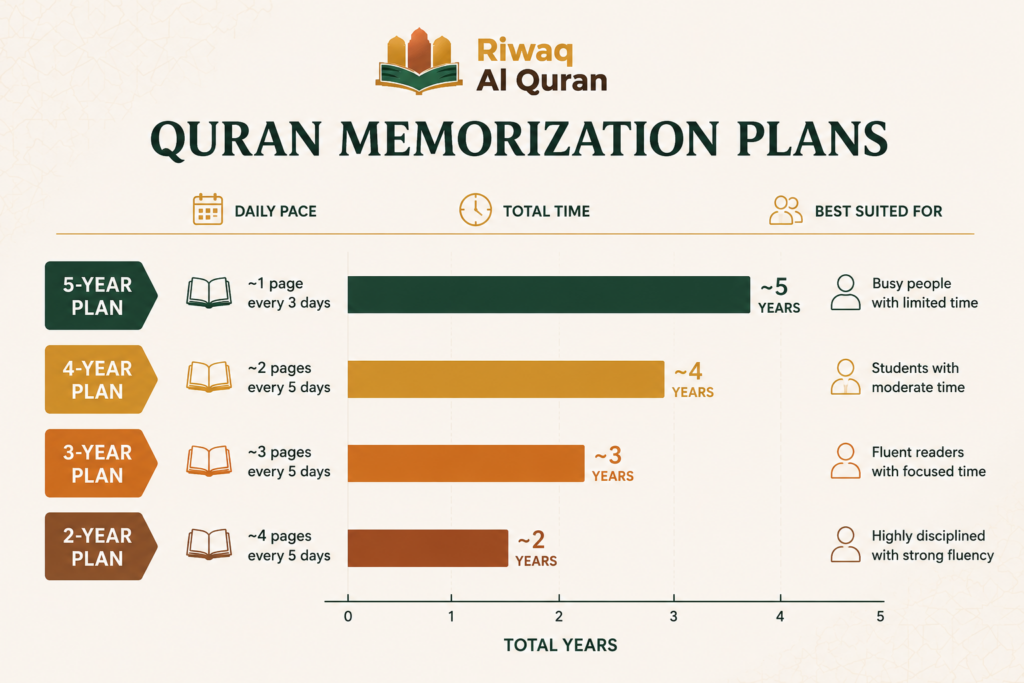
The table below compares the daily pace, total timeline, and who each plan realistically suits, before the next section walks through how to pick between them.
| Plan | Daily Pace | Total Time | Best Suited For |
|---|---|---|---|
| 5-Year Plan | ~1 page every 3 days | Just under 5 years | Full-time workers or parents with limited daily study time but strong consistency |
| 4-Year Plan | ~2 pages every 5 days | Just over 4 years | Students with moderate daily time who still need flexibility for busy weeks |
| 3-Year Plan | ~3 pages every 5 days | Just under 3 years | Fluent Arabic readers who can commit focused time most days of the week |
| 2-Year Plan | ~4 pages every 5 days | Just over 2 years | Highly disciplined students with significant daily time and strong Arabic fluency |
b) Choosing the Right Timeline for Your Situation
Picking between these four isn’t about choosing the most ambitious option — it’s about matching the pace to the time you can actually protect every day, not the time you hope to find.
- If your daily schedule is unpredictable (school exams, shift work, a demanding job), start with the 5-year or 4-year pace — a slower plan you finish is worth more than a fast one you abandon.
- If you already read Arabic fluently and can protect focused study time most days, the 3-year or 2-year pace is realistic, but speed should never come at the cost of accuracy — memorizing quickly with mistakes is far harder to fix later than memorizing slowly and correctly.
- If you’re unsure which pace fits, it’s worth testing one page’s worth of new memorization for a week before committing to a multi-year plan, since your actual retention speed only becomes clear once you try it.
- If you’re working within a shorter window — a summer break, a gap year, or a specific personal goal — much faster, more intensive tracks exist too, such as memorizing the Quran in 1 year, 6 months, 2 months, or even 30 days — though these demand near full-time daily commitment and are generally suited to students without competing obligations.
How to Build a Sustainable Daily Hifz Routine
A schedule only works if it fits into the hours you genuinely have, which is different for a full-time student than for someone working a 9-to-5 job.
1) The Working Professional Timetable
The best approach for working professionals uses “dead time” and the high-energy window between Maghrib and Isha, rather than trying to replicate a full-time student’s routine, as shown below.
| Time Slot | Activity | Why It Works |
|---|---|---|
| After Fajr | New lesson, even just 15 minutes | Your mind is fresh and uncluttered before the day’s demands begin |
| Commute (to/from work) | Listen to the new lesson on repeat, using a clear, slow-paced reciter | Auditory exposure throughout the day makes the study session that follows noticeably faster |
| Maghrib–Isha | ~20 minutes solidifying the new lesson, ~20 minutes revising the last 5 pages | This window is naturally quieter and higher-energy than late evening |
2) Setting Realistic Goals
A sustainable Hifz schedule prioritizes consistency over volume, and that means resisting the urge to match a full-time student’s pace when your schedule doesn’t allow for it.
- Don’t aim for a full page a day if you work a demanding job — five lines retained permanently outperform a full page memorized once and forgotten within a week.
- Set a target that feels slightly too easy rather than one that requires heroic effort daily; the consistency itself is what produces long-term progress, not the size of any single day’s target.
- Track your goal against what you actually completed each week, not what you intended — our Quran Memorization Tracker gives you a simple weekly format for this, since a schedule that only exists in your head rarely holds up under a busy week.
Two Techniques That Prevent Memorization Mistakes
A schedule tells you when to memorize; these two techniques address the much bigger risk — memorizing something incorrectly and having it stick.
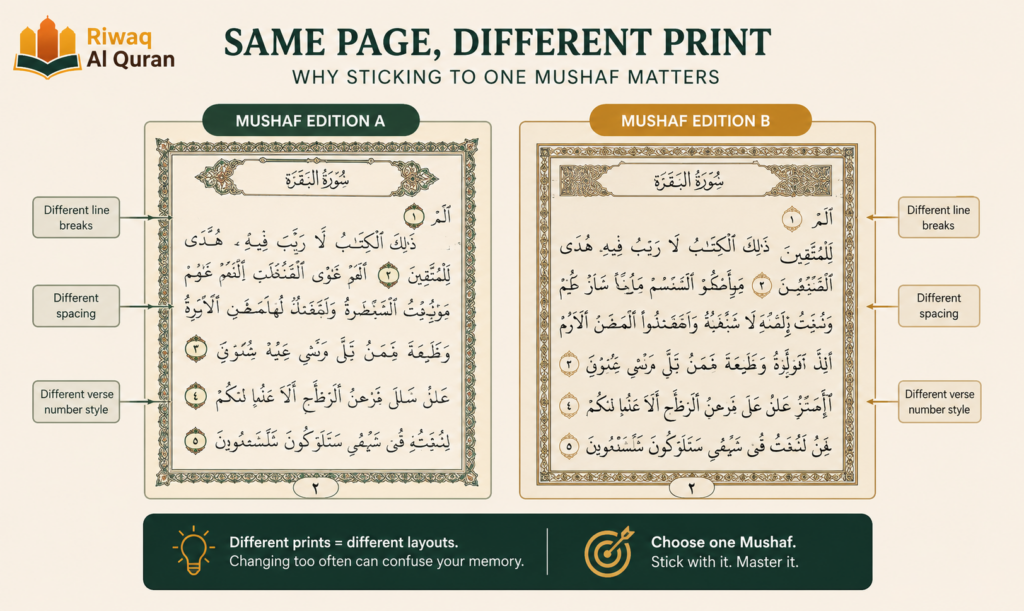
1) Visual Memory- Use the Same Mushaf Every Time
Always study from the exact same copy of the Quran, since switching between different print editions resets the visual familiarity you’ve built up.
- Your eyes effectively “photograph” the page layout over repeated exposure, so the position of a verse on the page becomes part of what you remember, not just the words themselves.
- This is why recall often becomes noticeably faster once you’ve used the same Mushaf edition for several months — you start recognizing where a verse sits before you even recall its wording.
- Switching editions mid-Hifz, even to a nicer print, can measurably slow recall until your visual memory adjusts to the new layout.
2) Talqin and Why You Should Hear It Correctly Before You Memorize It
Never memorize a new page without first hearing it recited correctly, since the goal is to memorize the sound of the verse, not just its written shape.
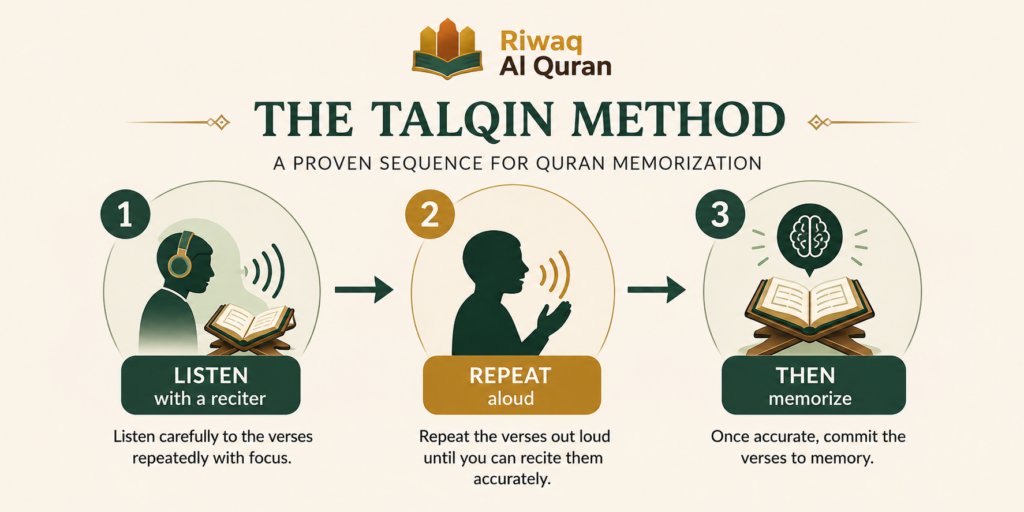
- Listen to a trusted reciter read the new page at least a few times before attempting to memorize it yourself.
- Repeat the verses aloud immediately after hearing them, rather than moving straight from listening to silent memorization.
- Have a qualified teacher check your recitation of the new page specifically, before you move on to memorizing the next one — catching an error at this stage costs minutes; catching it after weeks of repetition costs much more.
Mispronouncing a single word — the wrong Harakah, for instance — during this first stage creates a mental error that becomes very difficult to correct once it settles in.
Here’s what that kind of listening-first practice actually looks like for a student building this habit:
How to Correct Mistakes in Your Hifz Schedule
The moment you suspect an error has crept into your memorization, pause new memorization entirely and shift your full attention to revision with a qualified teacher.
- Stop adding new pages immediately — continuing to build on top of a mistake makes it harder to isolate later.
- Revisit the suspected page slowly with a teacher who can catch pronunciation and word-order errors you may no longer notice yourself.
- Re-test your recitation of that page after a few days of focused correction, rather than assuming one correction session has fully fixed it.
The most dangerous pitfall in self-directed Hifz is memorizing a mistake and reciting it correctly-sounding to yourself for weeks before anyone catches it — by the time it’s noticed, it’s already the version your memory defaults to, which is far harder to undo than to prevent in the first place.
Build Your Personalized Hifz Plan With Riwaq Al Quran
You don’t have to figure out the right pace on your own. Riwaq Al Quran is a comprehensive online platform offering personalized Quran, Arabic, and Islamic Studies classes for individuals of all ages and backgrounds, with instructors who follow a structured curriculum across Tajweed, Tafsir, and memorization.

If Hifz is your main goal right now, the Quran Memorization Online Course pairs you with certified Azhari tutors who build a plan around your actual schedule, track your monthly retention, and adjust your pace during busy weeks. Since Talqin and correct pronunciation matter just as much as the schedule itself, many students pair this with the Online Tajweed Classes to catch pronunciation errors early, before they become permanent habits.
Beyond Hifz specifically, Riwaq Al Quran also offers:
- For younger learners: Online Quran Classes for Kids.
- For understanding meaning alongside memorization: the Online Tafseer Course and Arabic Language Courses.
- For recitation fluency: the Online Quran Recitation Course and Online Qirat Course.
- For beginners starting from the basics: Noorani Qaida Online.
- For formal certification: the Ijazah Program.
Here’s what a structured schedule like this can lead to — one of our students placing first in Juz’ memorization:
Conclusion
Most Hifz schedules don’t fail because the plan was wrong — they fail because the pace was borrowed from someone else’s life. The student who commits to five lines a day and actually keeps that promise for five years will finish with the entire Quran.
The student who commits to a page a day and quits after six weeks finishes with nothing, no matter how ambitious the original plan looked on paper.
That’s the real function of a Quran memorization schedule: not to make you fast, but to make you consistent enough that speed stops mattering. Pair a pace you can sustain with the 70/30 balance between new memorization and revision, and let Talqin and Visual Memory protect what you’ve already built from quietly eroding.
Allah’s own promise to those who take up this path is direct: سَنُقْرِئُكَ فَلَا تَنسَىٰ (Surah Al-A’la, 87:6) — “We will make you recite, so you will not forget.”
The plan on this page works whether you finish in two years or five. What decides which one actually happens is whether you start today, at a pace honest enough to survive your worst week — not your best one.
FAQs
Here are direct answers to the questions people most often ask once they’ve picked a pace and started building their own Hifz schedule.
How often should I memorize the Quran each day?
Set a daily or weekly page target you can sustain consistently rather than an ambitious one you’ll abandon — five lines memorized permanently every day outperforms a full page memorized once and forgotten the following week.
How many pages should I memorize per day to finish in one year?
Completing the Quran in one year requires roughly two pages a day, which is an intensive pace best suited to students with significant daily study time and strong existing Arabic reading fluency.
What should I do if I fall behind on my memorization schedule?
Pause new memorization immediately and dedicate your full study time to revision until you’re confident your existing memorization is solid, since adding new pages on top of shaky ones compounds the problem rather than solving it.
Do I need to learn Tajweed before starting Hifz?
Learning Tajweed alongside your memorization, rather than after it, is strongly recommended, since memorizing a word with incorrect pronunciation early on creates an error that becomes far harder to correct once it’s settled into your memory.
Is it better to memorize quickly or slowly?
Slowly and accurately is better — memorizing quickly with mistakes is significantly harder to fix later than memorizing at a slower pace with correct pronunciation and solid retention from the start.