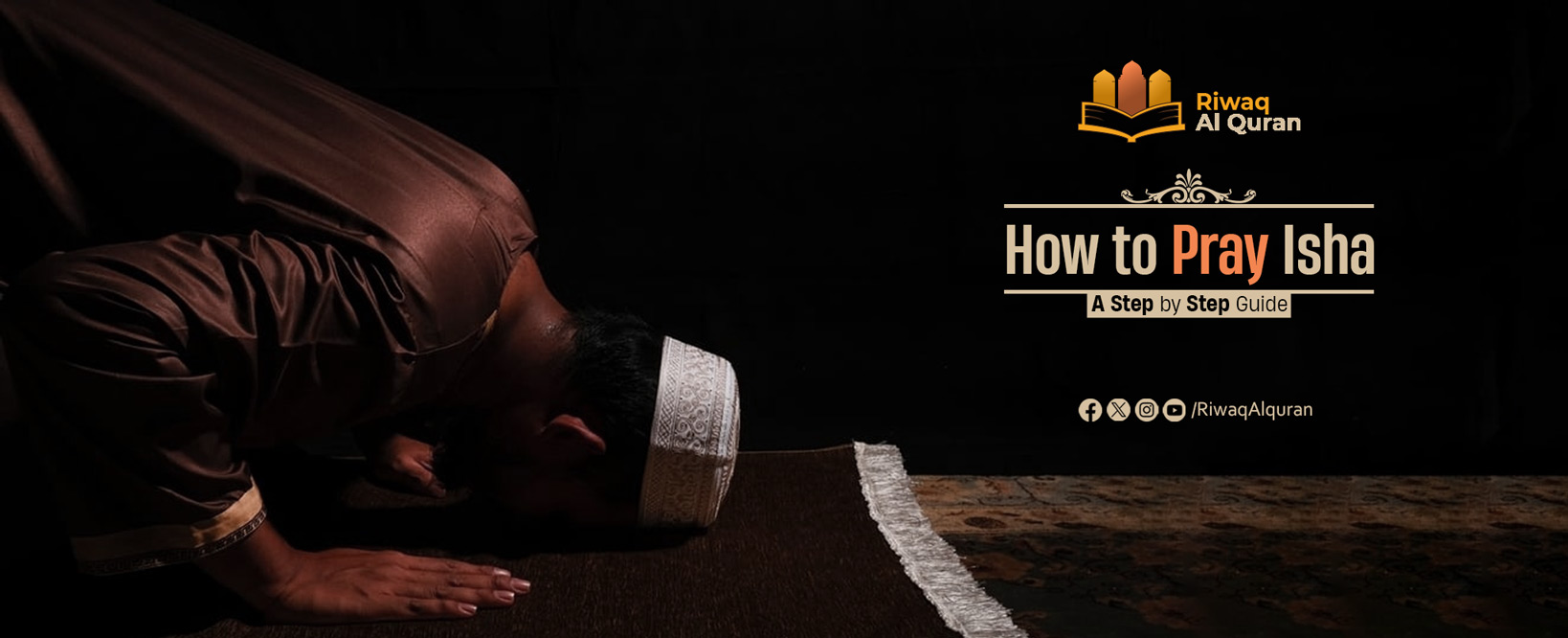
To perform Isha prayer: make your intention (niyyah), complete wudu, face the Qibla, say “Allahu Akbar,” recite Surah Al-Fatihah and a second Surah aloud in the first two rak’ahs, then bow, rise, and prostrate twice. Repeat for four rak’ahs total, reciting only Al-Fatihah silently in the last two. Finish with the Tashahhud and Tasleem.
Allah commands the establishment of prayer from the sun’s decline through the full darkness of the night:
“أَقِمِ الصَّلَاةَ لِدُلُوكِ الشَّمْسِ إِلَىٰ غَسَقِ اللَّيْلِ وَقُرْآنَ الْفَجْرِ ۖ إِنَّ قُرْآنَ الْفَجْرِ كَانَ مَشْهُودًا”
“Establish prayer at the decline of the sun until the darkness of the night, and [also] the Quran of dawn. Indeed, the recitation of dawn is ever witnessed.”— (Al-Isra: 78 )
This verse establishes the full arc of the daily prayer — from Dhuhr at midday through Isha at the fall of night’s darkness (ghasaq al-layl). The word ghasaq specifically refers to deep nightfall, which is the precise trigger for Isha’s beginning.
The five daily prayers constitute a central pillar of Islam, described in the Quran as a binding duty observed at its appointed times:
“إِنَّ الصَّلَاةَ كَانَتْ عَلَى الْمُؤْمِنِينَ كِتَابًا مَّوْقُوتًا”
“Indeed, prayer has been decreed upon the believers a decree of specified times.”— (An-Nisa: 103 )
The word mawqūtan — “at specified times” — makes clear that prayer in Islam is not a general aspiration to worship; it is a precise, scheduled act. The five prayers in order are:
- Fajr — dawn prayer
- Dhuhr — midday prayer
- Asr — afternoon prayer
- Maghrib — sunset prayer
- Isha — night prayer (the fifth and final)
Isha closes this daily cycle. Performing it consistently seals the day in obedience and invites Allah’s forgiveness before sleep.
What You Will Learn in This Article
- How to perform wudu before Isha
- How to make the correct niyyah (intention)
- The complete step-by-step Isha prayer guide
- How many rak’ahs Isha prayer has
- What to recite in each rak’ah (Arabic + transliteration)
- Post-prayer adhkar — what to say after Isha
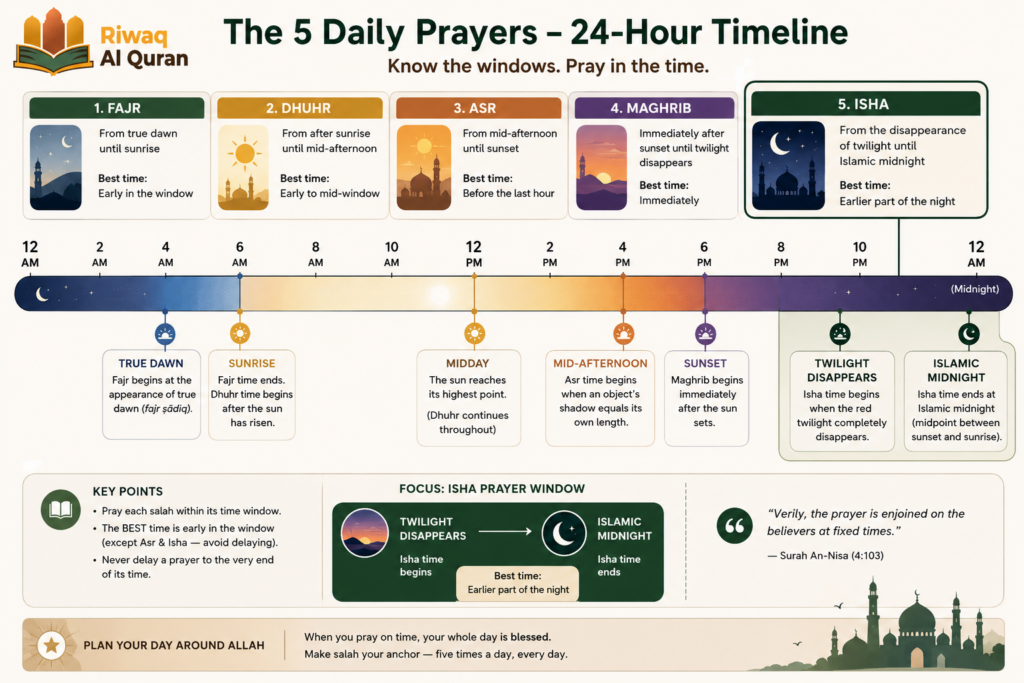
- Isha prayer time — when it starts and ends
- What to do if you miss the Isha prayer
- How travelers shorten Isha (Qasr)
- How to combine Maghrib and Isha (Jam’)
- How women perform the Isha prayer
- How to pray Isha when sick or unable to stand
- What to do if you make a mistake mid-prayer (Sujood As-Sahw)
- The most common mistakes to avoid
- The reward and virtue of Isha prayer
- Best surahs to recite in Isha
- How to perform the Sunnah and Witr prayer after Isha
Table of Contents
Before You Begin – Wudu and Niyyah
Two conditions must be met before the prayer is valid: you must be in a state of ritual purity (tahara) and you must have made your intention (niyyah).
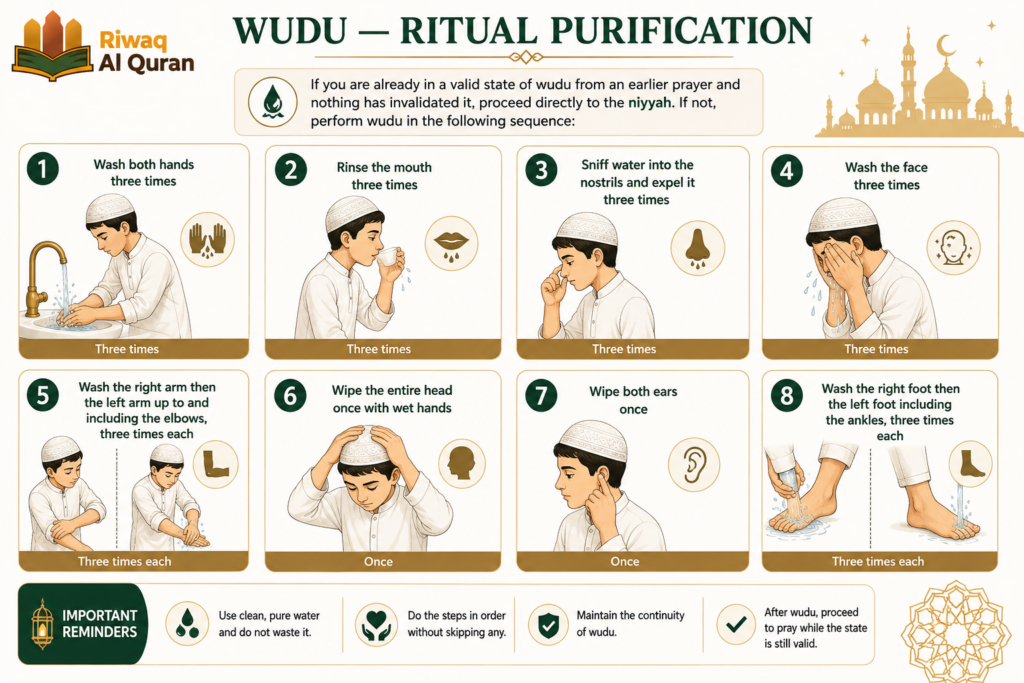
Wudu — Ritual Purification
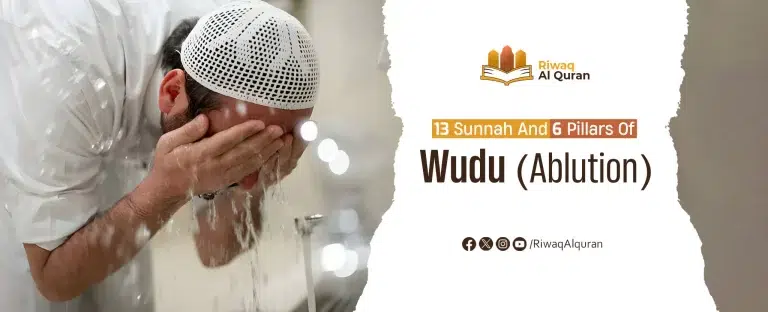
If you are already in a valid state of wudu from an earlier prayer and nothing has invalidated it, proceed directly to the niyyah. If not, perform wudu in the following sequence:
- Wash both hands three times.
- Rinse the mouth three times.
- Sniff water into the nostrils and expel it three times.
- Wash the face three times.
- Wash the right arm then the left arm up to and including the elbows, three times each.
- Wipe the entire head once with wet hands.
- Wipe both ears once.
- Wash the right foot then the left foot including the ankles, three times each.
Niyyah — The Intention
The niyyah is an internal resolution in your heart. It does not need to be spoken aloud, though saying it quietly is permissible. Your intention should specify three things: that you are performing the Isha prayer, that it is the four obligatory (fard) rak’ahs, and that it is performed for the sake of Allah alone.
A practical note for beginners: pause before raising your hands for takbeer, take one breath, and consciously acknowledge the transition from the world into prayer. The niyyah is not a formula — it is a conscious decision.
How to Perform the Isha Prayer — Step by Step
The Isha prayer consists of four continuous rak’ahs. Every position, every dua, and every transition is covered below — follow each step in sequence without skipping.
1. Stand, Face the Qibla, and Open the Prayer (Takbeeratul Ihram)
Stand upright on your prayer mat facing the Kaaba in Mecca. Raise both hands to your earlobes with palms facing forward and say:
“Allahu Akbar” (Allah is the Greatest)
This opening takbeer — called Takbeeratul Ihram — officially begins the prayer. Once said, you are in a state of prayer and must not speak or move outside the prescribed actions.
Fold your right hand over your left and rest them on your chest. Recite the opening supplication (dua al-istiftah) silently:
“Subhanakal-lahumma wa bihamdika, wa tabarakasmuka, wa ta’ala jadduka, wa la ilaha ghairuk.”
2. Recite Surah Al-Fatihah and a Second Surah (First Two Rak’ahs — Aloud)
In the first two rak’ahs, recitation is aloud. Begin with Surah Al-Fatihah in full:
“بِسْمِ اللَّهِ الرَّحْمَٰنِ الرَّحِيمِ ﴿١﴾ الْحَمْدُ لِلَّهِ رَبِّ الْعَالَمِينَ ﴿٢﴾ الرَّحْمَٰنِ الرَّحِيمِ ﴿٣﴾ مَالِكِ يَوْمِ الدِّينِ ﴿٤﴾ إِيَّاكَ نَعْبُدُ وَإِيَّاكَ نَسْتَعِينُ ﴿٥﴾ اهْدِنَا الصِّرَاطَ الْمُسْتَقِيمَ ﴿٦﴾ صِرَاطَ الَّذِينَ أَنْعَمْتَ عَلَيْهِمْ غَيْرِ الْمَغْضُوبِ عَلَيْهِمْ وَلَا الضَّالِّينَ ﴿٧﴾ (Al-Fatihah: 1–7 )
After Al-Fatihah, say “Ameen” quietly, then recite a second Surah or passage. Al-Fatihah is a rukn (pillar) of every rak’ah — the Prophet ﷺ said:
«لَا صَلَاةَ لِمَنْ لَمْ يَقْرَأْ بِفَاتِحَةِ الْكِتَابِ»
“There is no prayer for the one who does not recite Al-Fatihah.” — Sahih Al-Bukhari, Hadith 756 | Sahih Muslim, Hadith 394
This hadith is decisive — Al-Fatihah cannot be skipped in any rak’ah under any circumstance. Every rak’ah without it is, in the view of the majority of scholars, not counted.
3. Perform Ruku (Bowing)
Raise your hands to your earlobes saying “Allahu Akbar”, then bow at the waist with your back flat and hands gripping your knees. Recite silently three times:
«سُبْحَانَ رَبِّيَ الْعَظِيمِ»
“Subhana Rabbiyal Azeem” — Glory be to my Lord, the Most Great. Sahih Muslim, Hadith 772
4. Rise from Ruku (I’tidal)
Stand upright, raising your hands to ear level, and say:
«سَمِعَ اللَّهُ لِمَنْ حَمِدَهُ»
“Sami’Allahu liman hamidah” — Allah hears those who praise Him. Sahih al-Bukhari, Hadith 789; Sahih Muslim, Hadith 392
Then say:
«رَبَّنَا وَلَكَ الْحَمْدُ»
“Rabbana lakal hamd” — Our Lord, to You belongs all praise. Sahih al-Bukhari, Hadith 796; Sahih Muslim, Hadith 392
5. First Sujood (Prostration)
Say “Allahu Akbar” and lower into prostration. Seven body parts must touch the ground simultaneously:
- The forehead and nose together.
- Both palms, flat on the floor.
- Both knees.
- The undersides of all toes.
Recite silently three times:
«سُبْحَانَ رَبِّيَ الْأَعْلَى»
“Subhana Rabbiyal A’la” — Glory be to my Lord, the Most High. Sunan Abi Dawud, Hadith 870
6. Jalsa (Sitting Between the Two Prostrations)
Rise from sujood saying “Allahu Akbar” and sit briefly on your left foot with your right foot upright. Recite:
«رَبِّ اغْفِرْ لِي»
“Rabbighfirli” — O Allah, forgive me. Sunan Abi Dawud, Hadith 874; Jami’ at-Tirmidhi, Hadith 284
7. Second Sujood
Say “Allahu Akbar” and return to prostration. Recite “Subhana Rabbiyal A’la” three times. This completes one full rak’ah.
The Second Rak’ah and the First Tashahhud
Stand for the second rak’ah and repeat Steps 2 through 7 exactly — reciting Surah Al-Fatihah and a second Surah aloud, performing ruku, i’tidal, and two sujoods.
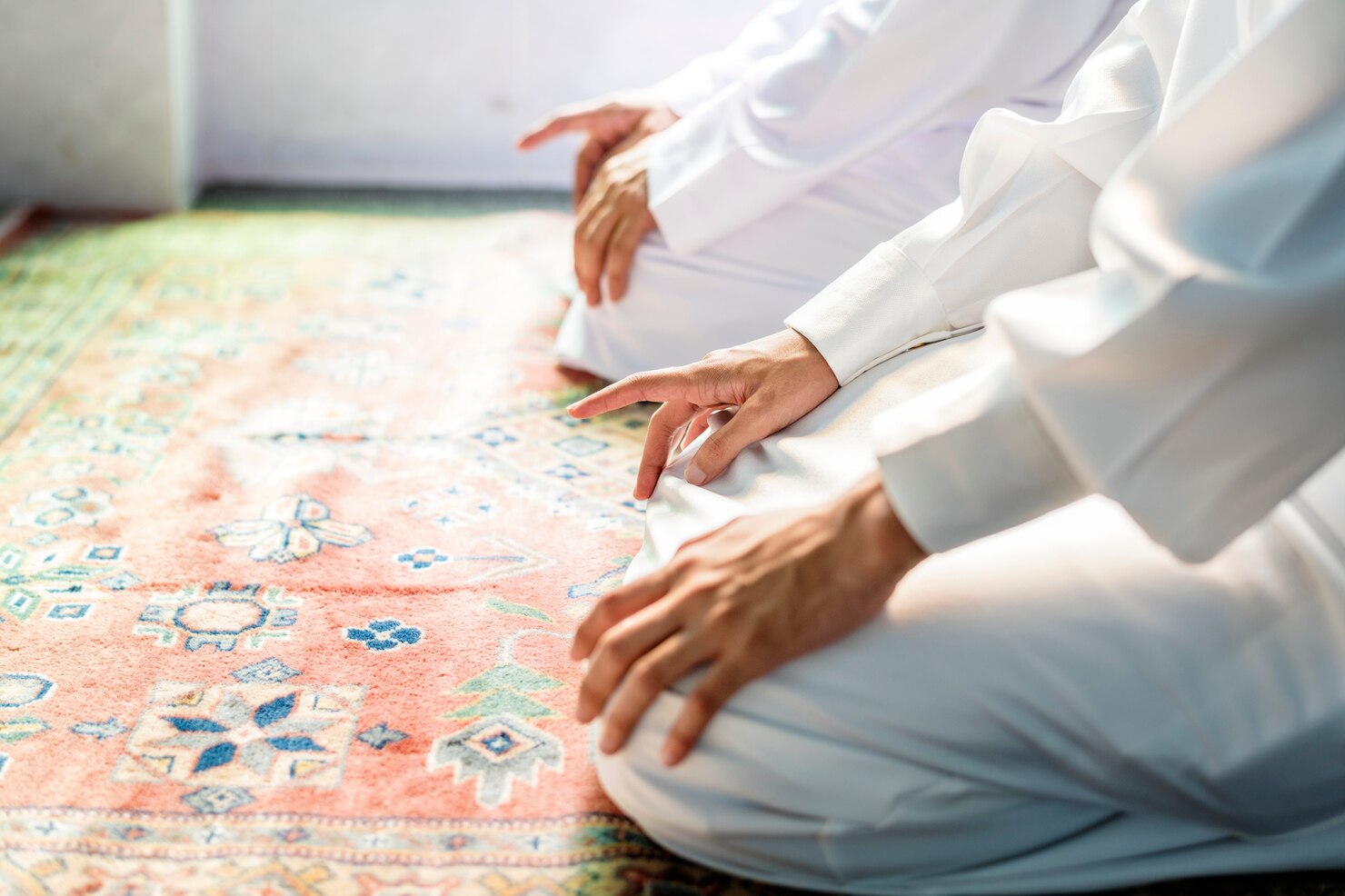
After the second sujood of the second rak’ah, sit and recite the first (short) Tashahhud. Raise your right index finger when you reach “Ashhadu alla ilaha illallah” and hold it raised until the Tashahhud is complete:
التَّحِيَّاتُ لِلَّهِ وَالصَّلَوَاتُ وَالطَّيِّبَاتُ، السَّلَامُ عَلَيْكَ أَيُّهَا النَّبِيُّ وَرَحْمَةُ اللَّهِ وَبَرَكَاتُهُ، السَّلَامُ عَلَيْنَا وَعَلَى عِبَادِ اللَّهِ الصَّالِحِينَ، أَشْهَدُ أَنْ لَا إِلَهَ إِلَّا اللَّهُ وَأَشْهَدُ أَنَّ مُحَمَّدًا عَبْدُهُ وَرَسُولُهُ.
“At-tahiyyatu Lillahi wa-salawatu wa’t-tayyibat, as-salamu ‘alayka ayyuhan-Nabiyyu wa rahmat-Allahi wa barakatuh. As-salamu ‘alayna wa ‘ala ‘ibad-Illah is-saliheen. Ashhadu alla ilaha illallah wa ashhadu anna Muhammadan ‘abduhu wa rasuluhu.” — Sahih al-Bukhari 831 · Sahih Muslim 402
{All dominion and greatness are for Allah, and all prayers and good deeds are for Him. Peace be upon you O Prophet, and likewise the Mercy of Allah and His Blessings. Peace be upon us and upon the pious servants of Allah. I testify that none has the right to be worshipped except Allah, and I testify that Muhammad is His servant and Messenger.}
The Third and Fourth Rak’ahs (Silent Recitation)
Stand for the third rak’ah. In the last two rak’ahs, two things change from the first two:
- Recite only Surah Al-Fatihah — no additional Surah after it.
- All recitation is done silently (sirr) — lips may move, but no audible sound.
Perform the full sequence of ruku, i’tidal, and two sujoods for both the third and fourth rak’ahs.
The Final Tashahhud and Tasleem
After the second sujood of the fourth rak’ah, sit and recite the final (long) Tashahhud, adding the Salawat Ibrahimiyyah:
التَّحِيَّاتُ لِلَّهِ وَالصَّلَوَاتُ وَالطَّيِّبَاتُ، السَّلَامُ عَلَيْكَ أَيُّهَا النَّبِيُّ وَرَحْمَةُ اللَّهِ وَبَرَكَاتُهُ، السَّلَامُ عَلَيْنَا وَعَلَى عِبَادِ اللَّهِ الصَّالِحِينَ، أَشْهَدُ أَنْ لَا إِلَهَ إِلَّا اللَّهُ وَأَشْهَدُ أَنَّ مُحَمَّدًا عَبْدُهُ وَرَسُولُهُ. اللَّهُمَّ صَلِّ عَلَى مُحَمَّدٍ وَعَلَى آلِ مُحَمَّدٍ، كَمَا صَلَّيْتَ عَلَى إِبْرَاهِيمَ وَعَلَى آلِ إِبْرَاهِيمَ، إِنَّكَ حَمِيدٌ مَجِيدٌ. اللَّهُمَّ بَارِكْ عَلَى مُحَمَّدٍ وَعَلَى آلِ مُحَمَّدٍ، كَمَا بَارَكْتَ عَلَى إِبْرَاهِيمَ وَعَلَى آلِ إِبْرَاهِيمَ، إِنَّكَ حَمِيدٌ مَجِيدٌ.
“At-tahiyyatu Lillahi wa-salawatu wa’t-tayyibat, as-salamu ‘alayka ayyuhan-Nabiyyu wa rahmat-Allahi wa barakatuh. As-salamu ‘alayna wa ‘ala ‘ibad-Illah is-saliheen. Ashhadu alla ilaha illallah wa ashhadu anna Muhammadan ‘abduhu wa rasuluhu. Allahumma salli ala Muhammadiw wa ala aali Muhammadin, kama sallayta ala Ibraheema wa alaa aali Ibraheema, innaKa Hameedum Majeed. Allahumma baarik ala Muhammadiw wa alaa aali Muhammadin, kamaa baarakta ala Ibraheema wa alaa aali Ibraheema, innaKa Hameedum Majeed.” — Sahih al-Bukhari 3370 · Sahih Muslim 406
The Tasleem
Conclude by turning your head to the right and saying:
«السَّلَامُ عَلَيْكُمْ وَرَحْمَةُ اللَّهِ»
“Assalamu alaikum wa rahmatullah” — Peace and the mercy of Allah be upon you. Sahih Muslim, Hadith 582
Then turn your head to the left and repeat the same. The four obligatory rak’ahs are now complete.
Why does this sitting matter? The final tashahhud is one of the obligatory elements (wajibat) of the prayer — deliberately omitting it invalidates the prayer. Rushing through it or standing before finishing it requires two prostrations of forgetfulness (sujood as-sahw) performed before tasleem.
The du’a before tasleem: After the Salawat Ibrahimiyyah and before you give tasleem, it is sunnah to make a personal supplication. The Prophet ﷺ said: “Then let him choose whichever supplication he wishes and supplicate with it.” — Sahih al-Bukhari, Hadith 835. One of the most beloved duas to recite here is:
“Allahumma inni a’udhu bika min adhabi jahannam, wa min adhabil-qabr, wa min fitnatil-mahya wal-mamat, wa min sharri fitnatil-masihid-dajjal.” — O Allah, I seek refuge in You from the punishment of Hell, from the punishment of the grave, from the trials of life and death, and from the evil of the trial of the False Messiah. — Sahih Muslim, Hadith 588
After the Tasleem – Post-Prayer Adhkar
Do not stand immediately after the tasleem. Remain seated and recite the following adhkar, which the Prophet ﷺ was consistent in after every obligatory prayer.
Say three times:
«أَسْتَغْفِرُ اللَّهَ»
“Astaghfirullah” — I seek forgiveness from Allah. Sahih Muslim, Hadith 591
Then say once:
«اللَّهُمَّ أَنْتَ السَّلَامُ وَمِنْكَ السَّلَامُ، تَبَارَكْتَ يَا ذَا الْجَلَالِ وَالْإِكْرَامِ»
“O Allah, You are Peace and from You comes peace. Blessed are You, O Possessor of Majesty and Honor.”Allahumma antas-salam wa minkas-salam, tabarakta ya dhal-jalali wal-ikram.” — O Allah, You are Peace and from You comes peace. Blessed are You, O Possessor of Majesty and Honor. — Sahih Muslim, Hadith 591
Then recite:
- “Subhan Allah” (Glory be to Allah) — 33 times.
- “Alhamdulillah” (All praise is due to Allah) — 33 times.
- “Allahu Akbar” (Allah is the Greatest) — 33 times.
Complete the hundred with:
«لَا إِلَهَ إِلَّا اللَّهُ وَحْدَهُ لَا شَرِيكَ لَهُ، لَهُ الْمُلْكُ وَلَهُ الْحَمْدُ وَهُوَ عَلَى كُلِّ شَيْءٍ قَدِيرٌ»
“There is no god but Allah alone, with no partner. To Him belongs all dominion and all praise, and He is over all things capable.”La ilaha illallahu wahdahu la sharika lah, lahul-mulku wa lahul-hamdu wa huwa ala kulli shay’in qadir.” — There is no god but Allah alone, with no partner. To Him belongs all dominion and all praise, and He is over all things capable. Sahih Muslim, Hadith 597
The Prophet ﷺ said:
«مَنْ سَبَّحَ اللَّهَ فِي دُبُرِ كُلِّ صَلَاةٍ ثَلَاثًا وَثَلَاثِينَ، وَحَمِدَ اللَّهَ ثَلَاثًا وَثَلَاثِينَ، وَكَبَّرَ اللَّهَ ثَلَاثًا وَثَلَاثِينَ، فَتِلْكَ تِسْعَةٌ وَتِسْعُونَ… لَا إِلَهَ إِلَّا اللَّهُ وَحْدَهُ لَا شَرِيكَ لَهُ… غُفِرَتْ خَطَايَاهُ وَإِنْ كَانَتْ مِثْلَ زَبَدِ الْبَحْرِ»
“Whoever says this after every prayer, his sins will be forgiven even if they are like the foam of the sea.” — Sahih Muslim, Hadith 597
Then recite Ayat al-Kursi (2:255) once. The Prophet ﷺ said: “Whoever recites Ayat al-Kursi after every obligatory prayer, nothing prevents him from entering Paradise except death.” — Al-Nasa’i, graded Sahih by Al-Albani.
How Many Rakats Is the Isha Prayer?
The Isha prayer has a clearly structured sequence of rak’ahs — some obligatory, some strongly recommended. Knowing the distinction allows you to prioritize when time is limited and build toward the full night’s session gradually.
1. The Obligatory (Fard) Rak’ahs
The Isha prayer consists of four obligatory (fard) rak’ahs. The first two are recited aloud (jahr) — you recite Surah Al-Fatihah and a second Surah audibly. The third and fourth rak’ahs are recited silently (sirr).
Missing these four rak’ahs without a valid reason is a sin. If missed, they must be made up (Qada) regardless of the time.
2. The Sunnah and Witr Rak’ahs
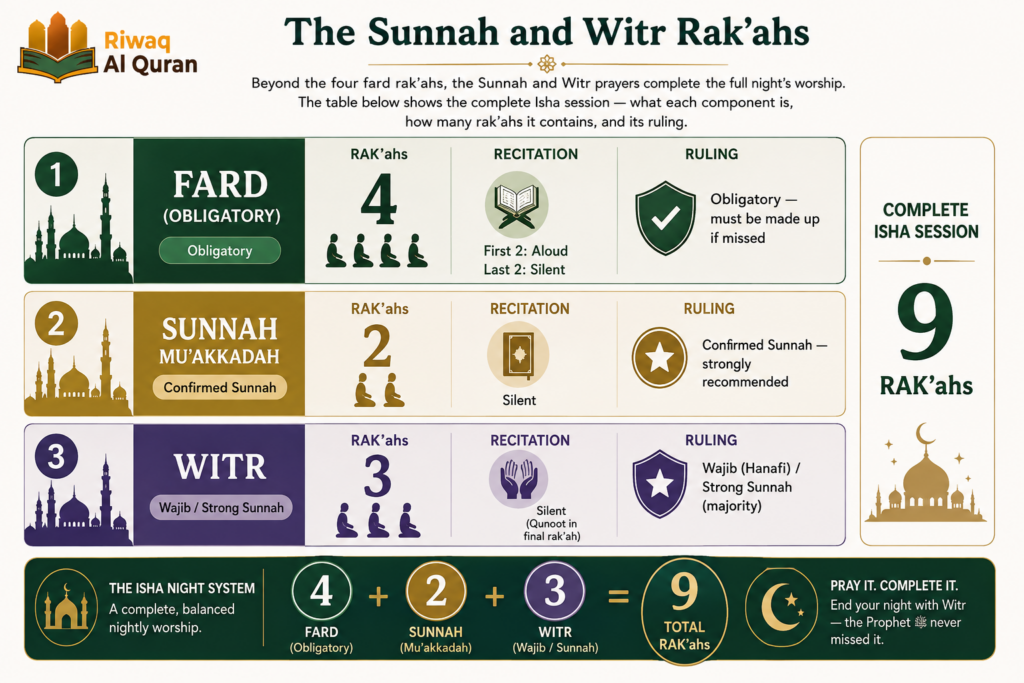
Beyond the four fard rak’ahs, the Sunnah and Witr prayers complete the full night’s worship. The table below shows the complete Isha session — what each component is, how many rak’ahs it contains, and its ruling.
| Prayer Type | Rak’ahs | Recitation | Ruling |
| Fard (Obligatory) | 4 | First 2: Aloud / Last 2: Silent | Obligatory — must be made up if missed |
| Sunnah Mu’akkadah | 2 | Silent | Confirmed Sunnah — strongly recommended |
| Witr | 3 | Silent (Qunoot in final rak’ah) | Wajib (Hanafi) / Strong Sunnah (majority) |
| Complete Session | 9 |
When to Perform the Isha Prayer
Knowing the exact time window for Isha protects you from accidentally praying outside the valid period — an error that renders the prayer invalid if the window has closed. Timing also governs important rulings for travelers and those combining prayers.
1. The Start and End Time of Isha
Isha begins when the red twilight (shafaq ahmar) on the horizon fully disappears after Maghrib. The key timing details are:
- Start time: when the red twilight on the horizon fully disappears after Maghrib
- Preferred end: Islamic midnight (the midpoint between Maghrib and Fajr)
- Permissible end: just before Fajr, for genuine necessity only
- Islamic midnight calculation: (total night duration from Maghrib to Fajr) ÷ 2
«وَوَقْتُ صَلَاةِ الْعِشَاءِ إِلَى نِصْفِ اللَّيْلِ الْأَوْسَطِ»
“The time of Isha is until midnight.”— Sahih Muslim, Hadith 612
Islamic midnight is not 12:00 AM on the clock. If Maghrib is at 6:00 PM and Fajr at 4:00 AM, Islamic midnight falls at 11:00 PM. This calculation shifts with the seasons — winter nights are longer, summer nights shorter. Delaying Isha past the preferred window out of laziness is disliked (makruh); habitually praying it near Fajr without necessity is discouraged by scholars.
2. What to Do If You Miss the Isha Prayer (Qada)
Missing Isha does not mean the obligation lapses. The duty remains until it is fulfilled.
«مَنْ نَسِيَ صَلَاةً فَلْيُصَلِّهَا إِذَا ذَكَرَهَا، لَا كَفَّارَةَ لَهَا إِلَّا ذَلِكَ»
‘Whoever forgets a prayer, let him pray it when he remembers it. There is no expiation for it other than that.”— Sahih Al-Bukhari, Hadith 597 | Sahih Muslim, Hadith 684
The phrase lā kaffārata lahā illā dhālik — “there is no expiation for it other than that” — is decisive. No charity, extra fasting, or other act substitutes for the missed prayer. The only remedy is to pray it. When making up Isha as Qada, it is prayed exactly as normal — four rak’ahs in the standard sequence — regardless of the current time of day.
3. Isha Prayer for Travelers — Shortening to Two Rak’ahs (Qasr)
When traveling a qualifying distance, the four-rak’ah Isha prayer is shortened to two rak’ahs. This concession is called Qasr (shortening) and is one of Islam’s most consistently applied travel easements.
“The Prophet ﷺ used to pray two rak’ahs when he was traveling, and he continued doing this until he met Allah.”
— Sahih Al-Bukhari, Hadith 1101
Qasr is not optional charity — the Prophet ﷺ applied it throughout every journey without exception. How to perform Isha as Qasr during travel:
- Pray two rak’ahs instead of four.
- Recite both rak’ahs aloud (as you would the first two of the normal Isha).
- Sit for the full final Tashahhud after the second rak’ah.
- Conclude with Tasleem — the prayer is complete.
The qualifying travel distance varies slightly by madhab (approximately 48–80 miles / 77–130 km), but the principle is agreed upon across all four major schools.
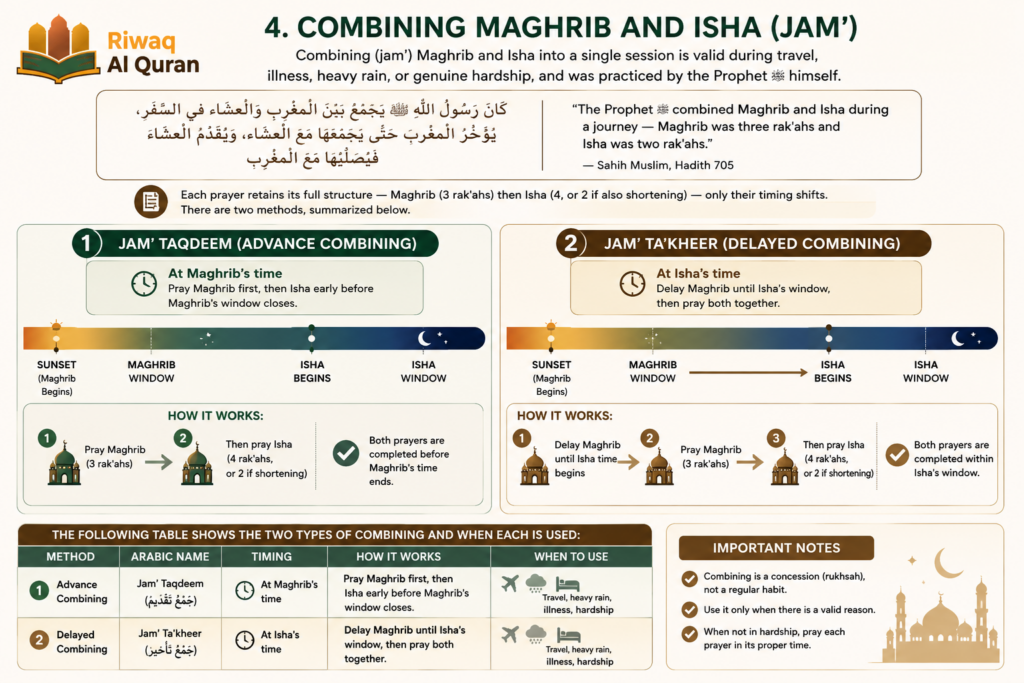
4. Combining Maghrib and Isha (Jam’)
Combining (jam’) Maghrib and Isha into a single session is valid during travel, illness, heavy rain, or genuine hardship, and was practiced by the Prophet ﷺ himself.
«كَانَ رَسُولُ اللَّهِ ﷺ يَجْمَعُ بَيْنَ الْمَغْرِبِ وَالْعِشَاءِ فِي السَّفَرِ، يُؤَخِّرُ الْمَغْرِبَ حَتَّى يَجْمَعَهَا مَعَ الْعِشَاءِ، وَيُقَدِّمُ الْعِشَاءَ فَيُصَلِّيهَا مَعَ الْمَغْرِبِ»
“The Prophet ﷺ combined Maghrib and Isha during a journey — Maghrib was three rak’ahs and Isha was two rak’ahs.”— Sahih Muslim, Hadith 705
Each prayer retains its full structure — Maghrib (3 rak’ahs) then Isha (4, or 2 if also shortening) — only their timing shifts. There are two methods, summarized below.
The following table shows the two types of combining and when each is used:
| Method | Arabic Name | Timing | How It Works |
| Advance combining | Jam’ Taqdeem | At Maghrib’s time | Pray Maghrib first, then Isha early before Maghrib’s window closes |
| Delayed combining | Jam’ Ta’kheer | At Isha’s time | Delay Maghrib until Isha’s window, then pray both together |
How Women Perform the Isha Prayer
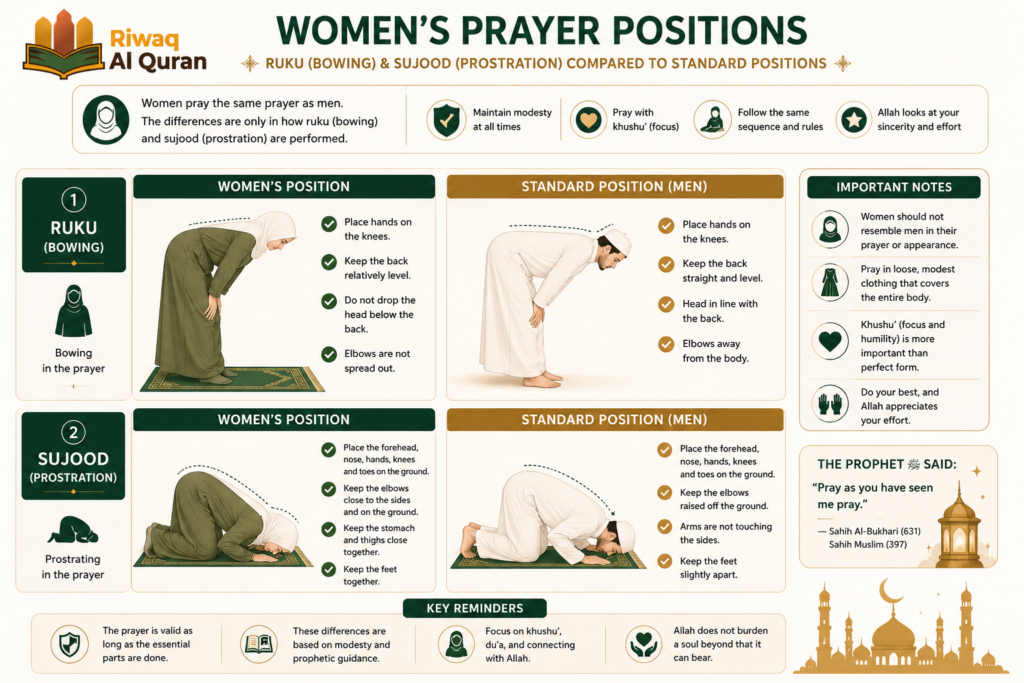
The Isha prayer is obligatory upon women exactly as it is upon men. The number of rak’ahs, the recitation, the timing, and the adhkar are identical.
There are minor differences in physical position that scholars from the Hanafi and Shafi’i schools recommend for women:
- In ruku, women bow slightly less deeply and keep their arms closer to their body rather than spreading the elbows outward
- In sujood, women keep their body more compact — the arms rest against the sides rather than being spread, and the abdomen rests closer to the thighs
- In sitting positions (Tashahhud and Jalsa), women sit with both feet directed to the right side (tawarruk on both sides), rather than sitting upright on the left foot
These differences are positions held by some scholars and not all — consult a qualified scholar if you want to follow a specific madhab’s ruling precisely.
Women in a state of menstruation (hayd) or post-natal bleeding (nifas) do not pray and are not required to make up missed prayers during those days. This is not a sin; it is a ruling from the Sharia.
How to Pray Isha When Sick or Unable to Stand
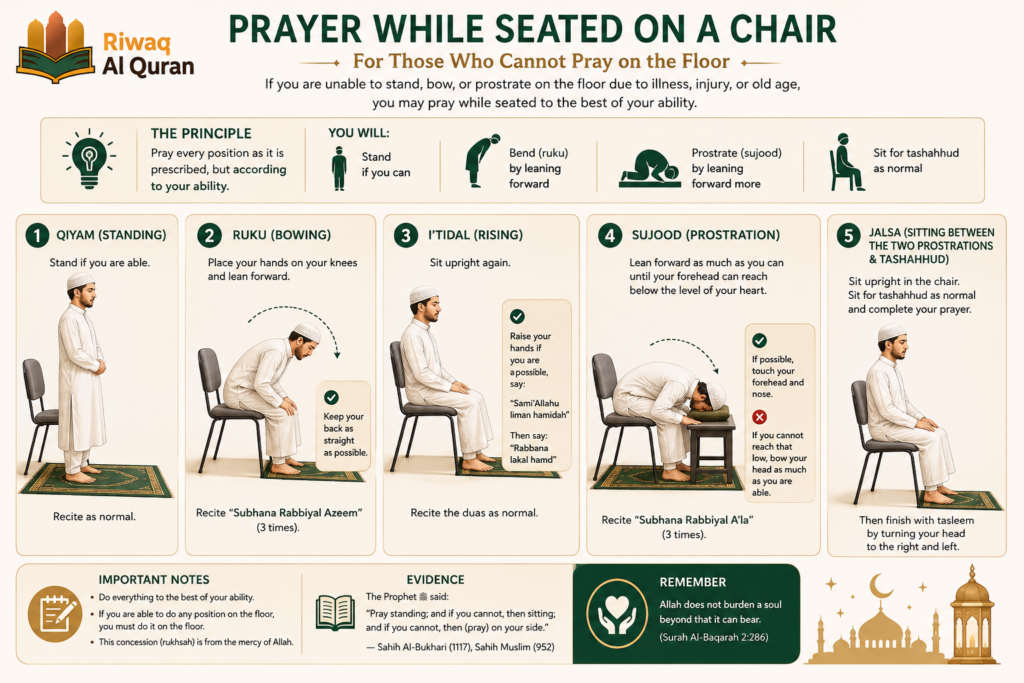
Islam does not require physical ability the person does not have. The ruling is graduated: you pray in whatever capacity you are able.
- If you cannot stand: Pray seated on a chair or on the floor. Bow forward from the waist for ruku and bow further forward for sujood, or use a table or surface in front of you.
- If you cannot bow forward: Indicate ruku and sujood with head movements — nod the head slightly for ruku and nod lower for sujood.
- If you cannot sit: Pray lying on your back. Face your feet toward the Qibla if possible, or simply face in that direction.
- If you cannot move at all: The intention (niyyah) and recitation of Al-Fatihah in the heart, with eye movements or mental acknowledgment of each position change, fulfills the obligation.
The Prophet ﷺ said:
«صَلِّ قَائِمًا، فَإِنْ لَمْ تَسْتَطِعْ فَقَاعِدًا، فَإِنْ لَمْ تَسْتَطِعْ فَعَلَى جَنْبٍ»
“Pray standing; if you cannot, then sitting; if you cannot, then on your side.” — Sahih Al-Bukhari, Hadith 1117
The prayer is never dropped as long as consciousness remains. The number of rak’ahs, Tashahhud, and Tasleem remain the same — only the physical execution changes.
What to Do If You Make a Mistake Mid-Prayer (Sujood As-Sahw)
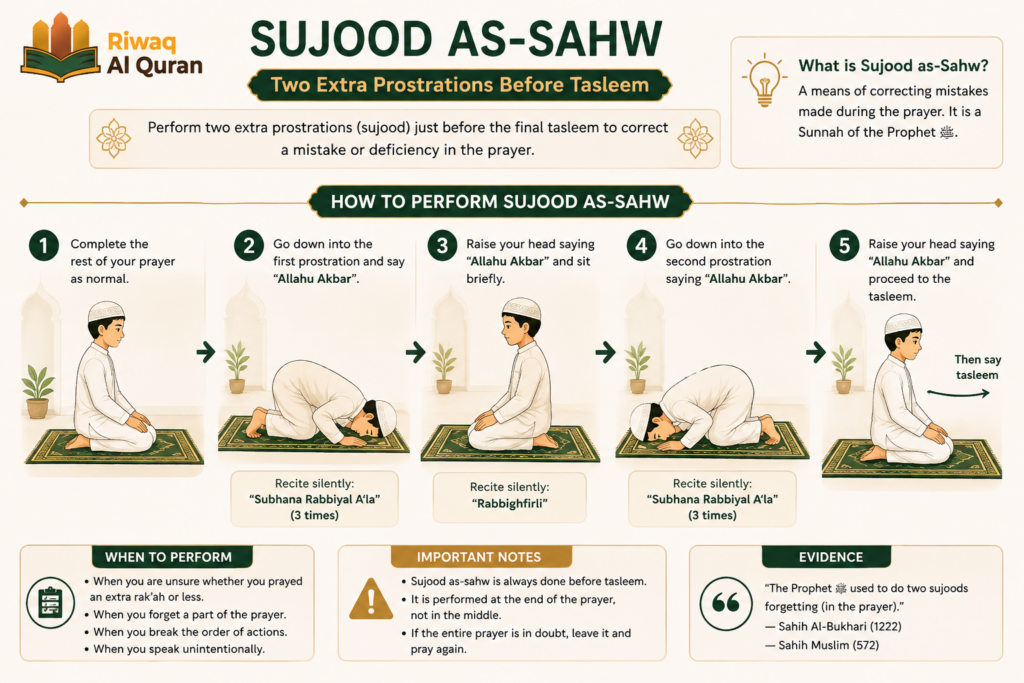
Sujood as-sahw (prostrations of forgetfulness) is the remedy for specific errors made during the prayer. It consists of two prostrations performed before the Tasleem (or in some cases after).
When Sujood As-Sahw Is Required
- Adding an extra rak’ah by mistake.
- Forgetting to sit for the first Tashahhud and standing for the third rak’ah before completing it.
- Omitting a wajib (obligatory) element — such as the first Tashahhud or the Tasbeeh in ruku or sujood.
- Any doubt about whether a rak’ah was completed.
Note: Forgetting Al-Fatihah entirely in a rak’ah requires repeating that rak’ah, not sujood as-sahw.
How to Perform Sujood As-Sahw
- After the final Tashahhud and Salawat, before Tasleem, say “Allahu Akbar”.
- Perform two full prostrations exactly as in regular prayer, reciting “Subhana Rabbiyal A’la” three times in each.
- Sit between the two prostrations and say “Rabbighfirli”.
- After the second prostration, sit and give the Tasleem to both sides as normal.
Common Mistakes to Avoid in the Isha Prayer
Learning the correct steps is half the work. Knowing where beginners consistently go wrong is the other half — and catching these early prevents months of flawed practice becoming habit.
a. Mistakes That Affect Prayer Validity (Must Repeat)
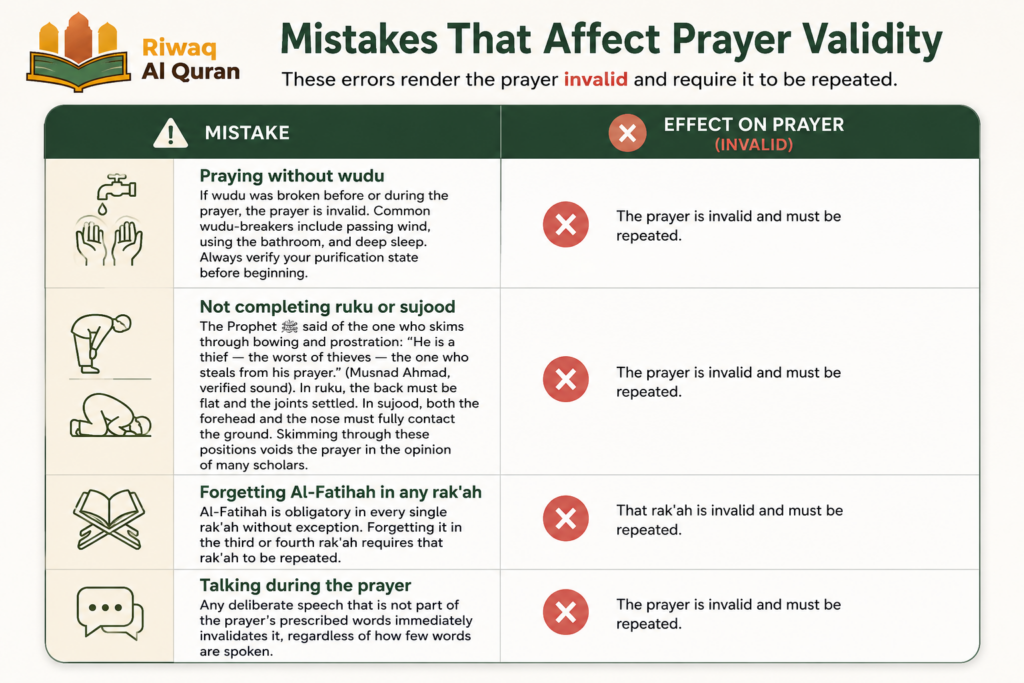
These errors render the prayer invalid and require it to be repeated:
- Praying without wudu — If wudu was broken before or during the prayer, the prayer is invalid. Common wudu-breakers include passing wind, using the bathroom, and deep sleep. Always verify your purification state before beginning.
- Not completing ruku or sujood — The Prophet ﷺ said of the one who skims through bowing and prostration: “He is a thief — the worst of thieves — the one who steals from his prayer.” (Musnad Ahmad, verified sound). In ruku, the back must be flat and the joints settled. In sujood, both the forehead and the nose must fully contact the ground. Skimming through these positions voids the prayer in the opinion of many scholars.
Forgetting Al-Fatihah in any rak’ah — Al-Fatihah is obligatory in every single rak’ah without exception. Forgetting it in the third or fourth rak’ah requires that rak’ah to be repeated. - Talking during the prayer — Any deliberate speech that is not part of the prayer’s prescribed words immediately invalidates it, regardless of how few words are spoken.
b. Mistakes That Reduce Quality Without Voiding the Prayer
These errors do not invalidate the prayer but contradict the Sunnah and weaken its quality:
- Reciting the third and fourth rak’ahs aloud — Only the first two rak’ahs of Isha are recited aloud. Many beginners recite throughout, which contradicts the established Sunnah even if it does not technically void the prayer.
- Rushing the Tashahhud — The Tashahhud is a direct address to the Prophet ﷺ and a testimony of faith. Reciting it at speed as a formality to be discharged defeats its purpose. Sit fully, point the index finger from the beginning of the Tashahhud, and recite at a pace that allows comprehension.
- Neglecting the Jalsa dua — Many beginners sit between the two sujoods and say nothing. The Jalsa has its own supplication — “Rabbighfirli” (O Allah, forgive me) — and some narrations report the Prophet ﷺ adding a longer version asking for mercy, health, and guidance. This is a moment of direct asking for forgiveness that the hurried prayer discards entirely.
- Raising only the forehead in sujood — Both the forehead and the nose must touch the prayer mat. The majority of scholars consider touching both obligatory — the forehead alone is insufficient.
The Virtue and Reward of Isha Prayer
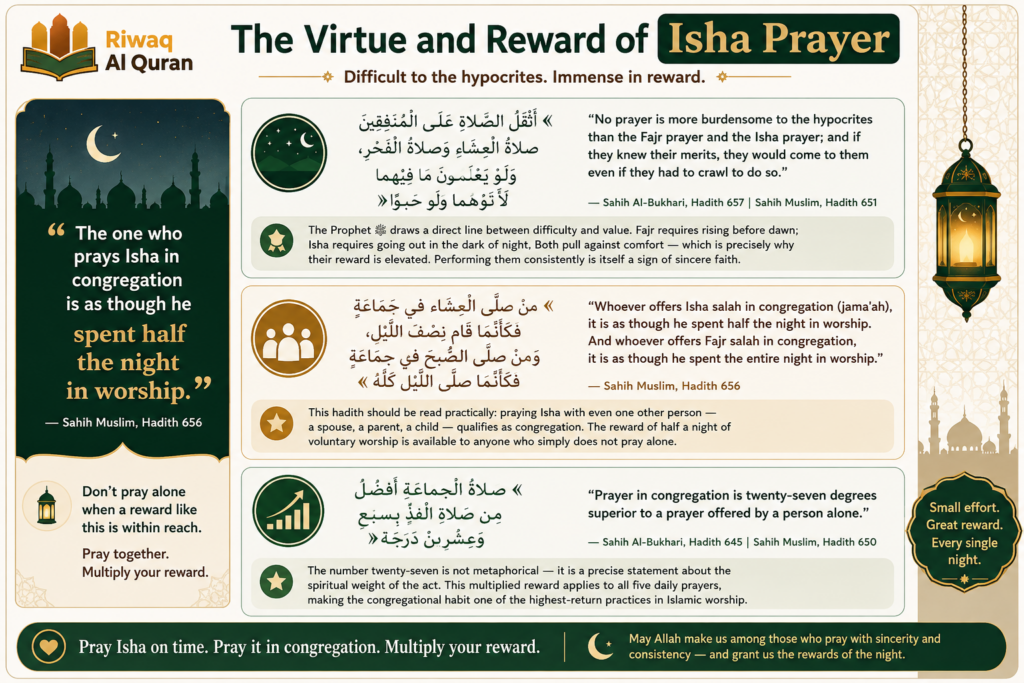
The Prophet Muhammad ﷺ specifically singled out Isha — alongside Fajr — as the most challenging prayers for the inattentive, precisely because their reward is proportionally greater:
«أَثْقَلُ الصَّلَاةِ عَلَى الْمُنَافِقِينَ صَلَاةُ الْعِشَاءِ وَصَلَاةُ الْفَجْرِ، وَلَوْ يَعْلَمُونَ مَا فِيهِمَا لَأَتَوْهُمَا وَلَوْ حَبْوًا»
“No prayer is more burdensome to the hypocrites than the Fajr prayer and the Isha prayer; and if they knew their merits, they would come to them even if they had to crawl to do so.”— Sahih Al-Bukhari, Hadith 657 | Sahih Muslim, Hadith 651
The Prophet ﷺ draws a direct line between difficulty and value. Fajr requires rising before dawn; Isha requires going out in the dark of night. Both pull against comfort — which is precisely why their reward is elevated. Performing them consistently is itself a sign of sincere faith.
The communal reward of Isha is equally remarkable:
«مَنْ صَلَّى الْعِشَاءَ فِي جَمَاعَةٍ فَكَأَنَّمَا قَامَ نِصْفَ اللَّيْلِ، وَمَنْ صَلَّى الصُّبْحَ فِي جَمَاعَةٍ فَكَأَنَّمَا صَلَّى اللَّيْلَ كُلَّهُ»
Whoever offers Isha salah in congregation (jama’ah), it is as though he spent half the night in worship. And whoever offers Fajr salah in congregation, it is as though he spent the entire night in worship.”— Sahih Muslim, Hadith 656
This hadith should be read practically: praying Isha with even one other person — a spouse, a parent, a child — qualifies as congregation. The reward of half a night of voluntary worship is available to anyone who simply does not pray alone.
And the virtue of praying in congregation is reinforced more broadly:
«صَلَاةُ الْجَمَاعَةِ أَفْضَلُ مِنْ صَلَاةِ الْفَذِّ بِسَبْعٍ وَعِشْرِينَ دَرَجَةً»
“Prayer in congregation is twenty-seven degrees superior to a prayer offered by a person alone.”— Sahih Al-Bukhari, Hadith 645 | Sahih Muslim, Hadith 650
The number twenty-seven is not metaphorical — it is a precise statement about the spiritual weight of the act. This multiplied reward applies to all five daily prayers, making the congregational habit one of the highest-return practices in Islamic worship.
Why the Night Is a Special Time for Worship
Isha prayer is not just the final prayer — it is the gateway to the night, which holds a unique status in Islamic worship that no other time of day shares.
Allah addresses the Prophet ﷺ directly about the night’s spiritual opportunity:
“وَمِنَ اللَّيْلِ فَتَهَجَّدْ بِهِ نَافِلَةً لَّكَ ۖ عَسَىٰ أَن يَبْعَثَكَ رَبُّكَ مَقَامًا مَّحْمُودًا”
“And from [part of] the night, pray with it as additional [worship] for you; it may be that your Lord will raise you to a praised station.”— (Al-Isra: 79 )
This verse immediately follows verse 78, which commands Isha — intentionally connecting the obligatory night prayer to voluntary night worship (tahajjud). Isha is the anchor; the voluntary night prayers are the extension. Many scholars describe Isha as the opening gate to the night’s spiritual hours.
Allah also describes the character of the truly righteous through their night worship:
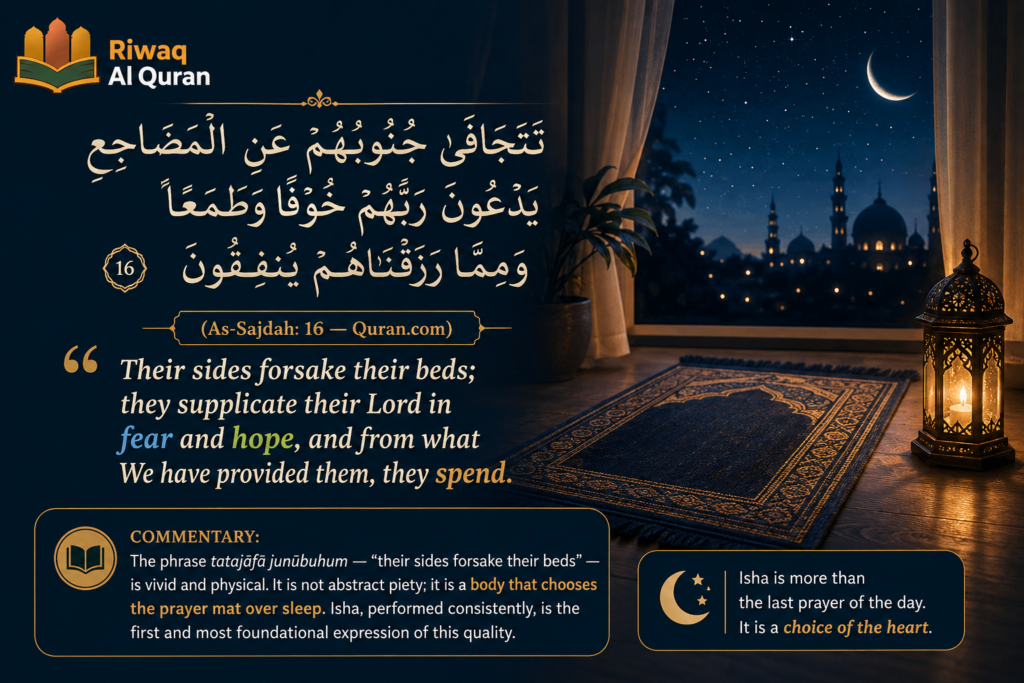
“تَتَجَافَىٰ جُنُوبُهُمْ عَنِ الْمَضَاجِعِ يَدْعُونَ رَبَّهُمْ خَوْفًا وَطَمَعًا ۖ وَمِمَّا رَزَقْنَاهُمْ يُنفِقُونَ”
“Their sides forsake their beds; they supplicate their Lord in fear and hope, and from what We have provided them, they spend.”— (As-Sajdah: 16 )
The phrase tatajāfā junūbuhum — “their sides forsake their beds” — is vivid and physical. It is not abstract piety; it is a body that chooses the prayer mat over sleep. Isha, performed consistently, is the first and most foundational expression of this quality.
Recommended Surahs to Recite in Isha Prayer
One practical challenge beginners face is not knowing which surahs to recite after Al-Fatihah. The surahs below are the most commonly used for Isha and are easy to memorize — for a broader list organized by length and difficulty, see: The Easiest Quran Surahs to Memorize for Salah.
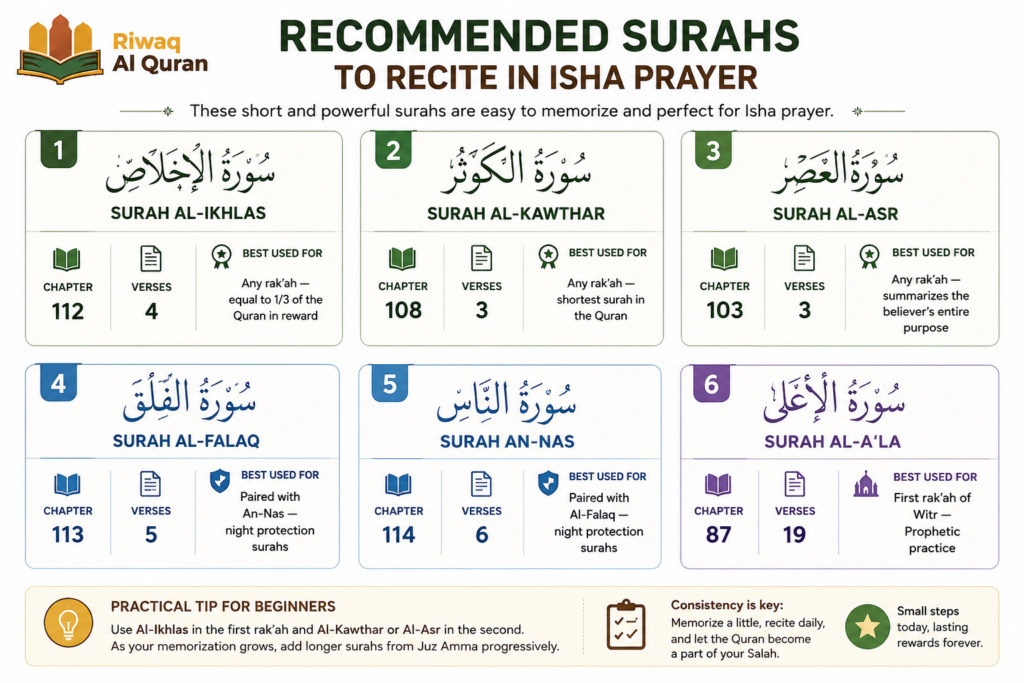
The table below shows the best surahs for Isha prayer, organized by chapter number, length, and recommended use:
| Surah | Chapter | Verses | Best Used For |
| Al-Ikhlas | 112 | 4 | Any rak’ah — equal to 1/3 of the Quran in reward |
| Al-Kawthar | 108 | 3 | Any rak’ah — shortest surah in the Quran |
| Al-Asr | 103 | 3 | Any rak’ah — summarizes the believer’s entire purpose |
| Al-Falaq | 113 | 5 | Paired with An-Nas — night protection surahs |
| An-Nas | 114 | 6 | Paired with Al-Falaq — night protection surahs |
| Al-A’la | 87 | 19 | First rak’ah of Witr — Prophetic practice |
A practical approach for beginners: use Al-Ikhlas in the first rak’ah and Al-Kawthar or Al-Asr in the second. As your memorization grows, add longer surahs from Juz Amma progressively.
The Sunnah and Witr Prayer After Isha
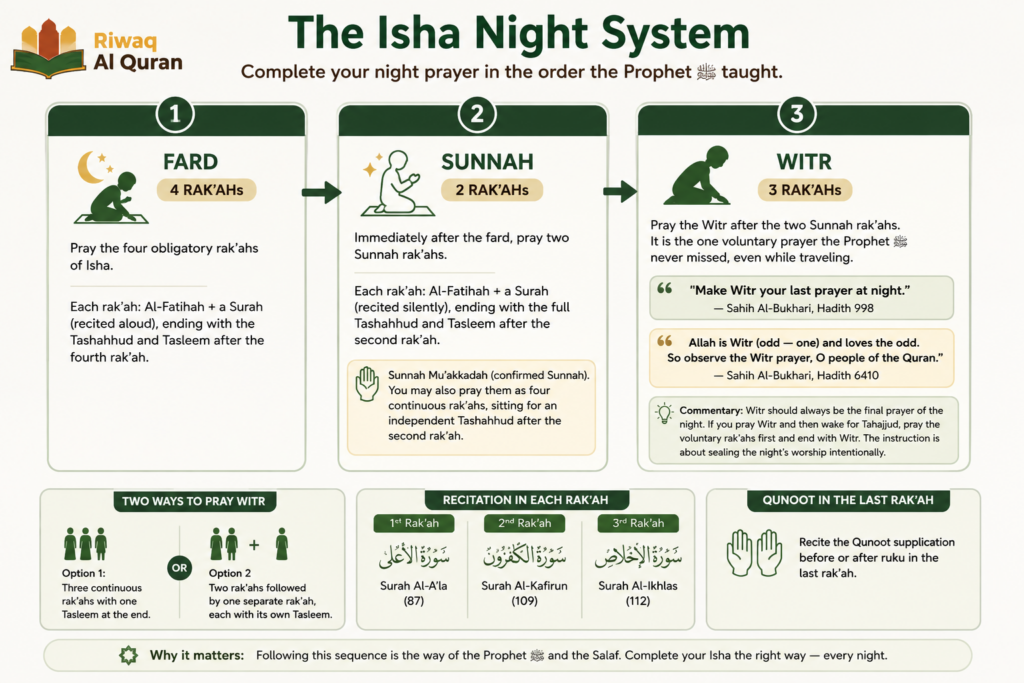
The four obligatory rak’ahs fulfill the minimum duty. The Sunnah and Witr that follow complete the night as a full act of worship. Think of it as a three-part system: the fard (obligation) → the Sunnah (confirmation) → the Witr (seal of the night).
For a deeper look at the full range of optional and Sunnah prayers in Islam, that guide covers all recommended voluntary prayers across the day.
Allah says about seeking help through prayer:
“وَاسْتَعِينُوا بِالصَّبْرِ وَالصَّلَاةِ ۚ وَإِنَّهَا لَكَبِيرَةٌ إِلَّا عَلَى الْخَاشِعِينَ”
“And seek help through patience and prayer. Indeed, it is a burden except for the humble.”(Al-Baqarah: 45)
The word kabīrah — “a burden” — is honest. Prayer requires effort. But the clause that follows is the key: it is only heavy except for the humble (al-khāshi’īn). The Sunnah and Witr prayers, because they are voluntary, tend to be where khushoo’ grows most naturally.
1. The Two Sunnah Rak’ahs After Isha
Immediately after the four fard rak’ahs, pray two Sunnah rak’ahs. These are performed identically to the first two rak’ahs of Isha — Al-Fatihah and a second Surah, recited silently this time — and end with the full Tashahhud and Tasleem after the second rak’ah.
These two rak’ahs are Sunnah Mu’akkadah (confirmed Sunnah). You may also pray them as four continuous rak’ahs, sitting for an independent Tashahhud after the second rak’ah before standing for the third and fourth.
2. The Witr Prayer
The Witr prayer is three rak’ahs performed after the two Sunnah rak’ahs — and it is the one voluntary prayer the Prophet ﷺ never missed, even while traveling:
«اجْعَلُوا آخِرَ صَلاتِكُمْ بِاللَّيْلِ وِتْرًا»
“Make Witr your last prayer at night.”— Sahih Al-Bukhari, Hadith 998
Witr should always be the final prayer of the night. If you pray Witr and then wake for Tahajjud, pray the voluntary rak’ahs first and end with Witr. The instruction is about sealing the night’s worship intentionally.
Allah’s love for odd numbers is directly connected to this prayer:
«إِنَّ اللَّهَ وِتْرٌ يُحِبُّ الْوِتْرَ، فَأَوْتِرُوا يَا أَهْلَ الْقُرْآنِ»
“Allah is Witr (odd — one) and loves the odd. So observe the Witr prayer, O people of the Quran.”— Sahih Al-Bukhari, Hadith 6410
The word witr itself means “odd.” This hadith reveals that the prayer’s structure — an odd number of rak’ahs — reflects a divine attribute. Scholars note that this is why all the daily prayers, when counted together, total an odd number.
The Witr can be performed in either of two ways:
- As three continuous rak’ahs with one Tasleem at the end.
- As two rak’ahs followed by one separate rak’ah, each with its own Tasleem.
In the final rak’ah, recite Surah Al-A’la (87) in the first rak’ah, Surah Al-Kafirun (109) in the second, and Surah Al-Ikhlas (112) in the third — then perform the Qunoot supplication before or after ruku in the last rak’ah.
Start Learning Correctly with Riwaq Al Quran — Book Your Free Trial
Prayer is both a physical skill and a spiritual one — posture, pronunciation, and presence of heart all develop faster under direct guidance than alone.
Riwaq Al Quran is a comprehensive online platform that offers personalized Quran, Arabic, and Islamic Studies classes for individuals of all ages and backgrounds.
Their experienced instructors use a structured curriculum covering Tajweed, Tafsir, and Memorization, making learning the Quran accessible and effective for complete beginners and advanced students alike. The live online format allows seamless communication between students and teachers — no commute, no fixed schedule constraints.
Hear directly from our students about how Riwaq Al Quran Academy has transformed their connection with the Book of Allah:
Whether you are looking for Quran and Arabic classes for kids, online Quran classes for adults, structured Arabic language courses, an Ijazah certification program, or broader Islamic Studies — each program is built around your pace, your level, and your goals.


Here is a selection of featured courses:
| Course | What You Will Learn |
| Online Tafseer Course | Deep meanings and context of Quranic verses |
| Noorani Qaida Online | Quranic basics and correct letter pronunciation |
| Online Quran Recitation Course | Fluent, expert-guided Quranic recitation |
| Online Tajweed Classes | Rules for accurate and beautiful recitation |
| Quran Memorization Online | Structured Hifz program with Tajweed integration |
| Online Qirat Course | The ten authentic Qirat recitation styles |
| Online Quran Classes for Kids | Interactive Quran learning built for children |
Your first class is free — no commitment, no pressure.

Conclusion
The Isha prayer is the fifth and final obligatory prayer of the day in Islam — four rak’ahs performed after nightfall that close the daily cycle of worship with remembrance and gratitude to Allah. The first two rak’ahs are recited aloud; the last two are silent. The complete night sequence adds two Sunnah rak’ahs and three Witr rak’ahs, for a full recommended total of nine.
Correct performance depends on valid wudu, a sincere niyyah, recitation of Al-Fatihah in every rak’ah without exception, and unhurried completion of ruku and sujood. For travelers, Isha shortens to two rak’ahs; in hardship, it may be combined with Maghrib. The most common errors — rushing prostrations, reciting the last two rak’ahs aloud, forgetting the Jalsa dua, and lifting only the forehead in sujood — are all avoidable once identified.
Praying Isha in congregation carries a reward described by the Prophet ﷺ as equivalent to half a night of voluntary worship. Start with the four obligatory rak’ahs, add the Sunnah and Witr as your practice grows, and approach each prayer with the presence of heart that transforms an obligation into a conversation. May Allah accept from you.
Frequently Asked Questions About the Isha Prayer
The following questions cover the most common points of confusion beginners encounter around Isha — timing, structure, travel rulings, and the Witr prayer. Each answer is kept direct and concise for quick reference.
How Many Rakats Is the Isha Prayer?
The Isha prayer has four obligatory (fard) rak’ahs, two confirmed Sunnah rak’ahs, and three Witr rak’ahs — nine in a complete session. The four fard rak’ahs are the required minimum; the Sunnah and Witr are strongly recommended and carry significant additional reward.
What Time Does the Isha Prayer Start and End?
Isha begins when the red twilight disappears from the horizon after Maghrib and must be completed before midnight — where midnight means the midpoint between Maghrib and Fajr, not 12:00 AM on the clock. Exact times vary by location and season; a reliable prayer time application gives accurate local windows.
What If I Miss the Isha Prayer?
You must make it up (Qada) as soon as you remember — the Prophet ﷺ said: “Whoever forgets a prayer, let him pray it when he remembers it” (Sahih Al-Bukhari, Hadith 597). It is prayed exactly as normal regardless of the time of day. Intentionally missing it is a major sin that still requires makeup; no other act of worship substitutes for the prayer itself.
Can Travelers Shorten the Isha Prayer?
Yes. When traveling a qualifying distance (approximately 48–80 miles / 77–130 km depending on the madhab), Isha is shortened from four rak’ahs to two. This is called Qasr, and the Prophet ﷺ applied it consistently throughout every journey (Sahih Al-Bukhari, Hadith 1101). The two rak’ahs are recited aloud and end with the full Tashahhud and Tasleem.
Can You Combine Maghrib and Isha Prayers?
Yes, in valid circumstances — travel, illness, heavy rain, or genuine hardship. This is called Jam’ and was practiced by the Prophet ﷺ himself (Sahih Muslim, Hadith 705). Each prayer retains its full structure; only their timing is combined. You may advance Isha to Maghrib’s time (Jam’ Taqdeem) or delay Maghrib to Isha’s time (Jam’ Ta’kheer
What Is the Difference Between the First Two and Last Two Rak’ahs of Isha?
In the first two rak’ahs, you recite Surah Al-Fatihah plus an additional Surah, aloud. In the third and fourth rak’ahs, you recite only Al-Fatihah, silently. A short Tashahhud is also recited after the second rak’ah before standing for the third.
Is the Witr Prayer Obligatory After Isha?
The majority of scholars consider Witr a confirmed Sunnah (Sunnah Mu’akkadah) — the Hanafi school considers it wajib (obligatory in practice). Either way, the Prophet ﷺ never abandoned it and instructed Muslims to make it the last prayer of the night. Habitually skipping it without reason is strongly discouraged across all four major schools
Sources
- Sahih Al-Bukhari — Imam Muhammad ibn Ismail Al-Bukhari (d. 870 CE)
- Sahih Muslim — Imam Muslim ibn Al-Hajjaj (d. 875 CE)
- Sunan Abu Dawood — Imam Abu Dawood Al-Sijistani (d. 889 CE)
- Quran.com — Quranic text and translation reference