| Key Takeaways |
| The Quran was revealed over approximately 23 years, beginning in 610 CE and concluding shortly before the Prophet’s death in 632 CE. |
| Revelation is divided into two periods: Meccan (13 years), focused on faith and creed, and Medinan (10 years), focused on law and community. |
| The order of revelation differs entirely from the compiled order of the Quran — the mushaf follows a divinely guided arrangement, not chronological sequence. |
The Quran was not revealed all at once. Over 23 years, Jibreel (peace be upon him) brought it to the Prophet Muhammad ﷺ in stages — responding to events, answering questions, building the Muslim community verse by verse.
The order in your mushaf is not the order of revelation. These are two distinct, intentional arrangements — and knowing the difference is foundational to any serious study of the Quran’s meaning and context.
Table of Contents
In What Order Was the Quran Revealed?
The Quran was revealed in two broad phases over 23 years: the Meccan period (approximately 610–622 CE) and the Medinan period (622–632 CE). The Meccan phase lasted roughly 13 years and comprised the majority of surahs by number — though shorter in total verses. The Medinan phase lasted 10 years and produced the longer, legislative surahs.
This phased revelation was not accidental. Allah ﷻ addressed it directly:
وَقَالَ ٱلَّذِينَ كَفَرُوا۟ لَوْلَا نُزِّلَ عَلَيْهِ ٱلْقُرْءَانُ جُمْلَةً وَٰحِدَةً ۚ كَذَٰلِكَ لِنُثَبِّتَ بِهِۦ فُؤَادَكَ ۖ وَرَتَّلْنَـٰهُ تَرْتِيلًا
Wa qāla alladhīna kafarū lawlā nuzzila ʿalayhi al-Qurʾānu jumlatan wāḥidatan, kadhālika linuthabbita bihi fuʾādaka wa rattalnāhu tartīlā
“And those who disbelieve say, ‘Why was the Qur’an not revealed to him all at once?’ Thus [it is] that We may strengthen thereby your heart. And We have spaced it distinctly.” (Al-Furqan 25:32)
The gradual revelation served multiple purposes: strengthening the Prophet’s heart ﷺ, allowing the community to absorb and act upon each command, and responding to the lived reality of a growing Muslim society.
Riwaq’s Online Quran Recitation Course builds the foundational skills non-Arabic speakers need to recite with confidence.
Book Your Free Session in Riwaq’s Recitation Course

Is the Quran Arranged in the Order it Was Revealed?
No, the compiled order of the Quran (Tartib al-Mushaf) differs entirely from the revelation order (Tartib al-Nuzul).
Why Was the Quran Not Arranged Chronologically?
The Quran was not arranged chronologically because the arrangement of the mushaf was divinely guided — the Prophet ﷺ received instructions from Jibreel on where each verse and surah belonged.
This is why Al-Baqarah appears first after Al-Fatiha in the mushaf, despite being revealed years after many other surahs.
Our Online Quran Memorization Course integrates revelation context into every stage of Hifz.
Start your Hifz journey with a Free Trial
Experience Riwaq Al Quran Classes
Watch real moments from our live sessions at Riwaq Al Quran and see how we bring learning to life. These clips highlight our interactive, student-focused approach designed to keep learners engaged, motivated, and actively involved in every step of their educational journey.
What Was the Very First Revelation of the Quran?
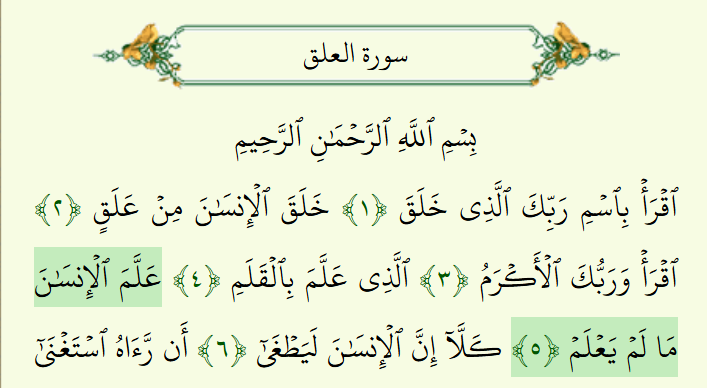
The first revealed verses were the opening five ayat of Surah Al-Alaq (96), revealed in the Cave of Hira during the month of Ramadan, approximately 610 CE.
اقْرَأْ بِاسْمِ رَبِّكَ الَّذِي خَلَقَ خَلَقَ الْإِنسَانَ مِنْ عَلَقٍ اقْرَأْ وَرَبُّكَ الْأَكْرَمُ الَّذِي عَلَّمَ بِالْقَلَمِ عَلَّمَ الْإِنسَانَ مَا لَمْ يَعْلَمْ
Iqra’ bismi rabbika alladhī khalaq. Khalaqa al-insāna min ‘alaq. Iqra’ wa rabbuka al-akram. Alladhī ‘allama bil-qalam. ‘Allamal-insāna mā lam ya’lam.
“Recite in the name of your Lord who created — created man from a clinging substance. Recite, and your Lord is the most Generous — Who taught by the pen — taught man that which he knew not.” (Al-Alaq 96:1–5)
These five verses are the first words of the Quran ever revealed to mankind.
This is the scholarly consensus (ijma’) position, supported by the authenticated narration of Sayyidah Aisha (may Allah be pleased with her) in Sahih al-Bukhari 3, which describes the first encounter between Jibreel and the Prophet ﷺ in precise detail.
Some classical scholars, including Ibn Hajar al-Asqalani in Fath al-Bari, noted a minority opinion that Surah Al-Muddaththir was first — but the majority position firmly holds Al-Alaq.
What Are the Characteristics of Meccan Surahs?
Meccan surahs — revealed before the Hijrah to Madinah — carry a distinct character that any student of Quran will recognize once they know what to look for.
They address the fundamentals of belief: the oneness of Allah (Tawhid), the reality of the afterlife, the prophethood of Muhammad ﷺ, and the rejection of polytheism.
Meccan surahs built the iman foundation before the obligations were established. You do not command prayer and fasting to a people who do not yet believe — this is the wisdom of the sequence.
What Are the Characteristics of Medinan Surahs?
Medinan surahs were revealed after the Hijrah (622 CE), when the Muslim community had established itself in Madinah and required legal, social, and political guidance.
These surahs contain the bulk of Islamic jurisprudence — the rulings on prayer, zakat, fasting, hajj, marriage, inheritance, and civil conduct.
Comparison of the Characteristics of Medinan Surahs VS Meccan Surahs
| Feature | Meccan Surahs | Medinan Surahs |
| Primary theme (often, not always) | Aqeedah (creed), Tawhid, Day of Judgment | Fiqh (law), community, interfaith relations |
| Verse length | Typically short, rhythmic, powerful | Typically longer, detailed, legislative |
| Address (often, not always) | “O mankind” (يَا أَيُّهَا النَّاسُ) | “O you who believe” (يَا أَيُّهَا الَّذِينَ آمَنُوا) |
| Tone | Urgent, compelling, vivid imagery | Instructional, legislative, explanatory |
| Examples | Al-Ikhlas, Al-Fatiha, Ya-Sin, Al-Kahf | Al-Baqarah, An-Nisa, Al-Ma’idah |
Scholars of Tafsir note that Medinan surahs also extensively address the People of the Book (Jews and Christians) and the hypocrites (munafiqun) — social realities absent in Mecca.
Surah Al-Baqarah, the longest surah in the Quran and the first Medinan surah in terms of revelation order, encapsulates this shift entirely.
At Riwaq Al Quran, our Online Quran Tafseer Course teaches students to read each surah through its historical context — understanding whether a passage is Meccan or Medinan fundamentally changes how you understand its application. This approach is taught by Azhari-certified scholars trained in classical Tafsir methodology.
Enroll Now in Riwaq’s Tafseer Course with a FREE trial

Why Does the Order in the Mushaf Differ From the Order of Revelation?
The compiled order of the Quran (Tartib al-Mushaf) was arranged under divine guidance — not according to when surahs were revealed. This is among the most important distinctions in Quranic sciences and one that frequently surprises students encountering it for the first time.
The Prophet ﷺ himself indicated the placement of each verse and surah as instructed by Jibreel.
Ibn Abbas (may Allah be pleased with him) reported that Jibreel would instruct the Prophet ﷺ on where to place each revealed portion, and the scribes of revelation would record it accordingly.
This is documented in classical works of Ulum al-Quran, including Al-Zarkashi’s Al-Burhan fi Ulum al-Quran and Al-Suyuti’s Al-Itqan fi Ulum al-Quran.
The result: the arrangement we read today is considered tawqifi — divinely ordained — not a human editorial decision.
What Is the Significance of Knowing the Revelation Order?
Understanding Tartib al-Nuzul (the order of revelation) is a tool for deeper understanding, correct interpretation, and sound jurisprudence.
Here is why it matters practically:
1. Abrogation (Naskh):
Some rulings were refined or replaced over time. A later verse may supersede an earlier one. Without knowing which came first, a student of fiqh cannot apply the rule correctly.
2. Contextual interpretation (Asbab al-Nuzul):
The “reasons for revelation” explain why specific verses were sent. Context changes meaning — understanding that Al-Kafirun was revealed in response to Qurayshi negotiation attempts entirely clarifies its message.
3. Tafsir depth:
Classical Mufassirun like Ibn Kathir and Al-Tabari consistently reference revelation context as a primary tool of exegesis.
For students working through the Tafsir meaning and science of the Quran, revelation order is one of the first frameworks any qualified teacher establishes.
Read Also: What Is the Difference Between Juz and Hizb in the Quran?
What Were the Last Verses Revealed?
Scholars hold that the final surah revealed in its entirety was Surah An-Nasr (110), which announced the completion of the Prophet’s mission. As for the final verse revealed, the most widely accepted scholarly position — recorded by Ibn Abbas and narrated in classical Tafsir literature — is that it was:
وَٱتَّقُوا۟ يَوْمًا تُرْجَعُونَ فِيهِ إِلَى ٱللَّهِ
Wattaqū yawman turjaʿūna fīhi ilallāh
“And fear a Day when you will be returned to Allah.” (Al-Baqarah 2:281)
This verse carries a profound weight — the final divine instruction to humanity before the revelation closed was a reminder of accountability and return to Allah ﷻ. Al-Suyuti records this position in Al-Itqan, attributing it to multiple companion narrations.
Surah Al-Ma’idah is also noted by scholars as among the final complete surahs, particularly the verse declaring the completion of the religion (Al-Ma’idah 5:3), revealed during the Farewell Pilgrimage in 10 AH.
Read Also: What Is Juz in the Quran?
Quran Revelation Timeline at a Glance
| Period | Timeframe | Location | Key Surahs | Primary Content |
| First Revelation | 610 CE | Cave of Hira | Al-Alaq (first 5 verses) | Command to read; prophethood begins |
| Early Meccan | 610–615 CE | Mecca | Al-Muddaththir, Al-Muzzammil | Warning, night prayer, patience |
| Middle Meccan | 615–619 CE | Mecca | Al-Kahf, Maryam, Ta-Ha | Stories of prophets, creed |
| Late Meccan | 619–622 CE | Mecca | Ya-Sin, Az-Zumar | Tawhid consolidation, afterlife |
| Early Medinan | 622–625 CE | Madinah | Al-Baqarah, Al-Imran | Law, Qibla change, Battle of Badr |
| Late Medinan | 625–632 CE | Madinah | An-Nisa, Al-Ma’idah, An-Nasr | Complete legislation, farewell |
Students pursuing structured Quran memorization schedules often find this timeline invaluable — memorizing with awareness of context builds deeper retention than memorizing words alone.
Read Also: What Is the Quran About?
Why Students Love Learning with Riwaq Al Quran
Hear directly from our students about how Riwaq Al Quran Academy has transformed their connection with the Book of Allah. Their experiences reflect the dedication, care, and quality that guide every step of our teaching.
Read Also: When Was the Quran Revealed?
Start Learning the Quran with Proper Context at Riwaq Al Quran
Understanding how the Quran was revealed is the first step toward reading it with the depth it deserves. At Riwaq Al Quran, our Azhari-certified instructors teach Quran not as isolated text but as a living, contextualized revelation.
Our Online Quran Memorization Course integrates revelation context into every stage of Hifz — and our Online Quran Recitation Course builds the foundational skills non-Arabic speakers need to recite with confidence.
- ✅ One-on-one sessions with Al-Azhar graduates
- ✅ Scheduling available 24/7 worldwide
- ✅ Plans from $32/month
- ✅ 2 free trial classes — no commitment required
- ✅ 100% Money-Back Guarantee
Book your free trial today and begin understanding the Quran the way it was meant to be learned.
We offer courses in Online Quran & Tajweed Classes, Arabic Language, and Islamic Studies.
- Online Quran Memorization Course
- Recitation Course
- Tafseer Course
- Tajweed Classes
- Online Quran Classes for Kids.
- Ijazah Program.
- Qira’at Course.
- Arabic Language Classes.
- Islamic Studies Courses.
Enroll now for 2 Free Trial Classes
Conclusion
The Quran’s revelation order is a window into divine wisdom. Allah ﷻ chose to reveal His final message across 23 years, building belief before law, addressing the heart before the hand. That sequence shaped a civilization.
For any student serious about understanding the Quran — whether through Tajweed, memorization, or Tafsir — knowing when and why each portion descended is inseparable from knowing what it means. The Quran rewards those who approach it with both recitation quality and contextual knowledge, Insha’Allah.
Frequently Asked Questions About the Order of Quranic Revelation
How many years did the revelation of the Quran take?
The Quran was revealed over approximately 23 years, from 610 CE when the Prophet Muhammad ﷺ received the first verses in the Cave of Hira, until shortly before his death in 632 CE. This gradual process — spanning both the Meccan and Medinan periods — allowed the Muslim community to receive, understand, and implement each revelation progressively.
Which surah was revealed first in the Quran?
According to scholarly consensus based on authentic narrations — including the hadith of Aisha in Sahih al-Bukhari — the first revealed surah was Al-Alaq (96), specifically its opening five verses. These were delivered to the Prophet ﷺ by Jibreel in the Cave of Hira during Ramadan, 610 CE. A minority scholarly opinion suggests Al-Muddaththir, but Al-Alaq is the dominant, widely accepted position.
What is the difference between Meccan and Medinan surahs?
Meccan surahs were revealed before the Hijrah (622 CE) and focus primarily on Tawhid, the afterlife, and prophethood, using short powerful verses. Medinan surahs were revealed after the Hijrah and address Islamic law, social conduct, and community governance through longer, more detailed passages. Understanding this distinction is foundational for studying and understanding the Quran correctly.
Why was the Quran revealed gradually rather than all at once?
Allah ﷻ explicitly answers this in Al-Furqan 25:32: the gradual revelation was to strengthen the Prophet’s heart and allow for measured, distinct delivery. From a pedagogical perspective, it also allowed the early Muslim community to internalize each command before the next arrived — a principle every teacher at Riwaq Al Quran recognizes as sound instructional design, applicable even in how we structure Quran memorization techniques today.